Zhejiang Robot Industry Association
Zhejiang University Robotics Institute
Golden Conference & Exhibition Group
Hangzhou Wisdom Source Exhibition Co., Ltd.
Hangzhou Sequoia Exhibition Co., Ltd.
In 2026, the Catalogue of Undergraduate Majors in General Institutions of Higher Education (2026) released by the Ministry of Education added new majors including Embodied Intelligence. This marks the formal integration of embodied intelligence into higher‑education, launching systematic training for interdisciplinary talents equipped with full‑stack capabilities spanning perception, decision‑making and actuation.
Shifting from scattered, trend‑chasing research interests to structured disciplinary development, universities are undergoing a fundamental change in their approach toward humanoid robots. No longer merely demo pieces for exhibition showcases, humanoid robots have become core teaching tools embedded within mainstream talent‑training programs.
Universities are moving faster on practical implementation than widely anticipated. Qingdao University of Technology has set up the Institute of Embodied Intelligence and Robotics, building a complete ecosystem covering hardware, algorithms, robot prototypes and industry‑specific applications. Its comprehensive embodied‑intelligence training ground, launched in May, centers on data acquisition, algorithm validation, technical hands‑on training and achievement commercialization. Adhering to the principle of “real‑world scenarios, real‑world applications, real‑world data”, the institute has established partnerships with UBTECH, 58 Robotics and other enterprises. It has been shortlisted as one of the second batch of prospective partner universities for national robot typical‑scenario pilot‑verification bases.
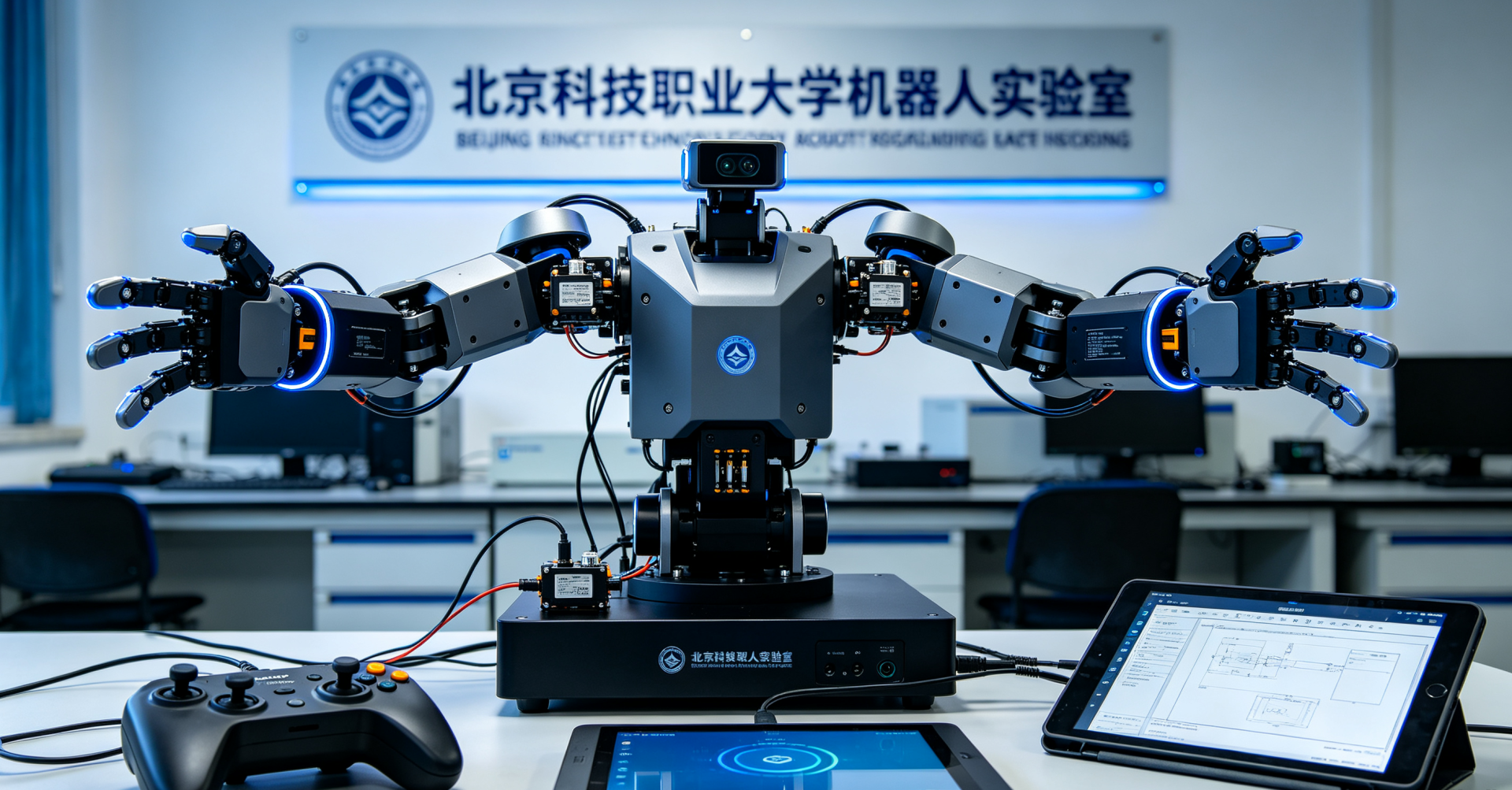
Concurrent with the August 2026 World Robot Conference, Beijing Vocational University of Science and Technology unveiled the Embodied‑Intelligence Robot Experimental Platform for Higher Education. Built around desktop‑sized humanoid robots paired with teleoperation kits and operation consoles, the platform integrates dual 7‑DoF anthropomorphic robotic arms, dexterous hands, brain‑body coordination systems and high‑definition vision cameras. It supports teaching and research tasks such as flexible material feeding, spot welding, screw fastening, sorting and box packing. It puts into practice the educational philosophy of “linking classrooms to workshops, and academic learning to employment”.
Suppliers are rapidly diversifying their offerings to meet demands from higher‑education institutions. UBTECH adopts an integrated approach of “curriculum delivery + laboratory setup + talent‑training system”. Its public solution covers the full closed‑loop workflow: data collection, model training, scenario deployment and feedback‑driven optimization. Anhui University of Science and Engineering launched a joint Embodied‑Intelligence Robot Excellence Experimental Class with UBTECH in 2026. In the same year, Guangzhou Polytechnic of Engineering purchased 3 sets of UBTECH humanoid agents, 2 open‑source bipedal humanoid educational robots and quadruped robots, with a total contract value of approximately RMB 1.938 million.
Unitree positions itself for secondary hardware development and hands‑on engineering practice within universities. Lijiang Normal University’s Embodied‑Intelligence Laboratory is equipped with Unitree H2 EDU full‑size humanoid robots and Go2 EDU quadruped robots. Qingdao City University inaugurated a joint Embodied‑Intelligence Industry College with Unitree in December 2025. It offers a micro‑major covering secondary development, system test & operation‑maintenance, data processing and model training, with hardware deployment including H2, G1, Go2 and A2 Pro. Xiamen Institute of Technology also established a joint industry college with Unitree in 2026.
On the simulation and algorithm front, the NVIDIA Isaac ecosystem — consisting of Isaac Sim for physics simulation, synthetic‑data generation and SIL‑HIL workflows, plus the GPU‑accelerated open‑source Isaac Lab learning framework that supports reinforcement learning, imitation learning and large‑scale parallel training for humanoids, robotic arms and AMRs — has become critical research infrastructure for universities. Public reports indicate four categories of vendors — robot OEMs, platform providers, simulation specialists and system integrators — are jointly building up the robotics‑education market.
Dual‑track training combining physical hardware and digital simulation is gaining traction across universities. Physical robots deliver real‑world force control, tactile feedback and interaction datasets, enabling students to understand robot behaviours under genuine physical constraints. Meanwhile, simulation platforms such as Isaac Sim generate massive volumes of reproducible synthetic data at low cost. SIL‑HIL technology bridges software‑in‑the‑loop and hardware‑in‑the‑loop to connect virtual and physical domains. Industry observers note this paradigm — validate workflows in simulation first, then verify on physical hardware — greatly lowers the technical barrier for students to get started with embodied intelligence. Teaching experiments are no longer bottlenecked by limited numbers of expensive physical robots.
Public sources point to a widely‑acknowledged million‑level talent shortage across the industry. The mismatch between vocational‑education output and explosive industrial demand has become a core challenge for industry‑education integration. For humanoid robots to move beyond laboratories toward mass‑scale production, the scarcest resource may not be any single standalone technology, but interdisciplinary professionals who understand mechanical hardware, algorithm models and real‑world scenario deployment. In short, as hardware and algorithms mature, the capacity of talent pipelines will directly set the pace of industrialization.
Looking ahead to late‑2026, HRIE 2026 Shanghai International Humanoid Robot & Full‑Robot‑Industry‑Chain Exhibition will run December 9‑11 at the Shanghai National Exhibition and Convention Center (SNIEC). Attendees will see practical case studies of talent pipelines jointly built by universities, research platforms and robot manufacturers. From structured courses and teaching labs to simulation platforms, humanoid robots are emerging as the core teaching tools of the embodied‑intelligence era. Talent development built around them forms the fundamental bedrock for the industry’s future.