Zhejiang Robot Industry Association
Zhejiang University Robotics Institute
Golden Conference & Exhibition Group
Hangzhou Wisdom Source Exhibition Co., Ltd.
Hangzhou Sequoia Exhibition Co., Ltd.
From August 19 to 23, 2026, the 2026 World Robot Conference was held in Yizhuang, Beijing, serving as a key vantage point to observe China’s robotics industry transition from prototype R&D toward mass‑production deployment. Public reports note that as the permanent host venue of the conference, Beijing Economic‑Technological Development Area has gathered more than 300 embodied‑intelligence ecosystem enterprises, with an industrial‑chain output exceeding RMB 10 billion.
According to incomplete statistics, at least 21 provincial‑level administrative regions across China explicitly mentioned “embodied intelligence” or “robots” in their 2026 government work reports. Industry analyses indicate that competition surrounding humanoid robots is no longer purely technological. It has evolved into a city‑ and regional‑level race for industrial ecosystems. Whichever region builds an “embodied‑intelligence hub” first will secure access to future industries.
Public data shows China’s humanoid‑robot industry has formed a landscape of four major clusters with differentiated positioning:
The Beijing‑Tianjin‑Hebei region functions as the national hub for technological innovation, boasting prominent strengths in algorithms, prototype development and standard‑setting. Industry analysis estimates that roughly 80 % of China’s humanoid‑robot algorithm patents originate from Beijing‑based enterprises.
Centered on Shenzhen, Dongguan and Guangzhou, the Pearl River Delta draws on its robust electronics‑information foundation. It leads the nation in hardware iteration speed and supply‑chain responsiveness, making it fertile ground for large‑scale leading enterprises to emerge.
Represented by Shanghai, Suzhou, Nanjing, Changzhou and Wuhu, the Yangtze River Delta enjoys a solid industrial‑robot manufacturing base. Shanghai acts as a headquarters, capital and export hub; Suzhou and Nanjing focus on mass production of robot bodies; Changzhou and Wuhu specialize in core components.
The Changsha‑Zhuzhou‑Xiangtan cluster targets heavy‑duty and special‑purpose industrial scenarios, while the Chengdu‑Chongqing region takes early steps in urban public services, cultural tourism and energy‑inspection applications.
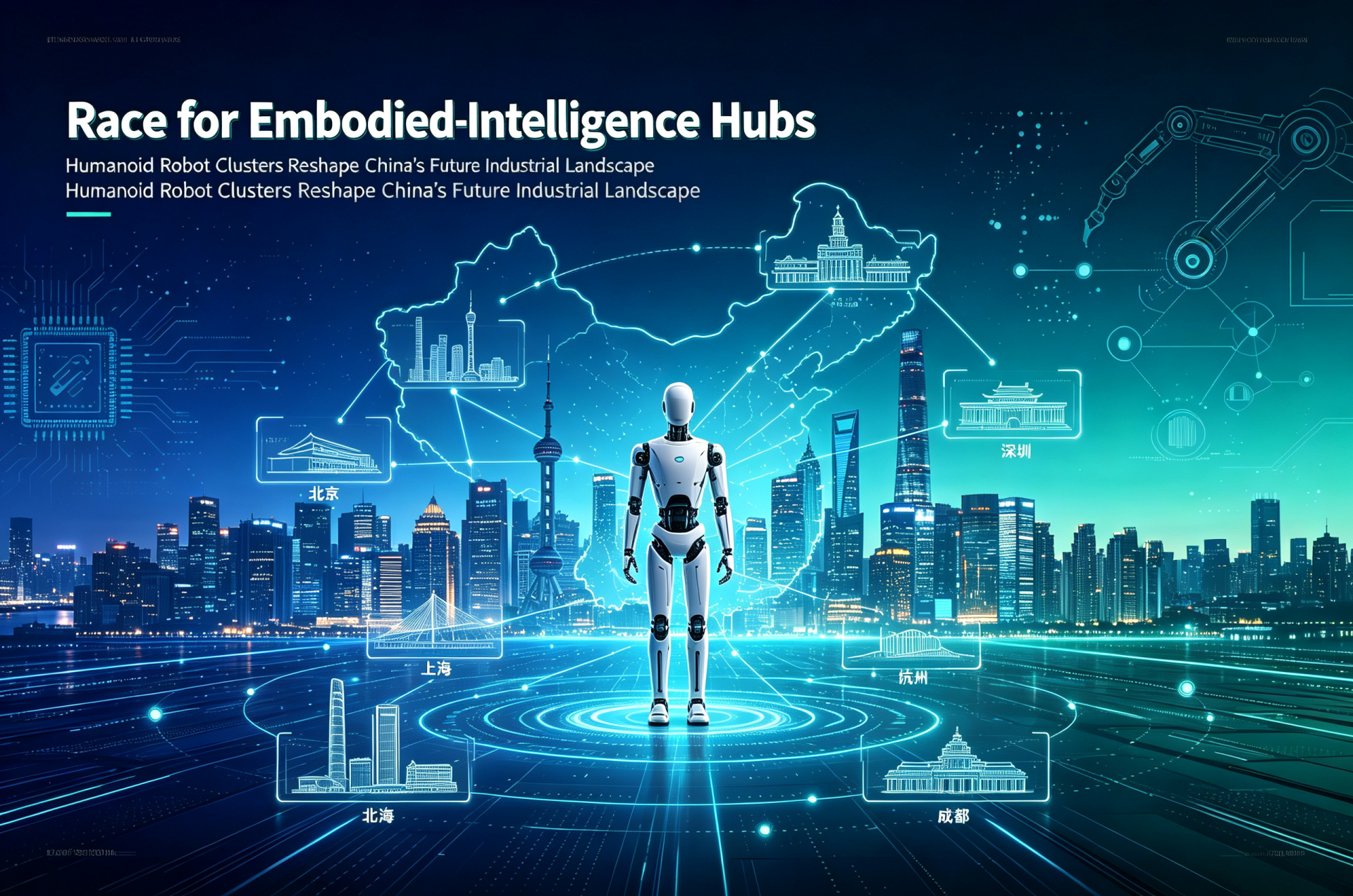
The four leading cities have charted markedly different development paths.
In March 2026, Beijing released the Beijing Action Plan for Scientific‑Technological Innovation and Industrial Cultivation of Embodied Intelligence (2025‑2027). It sets targets to foster a RMB 100‑billion‑scale industrial cluster and achieve an early mass‑production milestone of over 10 000 units by 2027. Public coverage records that Yizhuang has built the world’s first smart elderly‑care robot service station, the world’s first robot 4S store and themed restaurant, plus a 9 700 m² pilot‑verification platform for humanoid robots with an annual capacity of 5 000 sets. The 1 000th customer‑customized prototype rolled off its production line in January this year.
Shanghai positions itself as “the city best‑suited for mass production”. According to public records, 100 % of core components, data resources and control algorithms required for humanoid robots can be sourced within a 150‑kilometre radius centred on Shanghai. Zhangjiang Robot Valley hosts over 90 enterprises including AgiBot, Fourier Intelligence and Kepler, and has launched China’s first heterogeneous humanoid‑robot training ground. Lingang is home to a 20 000 m² real‑world‑scenario testing base.
Shenzhen is known as “the hardware capital”. By the end of 2024, Shenzhen counted more than 2 200 AI‑related enterprises. Its action plan aims for associated‑industry output above RMB 100 billion and over 1 200 participating enterprises. Huawei’s Global Embodied‑Intelligence Industry Innovation Centre commenced operations at the end of 2024, conducting joint R&D alongside robot‑body manufacturers such as Lepu, Topstar and Zhaowei Mechatronics.
Hangzhou’s embodied‑intelligence industrial‑cluster output reached RMB 106.8 billion in 2025. Unitree Robotics registers China’s highest annual output of humanoid robots and leads a national pilot programme for humanoid‑robot industrial standardization. In March 2026, Hangzhou enacted China’s first local regulation dedicated specifically to embodied intelligence: Hangzhou Regulations on Promoting the Development of Embodied‑Intelligence Robot Industry.
New‑tier cities are also surging forward in the race. Post‑holiday 2026 data from Liepin shows year‑on‑year growth rates for embodied‑intelligence job vacancies exceeding 100 % in Wuhan (+110.28 %), Hefei (+104.23 %) and Suzhou (+103.74 %). Industry analysis points out that core components can be fully sourced within the 150‑kilometre radius of the Yangtze River Delta. An efficient collaborative chain is taking shape: “R&D in Shanghai — manufacturing in Suzhou — complete‑machine assembly in Hangzhou”, unlocking dividends from regional integration.
A notable shift is underway: local subsidies are moving away from incentives for complete‑machine mass production toward performance assessments based on real‑world deployment outcomes. Public reports indicate authorities are setting hard metrics covering the number of deployed scenarios, continuous operating hours and labour‑replacement efficiency. This guides the industry away from concept‑driven hype and financing‑chasing, toward real‑world implementation and closed‑loop business operations. In the second half of inter‑city competition, success is no longer measured by prototype demos at press conferences, but by stable operation and viable commercial closed loops in real‑life scenarios.
As regional competition and cooperation deepen, the industry demands a platform that can showcase the full value chain: innovation origination, R&D, manufacturing, core components and end‑use scenarios. HRIE 2026 Shanghai International Humanoid Robot & Full‑Robot‑Industry‑Chain Exhibition (December 9‑11, 2026, Shanghai National Exhibition and Convention Center, SNIEC) serves as exactly such a gateway. Positioned as a full‑industrial‑chain event, it offers an ideal venue to witness the convergence and coordinated evolution of major industrial clusters including Beijing‑Tianjin‑Hebei, the Yangtze River Delta and the Pearl River Delta. Visitors can see the algorithm innovation strengths of Beijing, precision mass‑production capabilities of Shanghai, hardware supply‑chain advantages of Shenzhen and complete‑machine breakthroughs out of Hangzhou all converge at HRIE 2026. For anyone aiming to grasp the full picture of China’s embodied‑intelligence city race, this is an unmissable event.