
Zhejiang Robot Industry Association
Zhejiang University Robotics Institute
Golden Conference & Exhibition Group
Hangzhou Wisdom Source Exhibition Co., Ltd.
Hangzhou Sequoia Exhibition Co., Ltd.
For three years, the humanoid robot story was told in video clips. A biped glided across a stage. A five-fingered hand closed gently around an egg. A chief executive promised "millions" by some conveniently unspecified Tuesday. The spectacle was the product. In 2026, that era is quietly over. The industry has crossed from showing to shipping, and a strange thing has happened on the way to the robot future: the companies posting the loudest roadmaps are, more often than not, not the ones moving the most metal.
This is the 2026 humanoid scoreboard. And it runs on a single rule that cuts through the noise: the press-release number is the ceiling; the number that leaves the loading dock is the one worth trusting.
The Scoreboard, Plain and Simple
Strip away the spectacle and the scoreboard has only two columns that matter. The first is deployed — units that have actually been built, sold, and put to work outside the builder's own four walls. The second is claimed — the headline figure, the valuation, the breathless "soon." Every serious company on this list looks excellent in column two. Only some survive column one.
Why 2026 specifically? Because the tone of the entire sector flipped at the turn of the year. Demo videos no longer moved stock prices; delivery numbers did. A robot that could pour a cup of coffee on a looped clip stopped impressing anyone. What started to matter was whether a warehouse supervisor could point to a machine on a shift and say, "that one's ours, and it earned its keep." When you sort the field by deliveries rather than by mentions, the ranking comes out almost upside down from the ranking by media volume. Silicon Valley owns the narrative. China owns the units.
Unitree: The Quiet Volumetric Leader
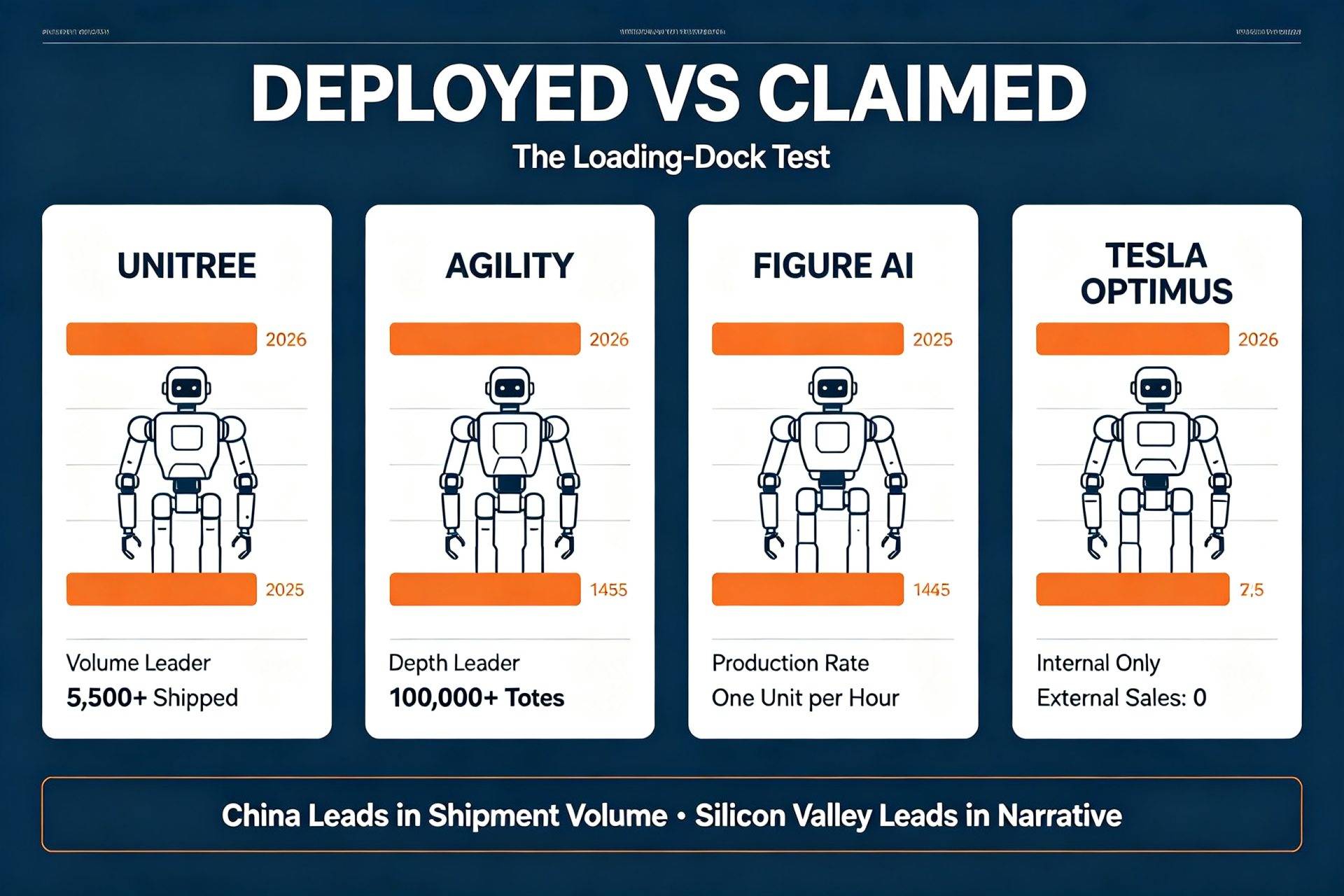
Start with the number nobody in the West talks about enough. Per industry shipment estimates, Unitree shipped more than 5,500 humanoid units in 2025 — roughly a third of global output that year. For 2026, the company has set a target of around 20,000 units. That is not a prototype cadence, dribbling out a handful of pre-production machines to friendly researchers. That is a consumer-electronics cadence, the kind of number that implies a supply chain already humming.
How does a Hangzhou-based company outship the American giants? Price is the blunt instrument. Unitree's G1 sells for roughly ¥99,000 (about $13,500), and its R1 platform is listed under $5,000 — a figure that, two years ago, would have sounded like marketing fiction. But the more important number sits at the bottom line: Unitree is, by most accounts, the only profitable whole-machine humanoid maker. Reported 2025 revenue came in at ¥1.708 billion with a net profit of ¥600 million.
Profitability is the tell. It means the company is not shipping metal at a loss to seed a future market; it is selling robots that customers are buying today, at a margin. A third of the world's humanoids, turned into a profit, at sub-$5,000 price points — that is the volume leader, whether or not the Western press has quite caught up to it.
Agility's Digit: Depth Over Flash
If Unitree wins on volume, Agility Robotics' Digit wins on something far harder to fake: depth. A robot sitting on a shelf is a statistic. A robot that has quietly moved more than 100,000 totes inside a GXO logistics warehouse is a fact — unglamorous, repetitive, and impossible to stage.
Agility has built its case on deployment, not demos. Beyond GXO, the company landed a deployment deal with Toyota in Canada, extending Digit's footprint from one marquee customer to a second global manufacturer and proving the model is not a single-account fluke. And in a move that signals real confidence in that track record, Agility moved toward a planned SPAC listing valued at roughly $2.5 billion in July 2026 — a public-market bet that leans on proven hours in the field rather than promised ones.
The deployment-depth leader is not the name with the most YouTube views. It is the one whose robots have logged the most real-world shifts, the most totes, the most midnight runs when the camera was off. Digit's 100,000 totes are exactly that species of proof — the kind a competitor cannot manufacture with a press release.
Figure AI: The Hype-and-Traction Balancer
Figure AI sits in the most interesting middle position on the board — enough genuine traction to be credible, enough valuation to stay a headline. Its BotQ factory is producing the Figure 03 at a rate of roughly one unit per hour, a pace that reads as a real manufacturing line rather than a bench in a research lab.
The credibility is anchored in BMW. Over an 11-month deployment at BMW's Spartanburg plant, Figure's robots contributed to the build of 30,000 X3 vehicles with placement accuracy above 99 percent — a number that matters precisely because automotive is merciless about error. A dropped part on a line is not a charming blooper; it is a cost. Tie that deployment to a reported ~$39 billion valuation and a partnership with OpenAI, and you get a company that has pulled off the rare trick of matching its story to its run-rate.
Figure is not yet at Unitree's volume, and not as deep in logistics as Agility. But it is the American name that can point to both a production line and a marquee customer at the same time — and that combination is exactly why it stays in the conversation after louder rivals have faded from the floor.
Tesla Optimus: Loudest in the Room, Empty Seats
Then there is the one everyone has heard of and almost no one has bought. Tesla's Optimus is, by any reasonable measure of attention, the dominant brand in humanoids. By any measure of delivery, it is not yet a product.
The signals are telling, and they cut both ways. In mid-2026, Tesla converted part of its Fremont Model S/X line to Optimus assembly — a genuine commitment of factory space and a real signal of intent. On the Q2 earnings call, the company said production was coming "soon," with a late-July-to-August window floated. But the mass-production "V3" body has still not been publicly revealed. And the hard number underneath all the noise: an estimated 1,000 to 1,200 units exist, all used internally, with zero external sales.
This is the textbook gap between ambition and run-rate. Tesla has the brand, the capital, and the factory footprint that smaller rivals envy. What it does not yet have is a single customer who paid for a robot and received one at the loading dock. Until that changes, Optimus is a promise with a logo, not a shipment with a receipt.
There is a second, quieter risk buried in the spec sheet, and it is the kind that bites a volume thesis where it lives. Each Optimus needs roughly 3.5 kilograms of NdFeB magnets spread across more than 40 actuators — the rare-earth permanent magnets that are the unglamorous heart of every joint. China controls about 94 percent of global sintered permanent magnet production, and in April 2025 it imposed export controls on that supply. For a company whose entire volume story depends on cheap, scalable actuators rolling out by the hundreds of thousands, that dependency is not a footnote. It is a constraint on the very narrative Tesla is selling.
Why China Owns the Volume
Step back from the four players and the pattern is unmistakable. By most shipment estimates, China accounted for somewhere between 85 and 97 percent of humanoid shipments across 2025 and the first half of 2026 — with Unitree, AgiBot, UBTech, and XPeng leading the count. This is not a quirk of one scrappy company out-shipping the West by accident. It is a structural lead, and it has three engines.
First, supply-chain density. The same ecosystem that built the world's drones, e-bikes, and smartphones can source motors, magnets, controllers, and frames within a day's drive of the factory floor. When a component is late, the fix is a phone call and a short truck ride, not a trans-Pacific gamble.
Second, cost discipline born of consumer-electronics competition. Chinese makers carry the instinct to ship a capable product at a price a Western lab would refuse to accept — and then to improve it on the next run. The R1 under $5,000 is not a loss-leader stunt; it is the logical output of an economy that has spent two decades perfecting cheap, good, and fast.
Third, and most underrated, a pragmatic bias toward deployment. Chinese makers have been quicker to put robots into warehouses, showrooms, and factories where they earn their keep immediately, rather than waiting for a perfect, general-purpose machine that may never arrive on schedule. They ship the useful now and iterate toward the magical later.
Silicon Valley is brilliant at the demo and the narrative. China is winning the part that actually decides the scoreboard in 2026: the unit that ships, sells, and shows up for work.
The Scoreboard, Revisited
The 2026 humanoid scoreboard does not reward the loudest roadmap. It rewards the loading dock. Unitree ships the most and makes money doing it. Agility has the deepest real-world hours on the floor. Figure has matched its hype to a production line and a BMW contract. Tesla has the biggest microphone and, so far, the emptiest order book.
If you want to see which of these claims survives contact with a warehouse floor, the place to look is wherever the robots actually appear in the flesh. Shanghai International Humanoid Robot and Robotics Industry Chain Exhibition (HRIE 2026), set for December 9–11, 2026 at the Shanghai New International Expo Centre, is shaping up to be one of the few venues where "shipping" is the price of admission — a chance to watch the scoreboard update in real time instead of on a press release.
The robots are here. The question was never whether they would arrive. It was always simpler, and harder: whose are actually leaving the building?