Zhejiang Robot Industry Association
Zhejiang University Robotics Institute
Golden Conference & Exhibition Group
Hangzhou Wisdom Source Exhibition Co., Ltd.
Hangzhou Sequoia Exhibition Co., Ltd.
For most of the past decade, building a humanoid robot meant one thing: machining metal. If you wanted a machine that could walk, grasp, and tidy a room, you first needed the capital and the months to design actuators, tune torque curves, and assemble a dextrous hand. The "brain" — the software that turned sense into motion — was a closely held asset, locked inside the labs of a handful of well-funded players who treated it as the moat that justified their valuations.
That equation is changing, and faster than most observers expected. In the summer of 2026, a different story is unfolding across the robotics world: the brain is going open. Foundation models and massive datasets are being published to the public web, free to download, fine-tune, and ship. A two-person startup in a converted garage can now pull a vision-language-action model off Hugging Face and have a working motor-control baseline before the weekend is over. The center of gravity in humanoid robotics is sliding — from the foundry to the repository, from hardware to neural software.
This is not a metaphor. It is a measurable shift, and the evidence arrived in a concentrated burst of open releases between May and August 2026.
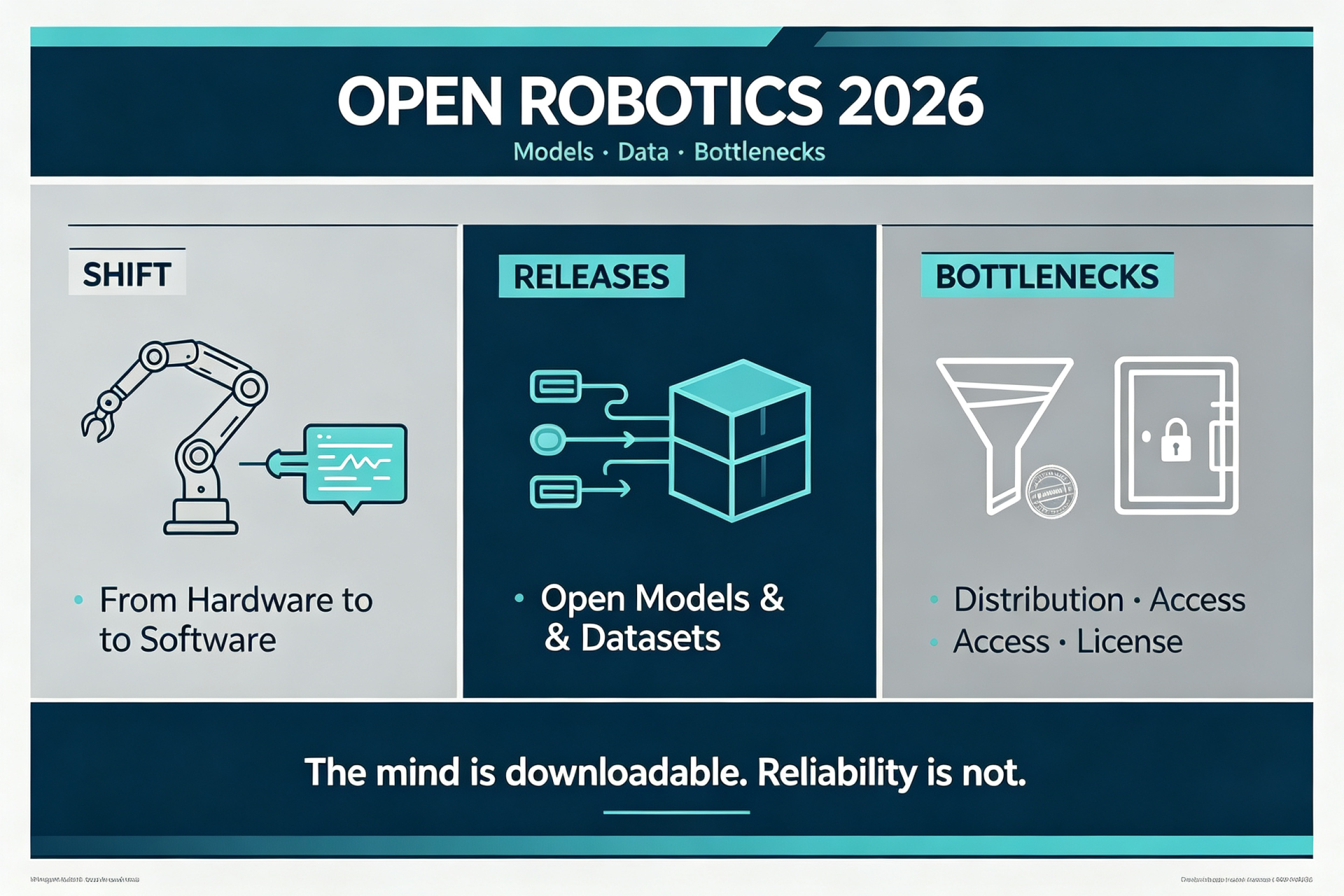
The romantic image of robotics is still the hardware — the gleaming humanoid, the bionic hand on a trade-show turntable. But ask any engineer who has actually shipped a product and they will tell you where the pain lives now: not in the actuators, but in the intelligence that drives them. Once a body can move, the hard problem becomes teaching it what to do, and doing so reliably in a messy, unpredictable world. Hardware has matured; cognition has not.
Open-sourcing answers that problem directly. When a capable model is released together with its training pipeline, its benchmark code, and a plug-and-play interface, the barrier to entry collapses. A team no longer has to reinvent motor control from scratch. They inherit a brain and spend their energy on the application layer — the specific tasks, environments, and customers that matter to them.
The strategic logic is familiar from software history: commoditize the substrate, compete on the application. What Linux did for operating systems, and what open weights did for large language models, open robotics brains are now doing for embodied AI. The body becomes a commodity chassis; the value migrates upward into the neural software and the data that trains it.
The clearest signal came on August 5, 2026, when Xiaomi open-sourced what it calls "Xiaomi-Robotics-1," a next-generation vision-language-action (VLA) embodied-AI foundation model. It went live on both Hugging Face and GitHub — and crucially, it shipped as more than a weights file. Xiaomi released the full pipeline from real-robot post-training to deployment, together with the benchmark code needed to reproduce its results.
That detail is the whole point. A research dump gives you a paper to admire; a deployable pipeline gives you a product to build. Per Xiaomi's release, the model was pre-trained on more than 100,000 hours of UMI (Universal Manipulation Interface) trajectories and then refined with over 10,000 hours of cross-embodiment post-training — meaning it learned to control not just one body but to generalize across different hardware configurations. On the widely used RoboCasa365 benchmark it reached 57.4% success, and on RoboDojo, 20.07%, both reported as record-setting marks for an openly released model.
Xiaomi positioned the release explicitly as an out-of-the-box, plug-and-play motor-control baseline. The wording is deliberate. The company is betting that the future of robotics value lies in open neural software, and that by lowering the entry barrier it widens the entire market — including, naturally, for its own hardware. It is a supplier strategy disguised as a public good: give away the brain, sell the bodies that run it.
A model is only as good as the experience it learned from, and here 2026 produced a wave of open datasets that would have been unthinkable two years ago.
On June 3, 2026, AgiBot (Zhiyuan) released "AGIBOT WORLD 2026" Dataset Phase 2, themed "Rich Interaction," on Hugging Face. It is billed as the industry's first open embodied dataset built around physical interaction, aimed at training world models, neural simulators, and physical perception. Its defining choice is philosophical as much as technical: 100% of the data is collected in real scenes, and it records not only successes but failures, not only expected but unexpected outcomes, not only stable but chaotic states. The field is moving past the "only successful demos" mindset toward what AgiBot calls full-state real physical feedback — the messy truth a robot actually meets in the world. (Phase 1 of the dataset, by contrast, was themed around imitation learning.)
Around the same window, a three-way collaboration between BitRobot, Hugging Face, and Unitree produced HIW-500 ("Humanoids-in-the-Wild 500"), described as the largest open-source humanoid teleoperation dataset collected from real homes. The numbers are striking: 12 homes across Southeast Asia, more than 500 hours of footage, 23,000 episodes, and over 10 TB of raw data. Hugging Face's LeRobot team then re-encoded the 10 TB down to 2 TB with what they report as zero fidelity loss, making it dramatically easier to share and download. The data was captured on the Unitree G1 — a 29-degree-of-freedom platform with a sub-$30,000 enterprise price — and it targets the long-horizon household tasks that define the "80/80" generalization benchmark coined by Unitree's Wang Xingxing: 80% task success across 80% of unfamiliar scenes.
And on the "Huisi Kaiwu" platform, the Beijing Humanoid Robotics Innovation Center's "RoboMIND" crossed a milestone that says as much about demand as about supply: global downloads surpassed 10 million in July 2026. RoboMIND V1.0 carried 100,000+ dual-arm trajectories across 4 robot bodies, 479 tasks, and 38 skills. V2.0 expanded to 310,000+ trajectories, 6 bodies, 739 tasks, 129 skills, more than 12,000 tactile-labeled samples, plus high-fidelity simulation assets. Ten million downloads is not a curiosity — it is a user base.
Step back, and these headline releases are part of a broader, fast-maturing commons. The open embodied-data ecosystem now spans several heavyweight collections:
AgiBot World — 1M+ trajectories spanning home, catering, industrial, retail, and office settings, collected via VR teleoperation, released under CC BY-NC-SA.
Google DeepMind's Open X-Embodiment — 1M+ trajectories across 22 robot types, under the permissive Apache 2.0 license.
DROID — 76,000 episodes gathered across 564 scenes by 13 North American labs.
RoboTwin 2.0 — 731 objects and 50+ bimanual manipulation tasks, openly available.
GraspVLA / SynGrasp-1B — 1 billion frames across 10,000 objects.
BridgeData V2 — 60,000 demonstrations spanning 70+ tasks.
RH20T — 110,000+ sequences totaling 40 TB.
For a field that spent years guarding data as a competitive moat, this is a genuine reversal. The old assumption — that whoever holds the most proprietary robot data wins — is being quietly challenged by a community that believes the opposite: that shared data raises all boats, and that the field's hardest bottlenecks are better solved in the open than in isolation. The 2026 releases simply accelerated a trend that the open-weight language-model moment had already made culturally inevitable.
And yet the open-data story is not a fairy tale. Be clear-eyed, and three hard limits remain — limits that explain why "open brain" has not yet become "open robot."
First, narrow distribution. Even the largest sets skew. A one-million-trajectory collection still reflects specific hardware, specific labs, and specific scenes. A model trained on one body's gripper rarely transfers cleanly to another's, and performance decays the moment a robot meets an environment the dataset never sampled. Volume is not the same as coverage. The "80/80" benchmark exists precisely because the gap between a model's lab score and its real-world reliability is still wide — and open data, for all its volume, has not closed it.
Second, high access friction. The most valuable sets are not always the easiest to get. AgiBot World and datasets like UniHand require an application and review process that can take days to weeks. The data is "open" in principle but gated in practice — a meaningful tax on smaller teams without institutional backing or the patience to wait. For a startup racing a product deadline, a three-week review queue can be the difference between shipping and stalling.
Third, license restrictions. The most common open license in this space, CC BY-NC-SA, is non-commercial. That is a real wall for any startup that hopes to build a product and sell it. A researcher can fine-tune freely; a company generally cannot ship. The result is a strange split: a thriving academic commons sitting alongside a commercial world that must still gather its own data to stay on the right side of the license. The brain may be open, but the right to monetize what you train on frequently is not.
So the brain is commoditizing faster than the data that trains it. The model you can download in an afternoon; the experience that makes it trustworthy in the wild, you often still have to earn — by collecting, labeling, and licensing your own.
The strategic picture for 2026 is therefore nuanced but directional. The robot's mind is becoming a shared, downloadable commodity, and that is democratizing who gets to build. Small teams are freed from reinventing motor control and pointed instead at the application layer, where real value and real differentiation now live — vertical tasks, local environments, and the unglamorous reliability work that turns a demo into a deployment. But the data that makes a brain dependable — broad, accessible, commercially usable data — remains the genuine constraint, and solving it will define the next phase of the field.
That tension is exactly what makes this moment worth watching, and worth gathering around. Events like HRIE 2026 — Shanghai International Humanoid Robot and Robotics Industry Chain Exhibition, held December 9–11, 2026 at the Shanghai New International Expo Centre — are where this open ecosystem and its developer community are beginning to concentrate: the model-builders, the dataset-publishers, and the application teams, in one place. For anyone betting that the robot's future is open, it is the room to be in.
The hardware was never the whole story. In 2026, the brain is open. The question is no longer who can build a robot — it is who can teach one well.