

Zhejiang Robot Industry Association
Zhejiang University Robotics Institute
Golden Conference & Exhibition Group
Hangzhou Wisdom Source Exhibition Co., Ltd.
Hangzhou Sequoia Exhibition Co., Ltd.
At 3 a.m. on a ward at China's 301 Hospital, a humanoid robot steps into an elevator, rides up two floors, and delivers a sealed packet of medication to a nurse's station. No fanfare. No demo video. According to iSoftStone's showcase at the World Robot Conference (WRC) 2026 in Beijing this August, it has been doing exactly this, around the clock, for months — one of a growing number of humanoid robots that have slipped out of the prototype lab and into the unglamorous reality of hospitals, nursing homes, and, increasingly, the home.
The robot is iSoftStone's A2. It is already deployed at 301 Hospital, the Sixth Affiliated Hospital of Sun Yat-sen University, and the Sijiqing nursing home, running 7×24, autonomously taking elevators across floors to deliver medication, scanning and verifying drugs, and syncing to hospital HIS (Hospital Information System) networks — with multi-modal response latency under 200 milliseconds. It is not a science project. It is on shift.
But A2 is also a sign of something larger and more interesting than the usual robotics hype cycle: humanoid robots are not arriving in healthcare as dramatic replacements for nurses and carers. They are arriving as gap-fillers — quietly taking on the structured, repetitive, and staffing-starved tasks that a stretched care system simply cannot cover.
The math is brutal. China has roughly 298 million people aged 60 and over, more than 127 million one-person households, and a majority of elderly households that are "empty-nest" — living without adult children on site. The professional carer workforce is nowhere close to keeping up. In hospital wards and nursing homes alike, the shortage shows up as the same relentless pressure: not enough hands for monitoring, not enough hours for documentation, not enough people for overnight patrol.
This is the context that makes a robot legible. The conversation is too often framed as "will robots replace carers?" — a question that misreads the actual constraint. The constraint is not labor that humans want to keep; it is labor that does not exist in sufficient quantity at any price the system can bear. A humanoid that can run a 24-hour fall-prevention patrol, or archive a thousand vitals readings, is not competing with a nurse for a job. It is doing the work that, today, simply goes undone.
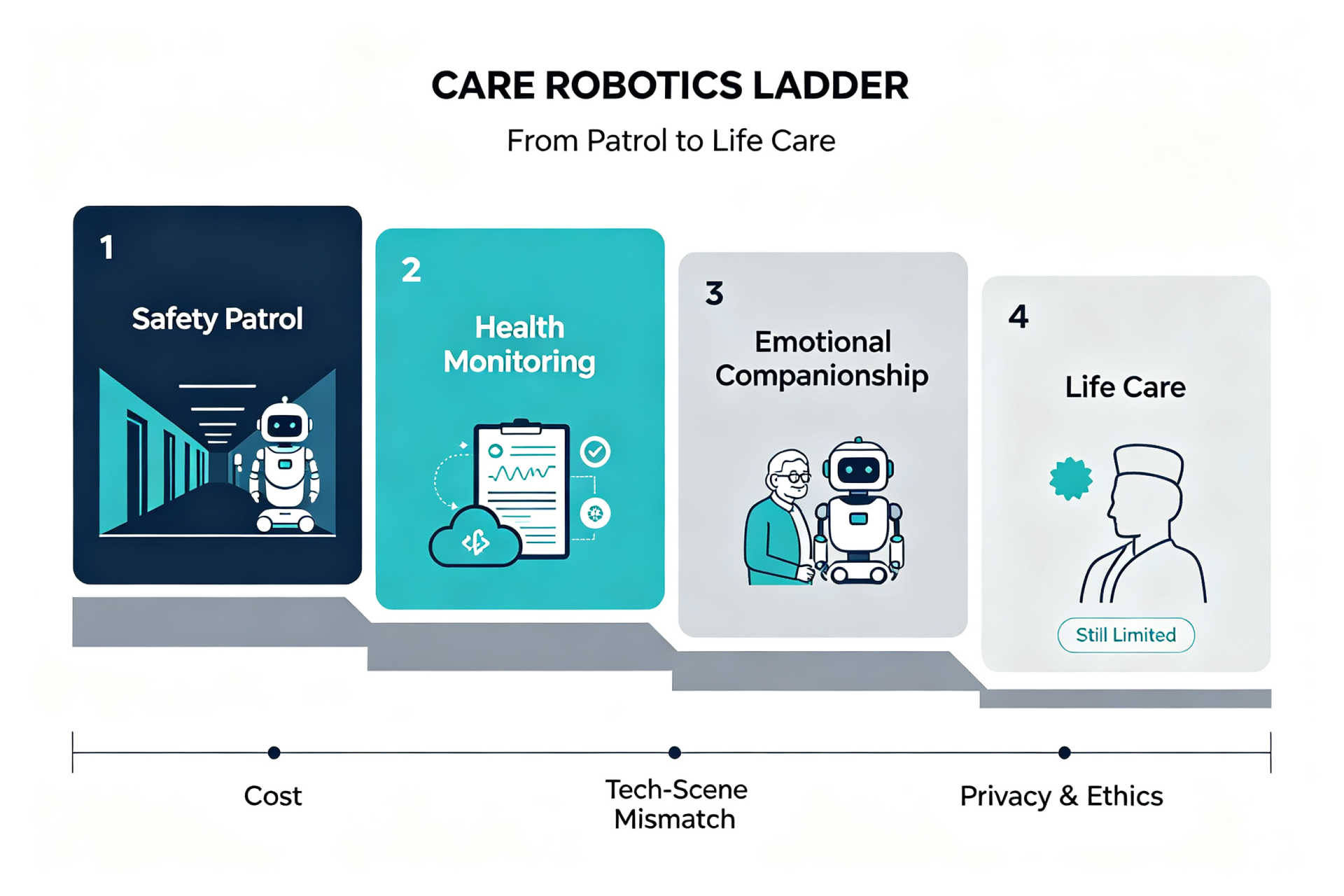
Which is why the entry path of these machines is so revealing. They are not starting with the hardest physical care. They are climbing a ladder in exactly the order a cautious operator would hope: security patrol first, then health monitoring, then emotional companionship, then — and only then — life care such as turning and transferring.
The first rung is the easiest to standardize: safety patrol. A robot that walks a corridor, detects a fall, and alerts staff is doing a task with clear success criteria and low physical risk. iSoftStone's A2 lists safety patrol among its seven task types, alongside ward monitoring, drug delivery, education, emotional companionship, activity support, and item/food delivery. The pattern repeats across the field: patrol and delivery are the "hello world" of care robotics because they are the most SOP-ized — scriptable, measurable, and forgiving of the occasional failure.
The second rung is health monitoring — and this is where 2026 has produced genuinely useful results rather than theatre. Guanggu Dongzhi's Lumen U1, on trial at Hubei Rongjun Hospital, automatically records nurses' vitals entries — blood pressure, blood sugar — uploads them to the cloud, and builds personalized health profiles. Xuanwu Hospital's "Dongfang Yu" health-assessment robot runs multi-modal, guided cognitive, motor, nutrition, and psychology scale assessments with reported similarity to manual assessment above 99%, compressing what used to be hours of manual intake into tens of minutes. These are not companions; they are instruments that remove a documentation and triage bottleneck.
The third rung, emotional companionship, is the most marketed and the most contested. Robots like the Fubao KZ100 — 35 of which were bulk-procured by Guangxi at roughly ¥10,000 each — are positioned for psychological support and daily companionship. Mojia's "Moyin" has shipped 300-plus units globally in 2025 and another 590-plus in the first half of 2026, across more than 60 countries and regions, landing in government offices, transit hubs, and exhibition spaces. The demand is real. So is the skepticism, which I'll come back to.
The fourth rung — life care: turning over bedridden patients, transferring them, assisting with toileting — is the one everyone agrees is the hardest and the one that matters most for disabled and frail elders. It is also, as we'll see, the one that is still largely empty.
Strip away the conference theatrics and a clear picture of 2026 emerges: the systems that work are the ones bolted onto structured environments with defined routines.
Shenzhen, in June 2026, launched what is described as the world's first humanoid nursing system, "Tianshu" and "Tianji." Tianshu is the orchestration hub; Tianji handles close care. Together they claim six capabilities: cross-device linkage, centimeter-level dexterous manipulation, multimodal emotional companionship, 24-hour fall-prevention patrol, cloud-based long-horizon planning, and compliant force control — and they can reportedly perform turning-over, wiping, companioning, and drug delivery without major retrofit of existing hospital hardware. That last point matters: a care robot that requires gutting a ward to install is a non-starter; one that drops into the current layout is deployable.
Benzi Juzhi, spun out of Fudan University and unveiled at WAIC 2026 on July 17, offers a smart nursing system built on a "human-machine-thing" triadic embodied foundation model. It is already operating in the lobby of Shanghai No. 2 Rehabilitation Hospital, handling guidance, companionship, and patrol, with six hours of continuous runtime, a 30-minute charge, and 24-hour rotation coverage — and it is designed to function in noisy, crowded scenes through full-duplex interaction and gesture recognition.
Rushen Robotics has collected more than 1,000 hours of real elderly-care scene data in Shanghai and is advancing a "thousand-households" home trial — the early, messy work of moving these machines out of institutions and into living rooms. And the market framing is shifting to match: China's smart elderly-care robot market is projected to exceed ¥10 billion in 2026.
For all the momentum, the hard parts are not the parts on stage. They are three stubborn barriers that deployment data keeps surfacing.
Cost. Core components — actuators, sensors, controllers — account for more than 60 percent of the bill of materials, and that keeps finished prices high. The Fubao bulk purchase at ~¥10k is the exception that proves the rule: most capable humanoids still sit far above what a nursing home or a family can absorb. Until the component stack cheapens, scale stays capped.
Tech-scene mismatch. This is the quiet crisis inside the hype. Flashy companionship and demo products abound, while the care that disabled elders most desperately need — turning-over, transferring, toileting — is nearly blank. The robots are good at the photogenic tasks and weak at the essential ones. Add weak dialect recognition and poor adaptation to unstructured, cluttered homes, and the gap between show floor and bedroom widens. The machines are, in a sense, arriving where the cameras are, not where the need is.
Privacy and ethics. Emotional-companion bots continuously collect intimate data — voice, affect, daily routine, health signals. That data is the product's fuel and its biggest liability. In response, the China Humanoid Robotics Hundred-People Association and the China Machinery Industry Federation have issued an initiative urging that safety and ethics be embedded throughout design, R&D, and deployment. It is an early signal that the sector knows the companion-robot intimacy problem is not a future concern; it is live now.
The honest read on 2026 is neither the breathless "robots are taking over" version nor the dismissive "it's all demos" version. It is that humanoids are finding a real, narrow, and growing foothold in care — precisely where tasks are structured, environments are controlled, and the human gap is widest. The patrol runs. The vitals get archived. The drugs get delivered. The most physically demanding and intimate care is still, mostly, waiting.
That is a genuinely useful place to be, if the industry is honest about the ladder. Fill the rungs that work, prove the value, and let the hard rungs earn their turn through data — exactly the kind of grounded progress that care-robotics players are expected to showcase later this year at HRIE 2026, Shanghai International Humanoid Robot and Robotics Industry Chain Exhibition, December 9–11, 2026, at the Shanghai New International Expo Centre.