

Zhejiang Robot Industry Association
Zhejiang University Robotics Institute
Golden Conference & Exhibition Group
Hangzhou Wisdom Source Exhibition Co., Ltd.
Hangzhou Sequoia Exhibition Co., Ltd.
A humanoid rolls off a production line and onto a warehouse floor. The hardware is identical whether it lands in Shenzhen, Stuttgart, or St. Louis — but the legal world it enters is not. In China, the machine is logged into a national lifecycle registry before it takes its first step. In Europe, it likely cannot be sold until a conformity assessment certifies it safe. In the United States, it can be deployed today, and the rules tend to arrive only after something goes wrong.
As humanoid robots shift from lab demos to paid labor in 2026, the world is not writing one rulebook — it is writing three. And the gap between them is fast becoming a commercial, security, and strategic fault line.
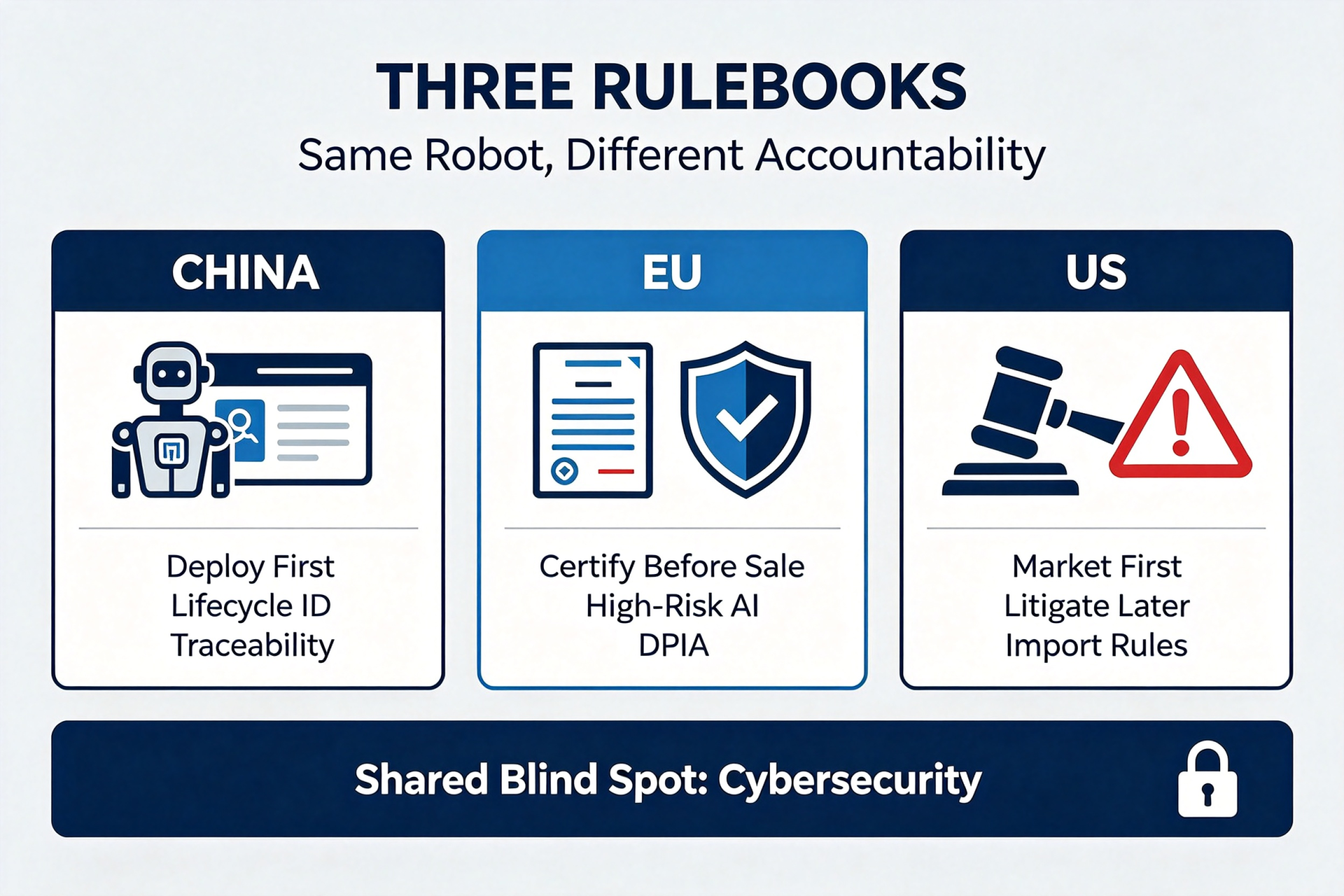
Strip away the press releases and the three major jurisdictions reveal three starkly different instincts about who should bear the burden of safety: the builder, the state, or the courts.
China has chosen "deploy first, rules in sync" — a posture that pairs aggressive field deployment with a pre-built accountability chain. The bet is that you learn faster by shipping, but you stay answerable by tracking every unit from cradle to scrapyard.
The European Union practices "strong ex-ante compliance." Embodied AI is treated as high-risk by default, and the gate is certification: prove safety and transparency before the robot reaches a customer.
The United States runs on "market first, rules after." There is no single robot statute. Existing consumer-protection and product-safety law applies, voluntary frameworks guide industry, and binding restrictions tend to emerge reactively — through litigation, agency action, or legislation passed after an incident or a geopolitical trigger.
None of these paths is "right" in the abstract. But for anyone buying or building humanoids across borders, the divergence is no longer academic. It shapes what you can import, what you must document, and what you are liable for.
China's most distinctive move is turning traceability into infrastructure. In June 2026, the Ministry of Industry and Information Technology (MIIT) issued the Specification for Full-Lifecycle Management of Humanoid Robots, which assigns every unit a 29-digit immutable unique identity code spanning production, distribution, maintenance, and recycling. According to MIIT, by that month more than 28,000 units had already been coded.
That code is not a sticker. It is welded into the machine's lifecycle. Replacing a key component requires authorization, re-binding the identity code, and re-testing before the robot can be redeployed. The effect is a kind of "pre-fabricated accountability chain": responsibility is built into the object before it ever earns a wage, so that when something fails, the question of whose robot it was is already answered.
This sits on top of earlier foundations. Shanghai published China's first local humanoid governance guidelines back in 2023, anchoring policy on the protection of human dignity and human safety. The broader legal stack — the Cybersecurity Law, the Data Security Law, and the Personal Information Protection Law — all apply to embodied systems. And the standards route is deliberately graduated: group standards first, then industry standards, then national standards, with the Humanoid Robots and Embodied Intelligence Standards System (2026 Edition) carving out a dedicated safety-and-ethics block.
The logic is coherent: move fast, but make sure every machine is legible to the state throughout its working life.
Europe's instinct is the mirror image — slow the door, fortify the frame. Under the 2024 EU AI Act, embodied AI systems are classified as high-risk. The Compliance burden falls on the manufacturer before market entry.
The timeline, however, keeps sliding. The original August 2, 2026 deadline for Annex III high-risk obligations was postponed by the Digital Omnibus package — Regulation (EU) 2026/1744 — to December 2, 2027, while product-embedded systems under Annex I were pushed to August 2028. That delay has given industry breathing room, but it has also created a peculiar limbo in which the rules are binding in principle yet forgiving in practice. Notably, general-purpose AI model obligations — including Article 50 transparency duties — are already being enforced by the EU AI Office, so the "frontier model" side of the regime is live even as the robotics side waits.
Then there is data. A warehouse humanoid is, in GDPR terms, essentially a mobile sensor array. Capturing faces, gaits, or voice in a workplace typically triggers a Data Protection Impact Assessment (DPIA), and EU data-residency rules still apply to whatever that robot records. The updated Machinery Regulation separately requires manufacturers to address cybersecurity risks that could affect physical safety. And while IEEE's P7000 ethics series is widely cited as best practice, it remains guidance — not hard law.
For European buyers, the practical takeaway is simple but heavy: compliance is a precondition of purchase, not a footnote to it.
The US approach is the most permissive at the point of sale and the most politically volatile at the border. There is no federal "Robot Law." The Federal Trade Commission and the Consumer Product Safety Commission apply existing consumer-protection and product-safety statute; NIST's AI Risk Management Framework is voluntary. Medical deployments still must clear HIPAA and FDA.
But 2026 brought a sharper edge. The Federal Communications Commission moved to ban new imports of foreign-made humanoid and quadruped robots — a step widely read as aimed at Chinese manufacturers. On Capitol Hill, a bipartisan House bill would require national-security review of foreign humanoid products, with a direct ban if a product goes unreviewed within a year. The through-line is clear: where Europe regulates the machine's safety, Washington is increasingly regulating the machine's origin.
The contrast with China and the EU is structural. In America, accountability is largely backward-looking — it is resolved through lawsuits, recalls, and legislation that follows an incident, rather than a code stamped at birth or a certificate signed before sale.
Seen together, the three models differ less on goals — everyone wants safe, trustworthy robots — than on where accountability is created:
China pre-builds it. The 29-digit code makes the robot itself the carrier of responsibility across its entire lifecycle. Accountability is manufactured into the product.
The EU certifies it. A conformity assessment and documented risk management must exist before the robot is marketable. Accountability is verified by the state before deployment.
The US litigates it. Responsibility is allocated after harm occurs, through courts and agencies reacting to real-world events. Accountability is resolved retrospectively.
A buyer in 2026 thus faces three different questions. In China: is this unit properly coded and traceable? In Europe: does it carry the right conformity and data-protection paperwork? In the US: who sues, and under what statute, if it hurts someone? The same robot, three audits.
Regulation, whatever its flavor, has a blind spot: cybersecurity. In 2017, security firm IOActive documented roughly 50 vulnerabilities across a range of popular robots. A 2026 follow-up found the same vulnerability classes still present — except that the attacker's bar has been lowered by AI-assisted exploitation. Many humanoids still ship with default passwords and no clear mechanism for security updates, a gap the automotive industry has prohibited since July 2024.
This is the rare issue that cuts across all three regulatory philosophies. China's lifecycle code tracks a machine's physical history, not necessarily its patch status. Europe's Machinery Regulation nudges at cyber-physical safety but stops short of a mandated update regime. America's voluntary frameworks leave it to the market. Experts increasingly urge "Security by Design" principles and a UL-style certification mark that tells a buyer a robot was built — and can be maintained — securely.
For now, the gap is a shared liability. A humanoid that can be hijacked is a liability in every jurisdiction at once.
The practical consequences are already landing.
For buyers, procurement is now a compliance decision, not just a specs decision. A logistics operator evaluating humanoids must ask jurisdiction-specific questions: Will this fleet satisfy China's identity-code requirements if deployed there? Can it meet a European DPIA and machinery conformity assessment? Will US import rules bar a foreign-made unit entirely? The cheapest robot on paper can become the most expensive once regulatory friction is priced in.
For builders, the harder truth is that regulation is fragmenting along geopolitical lines. A product engineered to sail through a Shanghai lifecycle registry may stall at a European conformity gate or a US import ban. Designers increasingly face a choice: build once for a global market that no longer exists, or build variants calibrated to three rulebooks. Standards harmonization remains a hope, not a reality.
For those who want to see how these philosophies play out in metal and code, exhibitions are becoming the place to compare them side by side. HRIE 2026 — Shanghai International Humanoid Robot and Robotics Industry Chain Exhibition, December 9–11, 2026 at the Shanghai New International Expo Centre (SNIEC) — offers a rare chance to watch China's deploy-and-track model operate on the show floor, alongside builders from around the world navigating the same divergent rulebooks.
The robots may look the same. The laws governing them do not. And in 2026, that difference is the story.