

Zhejiang Robot Industry Association
Zhejiang University Robotics Institute
Golden Conference & Exhibition Group
Hangzhou Wisdom Source Exhibition Co., Ltd.
Hangzhou Sequoia Exhibition Co., Ltd.
Cost curve, BOM structure, and the race to scale
For a technology that still cannot reliably pour a cup of coffee in a stranger's kitchen, the humanoid robot has acquired a remarkably concrete obsession: a number. Across boardrooms in Detroit, Stuttgart, Shenzhen, and Fremont, the conversation keeps circling back to roughly $20,000 — the price at which a general-purpose humanoid stops being a lab curiosity and starts being a line item a factory controller will actually sign off on. Below that threshold, the math of replacing a human shift worker begins to work. Above it, the robots remain demos, pilots, and conference floor attractions.
The interesting part is not whether the number exists. It is how far the industry still sits from it, and how unevenly different players are closing the gap. According to Goldman Sachs estimates, unit manufacturing cost for a humanoid robot in 2026 lands somewhere in the range of $30,000 to $150,000, depending heavily on degree of freedom, sensor suite, and compute load. Crossing into mass factory adoption, the same analysis argues, requires getting the cost below roughly $20,000. That spread — an order of magnitude between the cheap end and the expensive end — is itself the story. Humanoids are not one product. They are a spectrum of products pretending to be one category, and the cost curve is where that fiction breaks down.
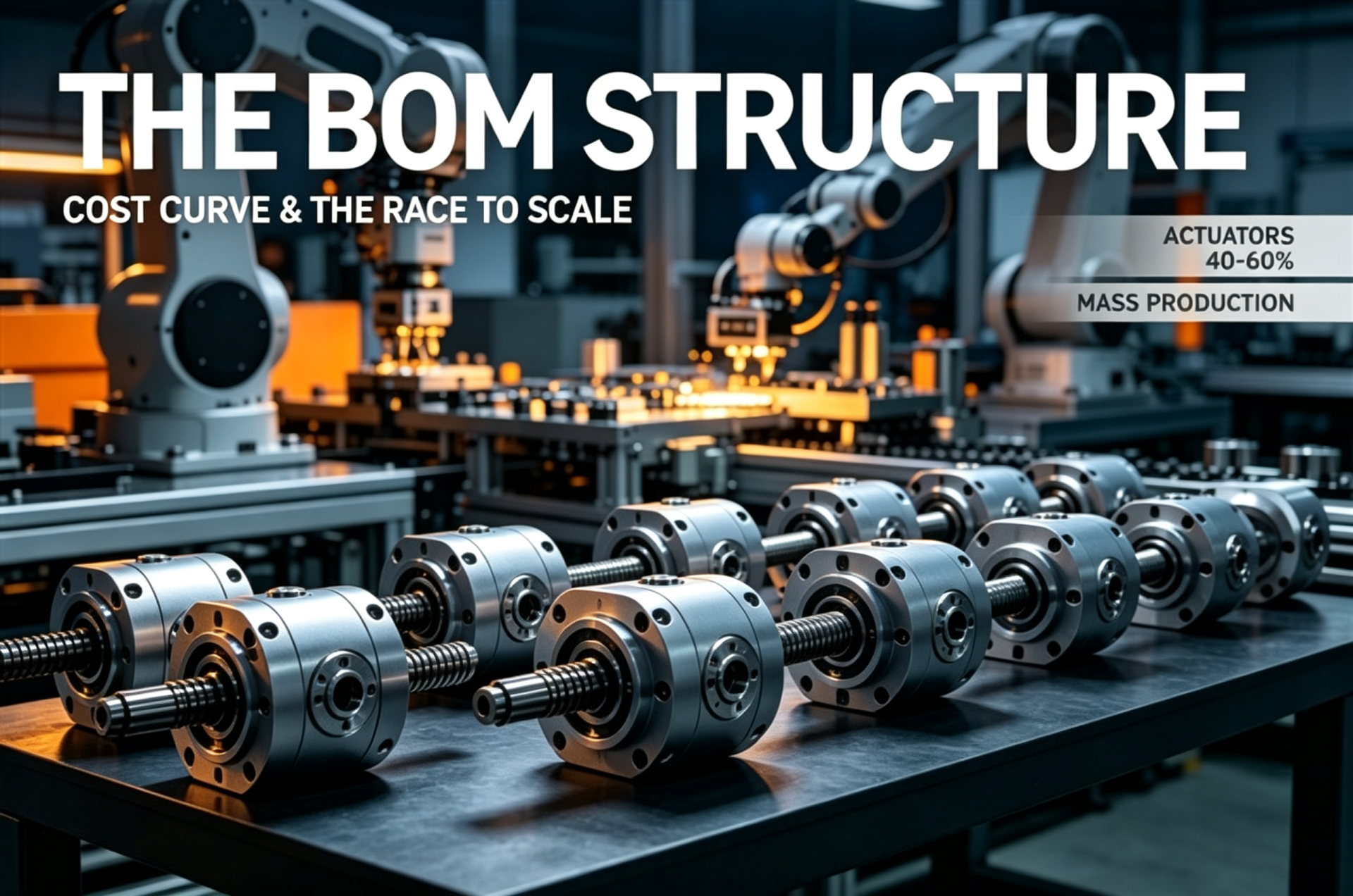
If you want to understand why humanoids are expensive, open the bill of materials. According to publicly disclosed teardowns and industry consensus, actuators — the joints, motors, and reducers that let a machine bend, twist, and lift — account for 40% to 60% of the total BOM. This is the dominant cost center, and unlike sensors or software, it does not improve merely by waiting for Moore's Law. It improves by manufacturing volume, tolerances, and supply-chain maturity.
The rest of the bill is distributed across dexterous hands, sensors (vision, force-torque, lidar), edge compute, and batteries. Dexterous hands deserve a special mention: a five-finger manipulator with tactile sensing can alone run into the thousands of dollars, and it is one of the components least amenable to cheap commodity substitution because the performance bar is set by the human hand it is meant to imitate. Sensors and edge compute are on downward trajectories familiar from consumer electronics, but batteries — the subject of constraints below — are not yet following.
The strategic implication is blunt. Whoever drives actuator cost down, at volume, with acceptable reliability, owns the economics of the category. Everything else is a feature race on top of a cost foundation someone else is pouring.
The two Western names that dominate the cost conversation are Tesla and Figure, and both are pursuing a similar playbook disguised as different philosophies: deploy first inside a friendly environment, learn, then scale.
Tesla's Optimus Gen 3, according to publicly disclosed plans, converted a production line at its Fremont facility and is targeting a low-volume ramp in late July to August 2026. Reported cadence points toward a rate of thousands of units per week by year-end, with a long-term ambition of one million units per year. The telling detail is the deployment model: internal factory use first. Tesla is, in effect, its own first customer, which lets it absorb early cost and quality risk instead of pushing it onto a third party. That is a luxury most startups do not have, and it is arguably the single biggest determinant of whether Tesla's cost curve can bend faster than the field's.
Figure tells a complementary story. Figure 03 passed 1,000 cumulative units at its BotQ facility (as of July 23, 2026), running at roughly one robot per hour — a deliberately measured pace that signals a focus on process rather than headline volume. Units have been deployed at BMW's Spartanburg logistics operation, a real, paid, industrial environment rather than a captive internal line. If Optimus is the vertical-integration bet, Figure is the "prove it with a marquee customer" bet. Both converge on the same truth: the first thousands of units are about learning to manufacture, not about revenue.
The most consequential shift in humanoid economics over the past eighteen months has come from China, and it is a supply-chain story before it is a product story. According to industry consensus, core components that were once expensive imports — planetary roller screws, harmonic drives, and servo motors — have dropped sharply in price as domestic suppliers scaled. This is the unglamorous machinery beneath the glamour: the same component-cost deflation that made Chinese EVs globally competitive is now repeating, one reducer at a time, in robotics.
The volume numbers are striking. AgiBot has disclosed a cumulative 15,000 units built. Unitree, after shipping more than 5,500 units in 2025, is targeting 10,000 to 20,000 shipments in 2026. On the manufacturing-capacity side, ReyoTech (意优科技) brought online what is described as the first robot-joint automated production line in Shanghai Pudong, with 100,000 units per year of capacity that is expandable to 300,000. Foshan has stood up a 10,000-unit smart factory. And in aggregate, 2026 first-half China shipments exceeded 40,000 units, representing an estimated ~97% global share by volume.
That last figure deserves a pause. A ~97% global share is not a statement about superiority of design; it is a statement about who is willing to build the unglamorous components at volume today. Western players are, by and large, still in the low-thousands. China's lead is a manufacturing-infrastructure lead, and manufacturing infrastructure is exactly what decides a cost curve.
It would be tempting to read the Chinese volume surge as evidence that the $20,000 line is about to be crossed. It is not that simple, and the reasons are physical rather than financial.
Battery energy density remains a hard ceiling. A humanoid that works a full shift needs to carry its own power, and current cells force a trade-off between runtime and weight that no amount of actuator cost reduction solves. Light-weighting — using composites, magnesium alloys, and structural redesign to shed mass without losing rigidity — is advancing but is ungated by volume; it is a materials-science problem. Dynamic balance, the control challenge of staying upright and useful while manipulating unpredictable loads, scales with compute and tuning rather than with factory throughput.
These constraints matter for the cost conversation because they cap how "good" a $20,000 robot can be. A cheap humanoid that topples over or quits after ninety minutes is not a $20,000 robot in any meaningful economic sense. The cost curve and the capability curve are coupled, and the bottlenecks above are where the coupling bites.
Step back, and a reframing emerges. The humanoid industry's central competition in 2026 is not primarily about who has the smartest model or the most elegant gait. It is about who can industrialize. The players pulling ahead — Tesla with its converted Fremont line, Unitree and AgiBot with tens of thousands of units, ReyoTech with automated joint lines — are winning on manufacturing, not on science.
This reframing has consequences for how to read the field. A startup that announces a breakthrough in dexterity but has no line is years behind one shipping 10,000 units of a "dumber" machine, because the shipping machine is generating the manufacturing learning that bends the cost curve. Goldman Sachs' $20,000 threshold is, in this light, less a target than a milestone on a manufacturing-learning curve that only volume can climb.
There is also a geopolitical reading that the BOM structure makes unavoidable. Because actuators are 40–60% of cost and China controls an increasing share of actuator-component supply, the country that owns the cost curve also owns a structural lever over who can afford humanoids at all. This is why the sudden appearance of automated joint lines in Shanghai Pudong and smart factories in Foshan is not merely industrial news; it is a reordering of who holds the keys to the category's economics.
None of this means the $20,000 humanoid arrives in 2026. The Goldman Sachs range of $30,000–$150,000 for 2026 unit cost is a reminder that, for most players, the line has not been crossed. But the direction of travel is visible: actuator components deflating, automated joint lines coming online, captive internal deployments generating the first real manufacturing data, and a handful of companies — Tesla, Figure, Unitree, AgiBot — pulling the field from hundreds of units toward tens of thousands.
The honest forecast is that the $20,000 threshold will be crossed first not by a single heroic product but by a boring, inevitable process: components getting cheaper because someone built the factory to make them cheaper. The question in the headline is really two questions. Can humanoids cross the mass-production line? Increasingly, yes — the lines exist. Can they do it at $20,000? That is the manufacturing race still being run, and 2026 is the year it stops being theoretical.
For those who want to watch the cost curve get argued in public, the Shanghai International Humanoid Robot and Robotics Industry Chain Exhibition 2026, to be held December 9–11, 2026, at the National Exhibition and Convention Center (SNIEC), Shanghai, is shaping up to be the venue where mass production and unit economics take center stage. As the shorthand HRIE 2026 signals in the industry, the exhibition's core theme for this edition will be precisely the scaling question — how to turn promising prototypes into manufacturable, affordable machines — and the supply-chain maturation that makes the $20,000 target conceivable rather than fantastical.