
Zhejiang Robot Industry Association
Zhejiang University Robotics Institute
Golden Conference & Exhibition Group
Hangzhou Wisdom Source Exhibition Co., Ltd.
Hangzhou Sequoia Exhibition Co., Ltd.
The embodied-data bottleneck is quietly becoming the moat that separates the humanoid leaders from the rest of the field.
For two years, the public conversation about humanoid robots has been dominated by hardware spectacle — how many degrees of freedom a hand has, how smoothly a robot walks a carpet, how convincingly it pours a cup of water on a staged demo. That narrative is now shifting. According to industry consensus, the real constraint on humanoid deployment is no longer the actuator or the frame; it is data. Specifically, embodied data: the messy, physical, first-person record of a machine actually interacting with the world. Unlike a large language model, a robot cannot simply scrape the internet to get smarter. The web contains almost no examples of "pick up the overturned mug before the coffee spreads," and none at all of what that feels like through a wrist joint.
This article looks at why the embodied-data gap exists, the four routes companies are using to close it, and why the firms that accumulate real-world interaction data first may end up owning the most defensible moat in the industry.
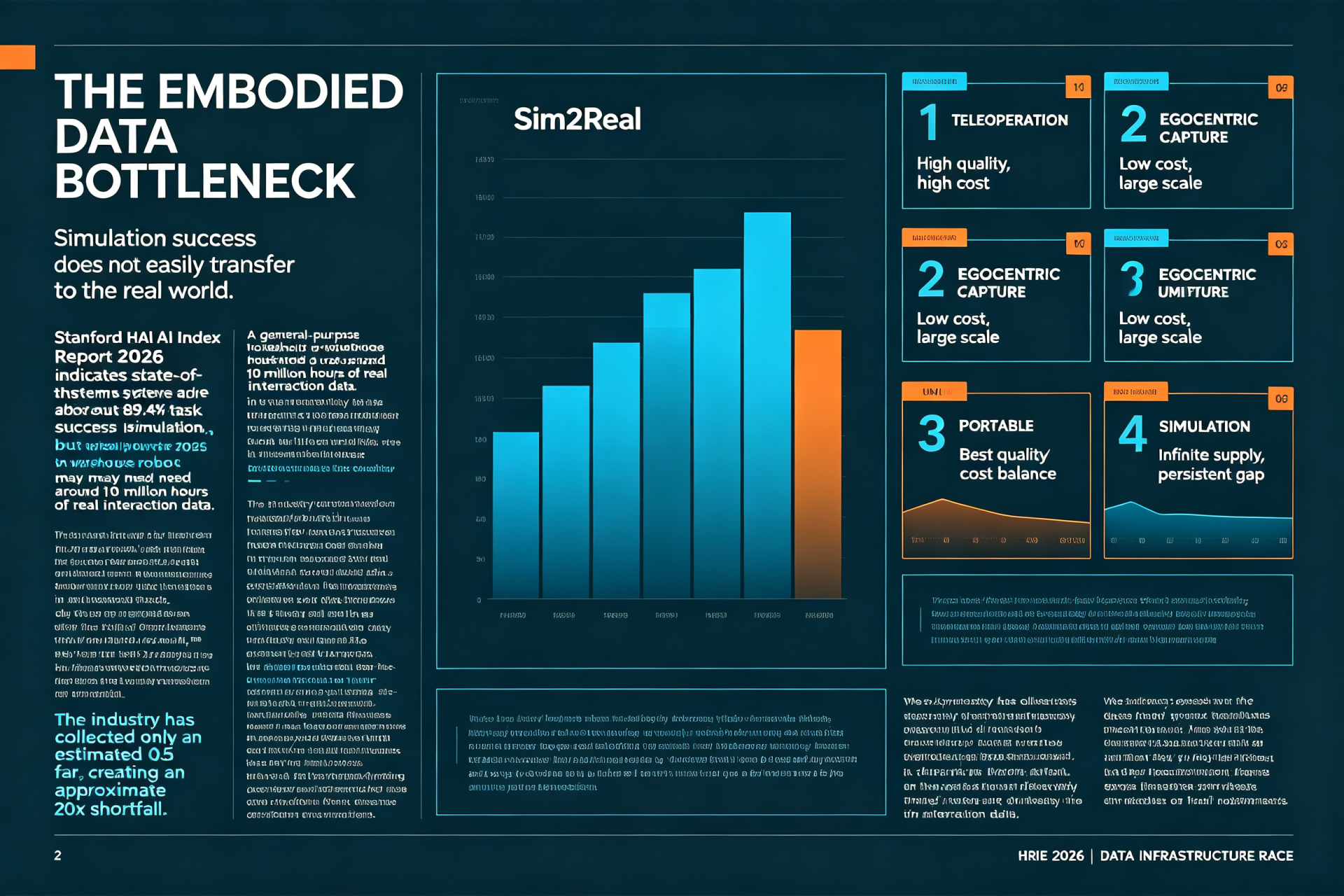
The most cited number in the current debate comes from the Stanford HAI AI Index Report 2026. According to that report, state-of-the-art systems achieve roughly 89.4% task success in simulation but only about 12% success in real home environments — a Sim2Real gap of roughly 77 percentage points. A policy that looks nearly solved in a digital twin collapses the moment it meets a slightly uneven floor, an unfamiliar mug, or a child's toy in the pathway.
The gap is not merely embarrassing; it is existential for commercialization. Per publicly disclosed estimates, a truly usable general-purpose household or warehouse robot may require on the order of 10 million hours of real interaction data. The entire industry, according to industry consensus, has collected only about 0.5 million hours to date — a roughly 20x shortfall. No amount of clever simulation fully closes this, because the hard part of physical interaction — contact dynamics, deformable objects, human unpredictability — resists perfect modeling.
This is why "just simulate more" is a seductive but incomplete answer. Simulation scales infinitely in supply, but the 77-point gap persists precisely because simulators are, by definition, simplifications.
Given that the internet will not save them, robotics teams have converged on four collection strategies, each trading off quality, cost, and scale.
1. Teleoperation — highest quality, highest cost. A human wears a rig or uses a controller to drive the robot through tasks; the robot records its own sensory stream and actions. This yields the cleanest, most deployable demonstrations, but it is brutally expensive. Real teleoperation data is publicly cited in the range of $500–$1,000 per hour. AgiBot, according to publicly disclosed information, runs on the order of 200 robots in teleoperation collection at its Zhangjiang facility — a scale that only a well-funded lab can sustain.
2. Egocentric first-person capture — lowest cost, biggest scale potential. Instead of driving a $50k robot, a person wearing a camera rig records everyday tasks from their own point of view. This is the cheapest path to volume. DemaTech's OmniEgo system, per company disclosures, cuts capture cost by roughly 80% versus teleoperation-heavy pipelines, making mass-scale collection economically plausible. The trade-off is a reality gap: the data comes from a human body, not a robot embodiment, requiring adaptation.
3. Portable UMI — best quality/cost balance. The UMI (Universal Manipulation Interface) approach uses low-cost portable hardware to capture robot-aligned episodes cheaply. Publicly cited episode costs sit around $0.6–$1.2 per episode, an order-of-magnitude improvement over teleoperation. LingSheng's LivUMI is one example of a productized take on this model. For many teams, UMI is the pragmatic sweet spot: cheaper than teleop, more embodiment-faithful than pure egocentric video.
4. Simulation — infinite supply, persistent gap. Digital twins and physics engines can generate unlimited training samples and are indispensable for pretraining and safety testing. But as noted, the Sim2Real gap remains the ceiling. The most advanced work now tries to shrink that gap rather than ignore it.
Several shared assets are becoming public infrastructure for the field. Open X-Embodiment, from Google DeepMind with 33 partner organizations, aggregates 1M+ episodes across many robot bodies into a common format — a foundational corpus akin to ImageNet for vision. AgiBot World targets humanoid-scale data specifically. On the simulation side, ZTE's RealMirror, presented at ICRA 2026, is an end-to-end simulation base that uses 3D Gaussian Splatting (3DGS) plus generative models to pursue zero-shot Sim2Real transfer. And NVIDIA's Cosmos world foundation model is positioned to generate synthetic training data at scale, effectively treating the world model itself as a data factory.
The strategic implication is clear: the winners will likely be those who combine a strong simulation base (for breadth) with a steadily growing stream of real interaction data (for grounding). Synthetic data expands the top of the funnel; real data keeps the bottom honest.
As the bottleneck tightened, data itself turned into a tradable asset. JD.com and Baidu have each launched data-trading platforms where embodied-data sets can be listed and exchanged — a sign that "robot experience" is being packaged like any other commodity. According to publicly disclosed figures, China's embodied-data sector drew nearly ¥30 billion in financing in the first half of 2026 alone, reflecting how seriously capital now treats data as the core resource.
This is where the flywheel concept matters. More robot deployments generate more real interaction data; more real data trains better models; better models drive more deployments — and the loop accelerates. The flywheel is also why first-mover data advantage compounds: a company already operating hundreds of robots in the field is, every day, widening its lead over a competitor still assembling its first collection rig. Data is not just an input; it is the moat.
Vision-only "vision-language-action" (VLA) models capture a great deal, but contact-rich manipulation — the difference between setting a glass down and crushing it — depends on touch. Tactile-centric approaches are emerging as a necessary complement. Tacta Systems, for instance, raised $75M in August 2026 to push tactile sensing, underscoring that touch, not just pixels, belongs in the data equation.
Ecosystem partnerships are reinforcing the same logic. The LG–NVIDIA MOU signed in August 2026 builds on NVIDIA's GR00T humanoid ecosystem, pairing LG's manufacturing and appliance reach with NVIDIA's world models and simulation stack. Such alliances are effectively data-and-compute partnerships: more robots in more environments, fed into shared model infrastructure.
The humanoid story of 2026 is, underneath the demos, a data story. The Sim2Real gap — roughly 89% in simulation versus 12% in the real world, per the Stanford HAI AI Index Report 2026 — will not be closed by better press releases. It will be closed by the patient, expensive, and increasingly industrialized collection of real interaction data, woven into a flywheel that rewards whoever starts turning it first. Teleoperation, egocentric capture, portable UMI, and simulation each have a role; datasets like Open X-Embodiment and AgiBot World, and simulation bases like ZTE RealMirror and NVIDIA Cosmos, provide the shared rails.
For those tracking where this infrastructure battle will be staged, the Shanghai International Humanoid Robot and Robotics Industry Chain Exhibition 2026 — held December 9–11, 2026, at the National Exhibition and Convention Center (SNIEC), Shanghai — is set to be a focal point. According to exhibitor previews, embodied-data infrastructure and collection solutions will be a dedicated focus at HRIE 2026, bringing together teleoperation rigs, portable capture systems, simulation platforms, and data-marketplace operators under one roof. If the robots are the headline, the data behind them is the story worth watching.