
Zhejiang Robot Industry Association
Zhejiang University Robotics Institute
Golden Conference & Exhibition Group
Hangzhou Wisdom Source Exhibition Co., Ltd.
Hangzhou Sequoia Exhibition Co., Ltd.
For most of the past decade, the humanoid-robot conversation was a conversation about hardware. How many degrees of freedom? What actuator topology? How long does the battery last, and can the machine stay upright when someone nudges it? That era is not over, but in 2026 it visibly lost the spotlight. The center of gravity in embodied AI has moved from the body to the brain — and the architecture of that brain is now, according to a broad and increasingly convergent industry consensus, a vision-language-action (VLA) stack with a world model fused inside it rather than competing against it.
The shift is not subtle. At the major 2026 research and industry gatherings — including the World Artificial Intelligence Conference (WAIC) and the Beijing Academy of Artificial Intelligence events — the dominant theme was no longer "build a better body" but "build a smarter brain." And the once-heated argument over whether world models or VLA models were the right path for robotics appears, by public accounts, to have been settled in a way few predicted two years ago: not as a winner-take-all contest, but as a merger. The world model is becoming a core submodule of the VLA stack. As Guo Yandong and others publicly argued during the 2026 discourse, the two approaches are not rivals. A world model is what gives a VLA the ability to simulate, predict, and sanity-check its own actions before it commits them to the physical world.
This article traces how that consensus formed, what the key 2026 technology releases tell us, and why the fusion of VLA and world models is likely to define the next chapter of humanoid robotics.
The reorientation of the field was most clearly visible in the public messaging coming out of WAIC and BAAI in 2026. Where previous cycles emphasized mechanical dexterity and locomotion demos, the 2026 narrative from researchers and vendors alike centered on cognition: How does a robot understand an open-ended instruction? How does it generalize to a task it has never been explicitly trained on? How does it recover when the world does not behave as expected?
According to publicly disclosed commentary from the 2026 season, the "world model vs VLA" debate that animated 2024 and 2025 has been effectively resolved. End-to-end VLA — mapping raw perception directly to motor actions through a single learned pipeline — is now the mainstream formulation. But a pure VLA, critics noted, can be inflexible and unsafe: it acts without necessarily understanding the consequences of its action. The world model fills that gap. It is the internal simulator that lets the robot ask, "If I do this, what happens next?" before it does it.
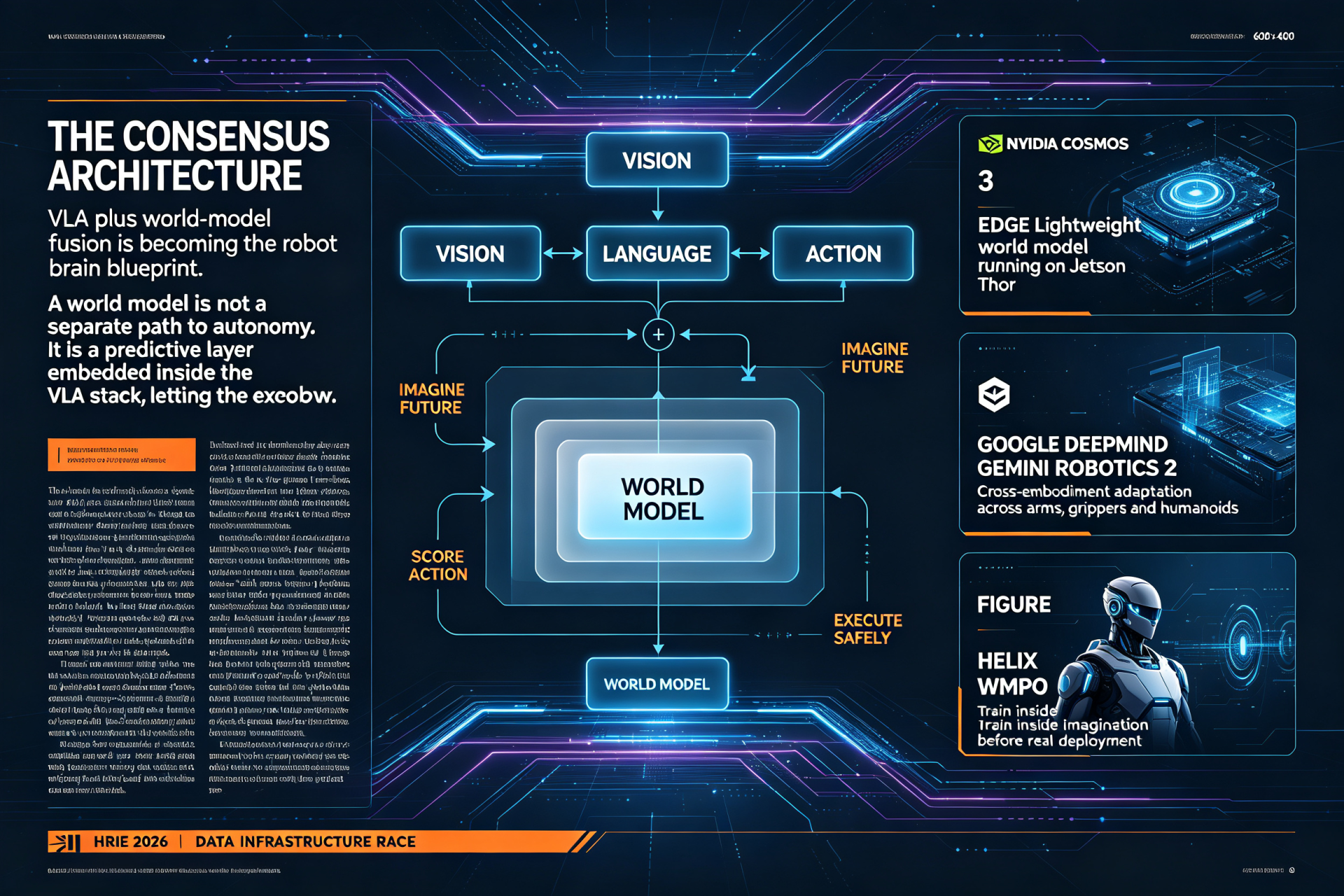
The elegant resolution, in the words of observers such as Guo Yandong, is that the world model is not a separate route to autonomy. It is a layer embedded in the VLA — a predictive, latent-space simulation engine that runs inside the same model family. In this framing, the robot "imagines" forward, scores candidate actions against its predicted futures, and only then executes. The brain eats the world model, and the world model makes the brain trustworthy.
Nowhere was the convergence more concretely demonstrated than in NVIDIA's 2026 roadmap. At SIGGRAPH in July 2026, the company unveiled Cosmos 3 Edge — a lightweight world model reported at roughly 4 billion parameters, designed to run locally on Jetson Thor edge chips at approximately 28 frames per second, and, importantly, released as open-source. The significance is architectural as much as technical. A world model small enough and efficient enough to live on the robot's own compute — rather than in a distant data center — means prediction and simulation can happen in the control loop, in real time, with no network round-trip.
That edge-world-model story is tightly coupled to NVIDIA's broader robotics stack. The Isaac GR00T robot foundation model and the Newton 1.0 physics engine are being adopted, according to public disclosures, across a striking cross-section of the industrial and humanoid landscape — ABB, KUKA, Fanuc on the industrial side, and Figure and Agility on the humanoid side. The implication is that a meaningful share of the world's robot "brains" are beginning to share common substrate: a foundation model for manipulation and mobility, a physics engine for simulation and validation, and now an on-device world model for forward prediction.
For an international B2B audience, this is the part that matters most. Interoperability and shared tooling lower the cost of building embodied products. A startup or an automaker that wants a humanoid does not have to invent cognition from scratch — it can stand on GR00T, validate in Newton, and run Cosmos 3 Edge on the robot itself. The "brain" is becoming a commoditized platform, exactly as the "body" became one.
If NVIDIA supplied the platform, 2026 also produced the proof points that the fused architecture actually works across very different machines.
Google DeepMind, on August 4, 2026, released Gemini Robotics 2 — described in public materials as a full-body model with cross-embodiment capability, able to adapt to new hardware in hours rather than weeks. The cross-embodiment claim is the crucial one: a single brain that transfers across arms, grippers, and whole humanoid bodies suggests the cognition layer is decoupling from any specific mechanical form. According to DeepMind's demonstrations, the model was shown running on the Apollo 2 humanoid, among other platforms.
Meanwhile, 1X Technologies has pursued a parallel path built on a proprietary world model pre-trained on more than one million hours of internet video of humans, combined with egocentric footage. The publicly stated advantage is data efficiency: because the model already understands a great deal about how bodies move through and manipulate the world, it can be fine-tuned for a new task with comparatively little teleoperation data. In an industry where collecting high-quality robot demonstration data is slow and expensive, a world model that arrives pre-loaded with intuitive physics and human behavior is a meaningful shortcut.
Figure's Helix system illustrates the "two-speed brain" pattern that several leaders have converged on. It pairs a slower, deliberative system (S2, the "brain") with a faster, reflexive system (S1, the "cerebellum"). Critically, Figure has described a method called WMPO — world-model policy optimization — that lets robots train inside their own imagination. Rather than requiring every learning step to be executed on real hardware, the robot can rehearse in the world model, optimizing its policy against predicted futures. This collapses the time and cost of training and, just as importantly, lets the system explore risky or rare scenarios safely.
Taken together, these three examples sketch the consensus architecture almost too neatly: a cross-embodiment VLA core, a world model for forward simulation and safe rehearsal, and a split between slow deliberation and fast execution.
Technology consensus is usually followed — or preceded — by capital. According to industry reports, the first half of 2026 saw record financing flows into embodied-intelligence "brain" startups, with the majority of that capital directed at VLA and world-model foundations rather than at actuators, sensors, or mechanical platforms. The message from investors mirrors the message from researchers: the defensible, differentiating value in humanoids is increasingly cognitive, not mechanical.
The strategic partnerships tell the same story. On August 13, 2026, LG Group and NVIDIA announced a memorandum of understanding to build a bipedal humanoid based on the Isaac GR00T model, Jetson Thor compute, and NVIDIA Halos safety systems, with a public target of a 2027 unveiling. This is a telling template: a large, non-robotics-native conglomerate entering humanoids by assembling a best-in-class "brain stack" from a platform vendor, rather than developing its own cognition from scratch. It is the commoditization thesis made concrete.
For the international supply chain, the takeaway is structural. The humanoid industry is stratifying into layers — bodies, actuators, and sensors on one side; foundation models, world models, and safety systems on the other. The upper layers are consolidating around a small number of platform providers, while the lower layers remain a competitive, fragmented hardware market. A B2B buyer in 2026 can assemble a humanoid far more easily than in 2024, and the assembly is increasingly a software-integration problem rather than a mechatronics problem.
The remaining open questions are less about whether world models belong in the robot brain — that now appears settled — and more about how deep and how trusted that fusion becomes. Three threads are worth watching:
Latency and edge efficiency. Cosmos 3 Edge showed a world model can run at ~28 fps on-device. The next benchmark is whether richer, higher-fidelity prediction can hold that speed as tasks grow more complex.
Safety and verification. A world model that imagines is only useful if its imagination is reliable. WMPO-style training and Halos-style safety wrappers will be judged by how rarely the robot is confidently wrong.
Open vs closed cognition. NVIDIA's open release of Cosmos 3 Edge contrasts with proprietary models from 1X and others. The licensing and openness of robot "brains" will shape who can build on them.
For those tracking the field in person, the Shanghai International Humanoid Robot and Robotics Industry Chain Exhibition 2026 — scheduled for December 9–11, 2026, at the National Exhibition and Convention Center (SNIEC), Shanghai — is positioned to be a focal point for exactly these debates. HRIE 2026 is expected to showcase the new generation of brain-first humanoids, with world models and embodied-AI foundation stacks among the show's headline themes. If 2026 was the year the industry agreed that world models eat the robot brain, HRIE 2026 will be where that consensus meets the hardware floor.