
Zhejiang Robot Industry Association
Zhejiang University Robotics Institute
Golden Conference & Exhibition Group
Hangzhou Wisdom Source Exhibition Co., Ltd.
Hangzhou Sequoia Exhibition Co., Ltd.
For the better part of a decade, the humanoid-robot conversation was dominated by legs, locomotion, and the unglamorous engineering of simply staying upright. That phase is closing. The industry's center of gravity is moving upward — literally — toward the part of the body that determines whether a robot can be useful once it has arrived at the workstation: the hand. A robot that walks flawlessly but cannot pick a strawberry, thread a connector, or feel the resistance of a delicate surface is a demonstration, not a worker. The hand, and the sensing that makes it intelligent, is fast becoming the discipline that separates a compelling video from a deployable machine.
This shift is not hypothetical. It was the subtext of the World Robot Conference 2026 (WRC 2026) in Beijing in August 2026, where dexterous manipulation moved from a fringe specialty to a headlined theme. And it will be a focal point at the Shanghai International Humanoid Robot and Robotics Industry Chain Exhibition 2026, held December 9–11, 2026, at the National Exhibition and Convention Center (SNIEC), Shanghai, where component suppliers, hand makers, and tactile-sensor startups are expected to converge in force.
The human hand is a marvel of redundant degrees of freedom, compliant skin, and real-time feedback. Replicating even a fraction of it on a robot is harder than replicating a torso or a thigh, because the hand must do two contradictory things at once: exert enough force to grip and manipulate, and apply fine enough control to avoid crushing what it holds. A leg can be stiff and still walk. A hand cannot be stiff and still work.
According to industry analysts, this is precisely why the hand has lagged behind other subsystems. Vision could be solved well enough with commodity cameras and mature algorithms; locomotion could be tuned against a known physics problem. But manipulation sits at the intersection of mechanics, materials, control, and perception, and each layer amplifies the difficulty of the others. A hand without sensing is a blind gripper. A sensor without a calibrated hand is noise. The two must co-evolve.
The WRC 2026 signal, according to public disclosures from the event, was that dexterous hands are shifting from "a mere hardware part" into the shared entry point through which robots acquire, execute, and verify skills. Tactile sensors, in the same framing, are now treated as the "second layer of infrastructure" after the hands themselves — not an accessory, but the substrate that turns motion into understanding.
Building the hand body is its own contest of engineering philosophies. The market today spans a spectrum from three-finger and under-actuated grippers to fully anthropomorphic five-finger designs with twenty or more degrees of freedom (DoF). Tendon-driven architectures, inspired by the way human tendons route force from forearm to fingertip, are favored where a slim, biomimetic profile matters. Direct-drive and geared-link designs trade some anthropomorphism for robustness and easier control.
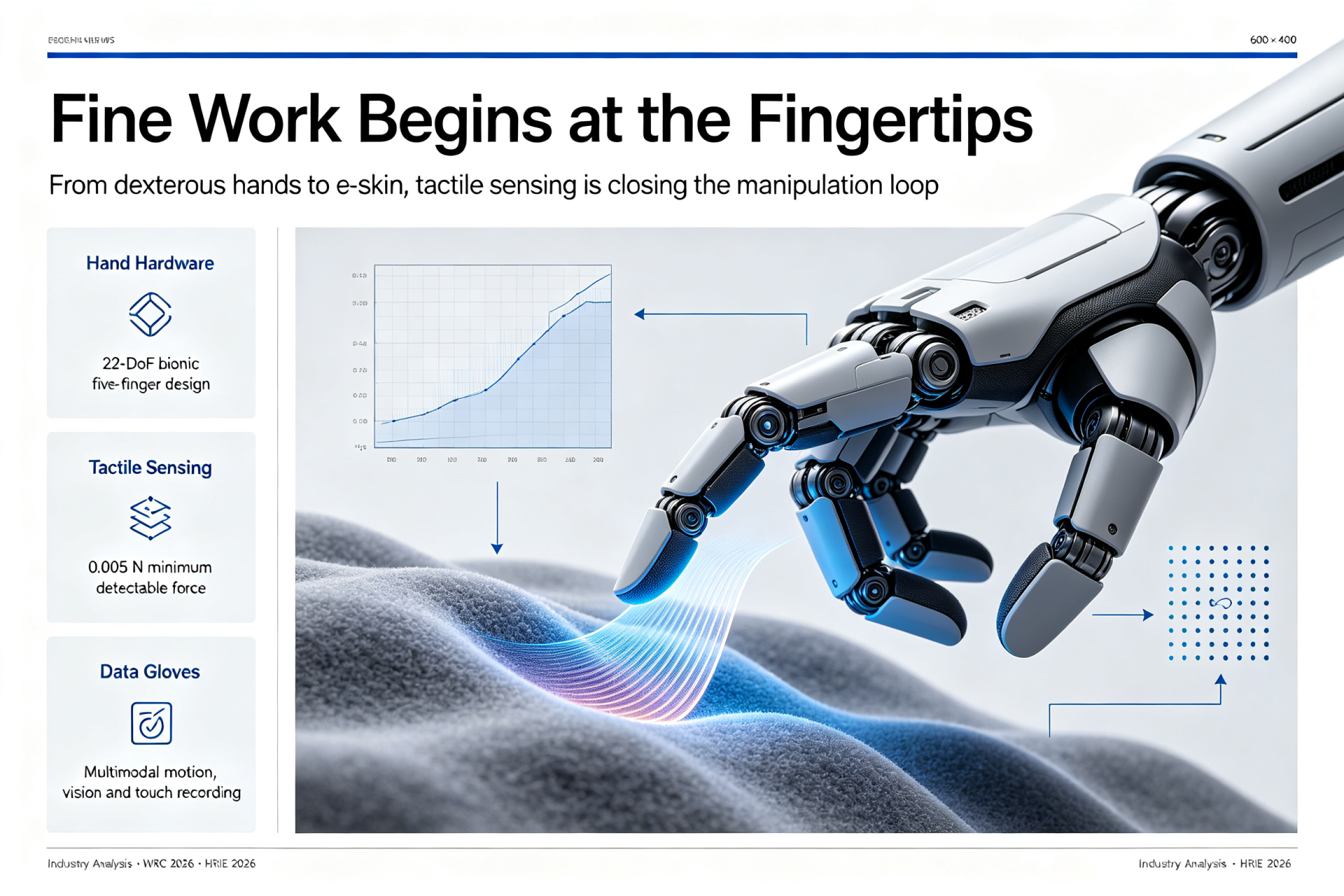
A clear reference point is DexHand021 Pro from Dexterity Intelligence (灵巧智能), a 22-DoF wrist-hand integrated, dual-tendon-driven, fully bionic five-finger hand. At WRC 2026 the company demonstrated the hand "spinning a walnut" — a classic in-hand manipulation task that requires the fingers to move an object relative to the palm without dropping it, purely through coordinated contact. That single demo encapsulates the goal: fine, controllable, reversible manipulation rather than a one-shot grasp.
The trade-off is familiar to anyone who has bought robotics hardware: more DoF means more actuators, more tendons or linkages, more points of failure, and a harder control problem. The industry has not settled on a single winning design. Instead, according to industry research, we are seeing a healthy divergence — low-DoF hands for cost-sensitive, repetitive tasks, and high-DoF bionic hands for tasks that demand human-like dexterity. The right hand is the one matched to the job, not the one with the highest spec sheet.
If the hand is the actuator, the electronic skin (e-skin) is the sense organ. Tactile sensing closes the loop that vision alone cannot. A camera sees the surface; it cannot feel the give of soft tissue, the slip of a greasy part, or the exact moment a connector seats. Tactile feedback is what lets a robot stop pressing the instant it feels enough resistance — the difference between "placing" and "crushing."
The technology routes are genuinely pluralistic, and none has yet won. Piezoresistive, capacitive, piezoelectric, optical, triboelectric, and electromagnetic approaches all coexist, each with advantages in sensitivity, durability, signal noise, or manufacturability. E-skin is, in effect, a "multi-layer sandwich" — a flexible substrate, a sensing layer, sometimes a conduction layer, and a protective surface — laminated thin enough to conform to a curved fingertip and robust enough to survive millions of touches.
The hard bottlenecks, according to industry research, are not the single sensor but the system: integration with the hand body, scaled manufacturing at consistent quality, and calibration across thousands of sensing points. A sensor that reads 0.1 N on one finger and 0.14 N on another, with no calibration map, is a sensor that cannot be trusted. PaXini (帕西尼) illustrated how far the frontier has moved at WRC 2026, unveiling the GEN4 FUSE — described as the world's first self-developed native 6D tactile-sensing chip — embedded in its fourth-generation ITPU multidimensional tactile sensor line. The company also showed PX-FOOTRIX, billed as the world's first foot multi-dimensional tactile sensor, and a PXCap Pro five-finger data glove. Together these build a full-body force-tactile matrix "from fingertip to sole," while PaXini's Neuron electronic skin is thin and flexible enough to conform to arms, legs, and torso. Publicly disclosed performance includes a minimum detectable force as low as 0.005 N — demonstrated in a feather test — a figure that signals just how sensitive commodity-grade tactile arrays are becoming.
The payoff of all this is the end of what engineers call "blind-man-feeling-the-elephant" reliance on vision alone. With tactile closed-loop control, the robot knows not just where the object is, but what it feels like to hold it, and can adjust in real time.
A dexterous hand is only as good as the policy that drives it, and policies need data. This is the quiet bottleneck behind the glamour: humanoids need enormous, high-quality datasets of manipulation, and the richest signal is multimodal — motion, vision, and touch recorded together.
Dexterity Intelligence addressed this directly with two launches alongside DexHand021 Pro: the OptiUMI portable multimodal data-collection system and the TriUMI three-finger data platform. Both are designed to record motion, vision, and tactile signals as a single training dataset, turning a human demonstration into machine fuel. PaXini's PXCap Pro data glove plays a similar role on the sensing side, capturing hand pose and, in the company's ecosystem, pairing with tactile arrays to log what a skilled human feels while working.
According to publicly disclosed positioning from both companies, the strategy is to commoditize the capture of expert manipulation. If collecting paired vision-touch-motion data becomes cheap and portable, the bottleneck shifts from "we lack data" to "we lack compute and better models" — a problem the broader AI industry is far better equipped to attack. This is why data gloves and open datasets deserve a place beside the hardware in any serious discussion of the field.
The numbers tell the story of a category moving from prototype to procurement. According to industry research, China's dexterous-hand sales are projected to jump from roughly 19,200 units in 2025 to about 70,200 units in 2026, with some forecasts putting demand above 430,000 units by 2030. At the same time, the single-hand cost has fallen from around ¥50,000 in 2024 to under ¥10,000, with six-DoF models reaching as low as ¥6,000–8,000. Falling price and rising volume is the classic signature of a component crossing from bespoke to commodity.
The sensing side is growing in parallel. The global robot tactile-sensor market is estimated at roughly $330 million in 2026, while China's tactile-sensing market is put at about ¥1.15 billion, projected to reach roughly ¥2.36 billion by 2028. Capital is following the curve: PaXini publicly disclosed in August 2026 that it closed a strategic round of approximately ¥1 billion, bringing cumulative funding to around ¥4 billion — reported as a record for the tactile-sensing category.
Caveats matter. Forecasts are sensitive to assumptions about how fast humanoids are actually deployed in factories and warehouses, and cost curves depend on scaled manufacturing that the industry is still building. But the direction is consistent across sources: the hand and its sensing are becoming line items in real bills of materials, not line items in research grants.
The most important reframing of 2026 is conceptual. For years the hand was specified like any other actuator — a part with a torque curve and a price. The WRC 2026 disclosures argue for a different mental model: the dexterous hand is the shared entry point through which a robot acquires a skill, executes it, and verifies that it worked. Touch is what lets the robot confirm success without a human looking over its shoulder.
That reframing has practical consequences. It means hand makers, sensor makers, data-glove makers, and model trainers are no longer separate supply-chain tiers but one integrated stack. A hand without calibrated tactile data is half a product. A dataset without a hand to act it out is inert. The winners are likely to be the players — or the ecosystems — that treat the hand, the skin, and the data as one system.
This integration is exactly what buyers will want to inspect up close. At HRIE 2026, dexterous hands and tactile sensing will be a focal point of the show, bringing together the hand bodies, the e-skin, the native sensing chips, the data gloves, and the datasets that together define whether a humanoid can truly do fine work. For an international audience tracking where the humanoid industry is actually spending its engineering effort, the hand is the place to look — and December in Shanghai is the place to see it.