



Zhejiang Robot Industry Association
Zhejiang University Robotics Institute
Golden Conference & Exhibition Group
Hangzhou Wisdom Source Exhibition Co., Ltd.
Hangzhou Sequoia Exhibition Co., Ltd.
For most of the last decade, the humanoid-robot story was told in hardware terms: degrees of freedom, walking gaits, dexterous hands, and the inevitable "next Tesla." That framing is now quietly becoming obsolete in the boardrooms where the real buying decisions happen. The more consequential shift is not whether a robot can walk, but whether a factory manager can sign a contract that turns a $150,000 machine into a predictable monthly line item—an "employee" you can hire, scale, and return. This is the logic of Robots-as-a-Service (RaaS), and by 2026 it has moved from vendor pitch to the default commercial model in several industrial deployments.
The clearest signal came from the automotive sector, but the larger story runs through logistics warehouses, Chinese municipal procurement, and a recurring-revenue flywheel that is reshaping how robotics vendors think about their own balance sheets. RaaS is not a financing gimmick. It is the mechanism that lets humanoids clear the gap between impressive demos and boring, repeatable, profitable operations.
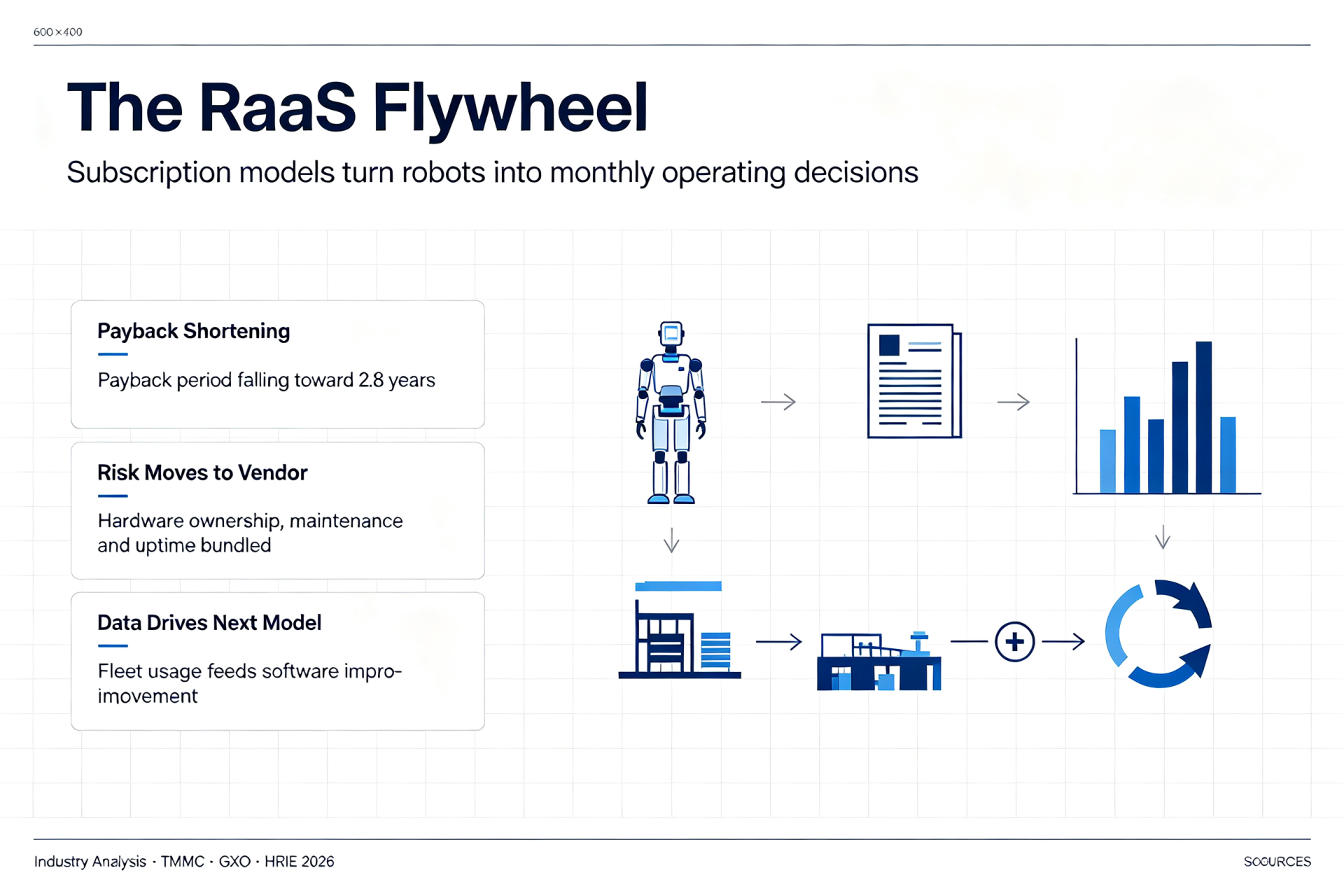
RaaS is the robotics adaptation of the software world's subscription model. Instead of buying a robot outright, a customer pays a recurring fee—often linked to usage—that bundles the hardware, software updates, maintenance, insurance, and on-site support. In practice, the vendor retains ownership of the machine and the customer buys outcomes: totes moved, bins transferred, inspections completed, hours logged.
This structure is unusually well suited to humanoids specifically, for three reasons. First, unit economics. A capable humanoid still carries a bill-of-materials cost that puts outright purchase out of reach for most mid-sized manufacturers; we return to the $100k–$150k range below. Second, the technology is improving fast enough that a buyer who commits capital today may regret the lock-in within 18 months. Subscription transfers that depreciation and obsolescence risk back to the vendor. Third—and most strategically—the vendor keeps the hardware in its own lifecycle, which means it keeps collecting the real-world data that makes the next model better. RaaS is, in effect, a data-harvesting and continuous-improvement contract dressed as a leasing agreement.
Agility Robotics has been the clearest proof point. Its Digit robot runs on a RaaS basis, and at a GXO fulfillment center it has, according to publicly disclosed figures, moved more than 100,000 totes and logged over 65,000 operational hours—widely cited in industry media as one of the most commercially successful humanoid deployments to date. The RaaS starting price is reported at roughly $10 per operating hour, with monthly per-unit fees in the range of about $1,500 to $8,000 and contract terms of 12 to 36 months. Those numbers are the closest thing the industry has to a published price sheet.
The most instructive development of early 2026 was not a single deployment but a pair of them that pointed in opposite directions.
On the "in" side, Toyota Motor Manufacturing Canada (TMMC) signed, on February 19, 2026, what has been described as the first commercial RaaS agreement for humanoids in North American automotive. The deal puts seven Digit units onto the RAV4 production line, following a year-long pilot with three units. Crucially, TMMC avoided the roughly $250,000-per-unit upfront purchase price by subscribing instead. For an automaker, this is a meaningful commitment: it signals that RaaS is becoming the default first-buy model for humanoids in industry, not a stopgap for cash-strapped shops. When a tier-one manufacturer chooses to hire rather than buy, the financing model itself becomes part of the product specification.
The "out" side is the necessary counter-signal. Around the same period, Amazon reportedly and quietly cancelled its Digit program, with media reports attributing the decision to throughput concerns. This is not a footnote; it is the cautionary half of the same lesson. RaaS does not magically make a robot fit a task it cannot perform reliably at scale. The Amazon experience proves that subscription economics only work when the task and environment fit the capability—otherwise the monthly fee just invoices you for a problem that hasn't gone away.
The pattern that emerges from the two cases is consistent with where humanoids are genuinely mature. The scenarios with stable, defensible return on investment are the unglamorous ones: tote and bin movement, material transfer between stations, and inspection rounds. These are structured, repetitive, and tolerant of the current state of machine reliability. By contrast, high-precision work such as welding and stamping remains firmly the territory of fixed-arm collaborative robots (cobots), where cycle time, repeatability, and safety envelopes are already solved. Humanoids are not yet—and may not soon be—a general replacement for specialized fixed automation. They are an addition to it, aimed at the messy, variable middle of the factory floor.
The commercial case for RaaS rests on a payback curve that has been bending in the right direction. According to industry research cited across 2026 coverage, the payback period for humanoid deployment has fallen from roughly 5.3 years in 2019 to about 2.8 years today. Adopters report first-year labor-cost reductions in the range of 22–28 percent, and automation-heavy plants have cut exposure incidents—the safety events that put humans in harm's way—by more than half.
Those figures matter because they convert a curiosity into a capital-budget line. A 2.8-year payback is squarely inside the planning horizon of an operations director. A 22–28 percent labor saving is the kind of number that survives a CFO review. And a halving of exposure incidents is a risk-management argument that procurement and EHS teams both understand.
Yet the upfront-price barrier remains real. With humanoid unit prices still estimated at $100k–$150k, an outright purchase is simply out of reach for most mid-sized manufacturers, who are precisely the segment that stands to benefit. This is the wedge that fuels leasing and subscription models: RaaS converts a six-figure capex obstacle into an opex decision that fits within an existing operating budget. The technology did not get cheap enough to buy; the financing got good enough to rent.
China's commercialization route looks different from the North American one, and it is working on its own terms. The dominant pattern is what might be called the "government + industry" large-account model, where municipal procurement and state-linked industrial projects create anchor demand that private customers can later follow.
According to publicly disclosed figures, Galaxy General won a roughly ¥236 million (approximately $32 million) Yibin municipal embodied-AI project—reported as a domestic single-order record and a validation of the large-account approach. The size of that order matters less than what it represents: a municipality treating embodied AI as infrastructure, with a vendor willing to deliver at scale rather than in pilot quantities.
The pure-play commercial vendors are posting numbers that suggest the "sell hardware first, add software later" path is viable. AgiBot (Zhiyuan) disclosed 2025 revenue of about ¥1.05 billion and, according to company-reported figures, exceeded ¥1 billion in the first quarter of 2026 alone. Unitree reported 2025 revenue of roughly ¥1.70 billion with about ¥590 million in deducted net profit and is already profitable. For an industry often dismissed as pre-revenue, profitability at Unitree and nine-figure quarterly revenue at AgiBot are notable milestones.
AgiBot has also begun exporting the RaaS model outward. On July 17, 2026, it launched a RaaS network based in Melbourne covering Australia and New Zealand, targeting mining, commercial cleaning, and research and education. The company's 15,000th robot rolled off the production line in June 2026, and its A2 Ultra model is reported to be running in thousands of real-world units. Scale of that order changes the conversation: at thousands of deployed units, the data flywheel turns fast enough that software improvement becomes a function of installed base rather than of lab effort.
Step back from individual deployments and the structural change is the most interesting part. The revenue model of a humanoid vendor is evolving from "sell hardware once" to a recurring mix of "hardware + software + service + ecosystem." That sentence understates how different the two businesses are.
A one-time hardware sale transfers the asset and ends the relationship; the vendor's incentive ends at the door. A recurring model inverts that: the vendor retains hardware-lifecycle control, carries the maintenance and uptime burden, and continuously collects real-world data to improve its models. Each deployed unit is not a closed transaction but an open sensor feeding the next software release. Over time, the defensible value shifts from the metal to the model—and to the ecosystem of customers, developers, and use cases built on top.
This is the flywheel that makes RaaS strategically superior to outright sales for the vendor, even before considering the customer's preference. It also explains why vendors are willing to accept lower upfront cash: they are buying a data and relationship stream that compounds. The risk, of course, is balance-sheet risk—RaaS vendors carry depreciating inventory on their own books and must manage utilization across a fleet. A robot sitting idle in a warehouse is the vendor's cost, not the customer's. That asset-risk management becomes a core competency, and it quietly separates the vendors that can scale RaaS from those that merely offer it.
The enthusiasm needs boundaries. RaaS does not fix a poor task fit, as the Amazon cancellation underlined. The model also concentrates risk on the vendor's balance sheet and depends on utilization; a fleet that cannot be placed is a liability, not an asset. Customers, for their part, should watch for lock-in through proprietary software and data, and for the fine print on uptime guarantees and liability when a robot causes an incident.
There is also a capability boundary that no financing model erases. Humanoids are maturing fastest in structured, repetitive, tolerance-friendly tasks: tote and bin movement, material transfer, inspection. High-precision processes—welding, stamping, tight-tolerance assembly—remain the domain of fixed-arm cobots and dedicated automation. Treating a humanoid as a universal replacement is the fastest route to a disappointed CFO. The honest framing is augmentation: RaaS lets a plant add flexible labor to the variable parts of its operation without betting the capital budget on a general-purpose promise.
For international buyers, the China and North America paths are converging on the same conclusion from different directions. North America is proving RaaS through tiered automotive and logistics customers who want to avoid capex. China is proving volume through large-account and municipal demand that seeds an installed base. Both validate the same inflection: the commercial question is no longer "can it walk" but "what is the monthly cost per useful hour, and what happens when the contract renews."
The humanoid industry's coming-of-age will not be measured in YouTube demos but in signed service contracts. The Toyota commitment, the Amazon pullback, the shortening payback curve, and China's large-account records all point to the same verdict: RaaS is the commercial inflection point because it solves the only problem that ever mattered for adoption—making a still-expensive, still-improving machine fit inside a normal operating budget.
That convergence of hardware maturity, recurring-revenue models, and real-world deployment data will be on full display at the Shanghai International Humanoid Robot and Robotics Industry Chain Exhibition 2026 (December 9–11, 2026, at the National Exhibition and Convention Center (SNIEC), Shanghai). Industry observers expect commercialization and RaaS to be a core theme at HRIE 2026, where vendors, manufacturers, and municipal buyers are likely to negotiate the next wave of "hiring" decisions—turning the humanoid from a product on a shelf into a line item on a contract.