
Zhejiang Robot Industry Association
Zhejiang University Robotics Institute
Golden Conference & Exhibition Group
Hangzhou Wisdom Source Exhibition Co., Ltd.
Hangzhou Sequoia Exhibition Co., Ltd.
For three years the humanoid-robot conversation has been dominated by metal and muscle: how many degrees of freedom a hand has, how many hours a battery lasts, whether a biped can climb stairs without face-planting. That obsession with the body was understandable—actuators, sensors, and power systems were the visible bottleneck. But as we approach the end of 2026, the industry's center of gravity has quietly moved upward, into the layers of code that decide what a machine actually does once it is standing up. The real contest for the next decade is no longer about who builds the best-looking robot. It is about who owns the software stack, the robot operating system, and the developer ecosystem that runs on top of it.
This shift is easy to miss because software is invisible. A visitor at a trade show sees a robot walk; they do not see the behavior tree, the whole-body controller, or the simulation pipeline that made the walk possible. Yet those invisible layers are where margins, lock-in, and platform power are being created. If 2025 was the year humanoids became physically plausible, 2026 is the year they become programmable—and programmability is a software story.
The temptation, especially for hardware-first teams, is to treat software as plumbing: something you bolt on after the prototype walks. That framing is exactly backwards. According to industry analysis, the cost and difficulty of the embodied-AI software stack—perception, decision-making, control, and the simulation environment that ties them together—is now the dominant engineering risk for most humanoid programs, not the servo motors.
There is a second reason the stack is underrated: it is genuinely hard to see. Perception errors, planning failures, and sim-to-real gaps do not show up in a spec sheet. A robot can have a beautiful bill of materials and still be useless in a warehouse because its navigation stack cannot handle a pallet that is three centimeters off nominal. The body is the shell; the software is what makes the shell a colleague rather than a curiosity.
And there is a strategic reason the stack gets ignored. Hardware is a one-time sale; software is a recurring relationship. A robot OS that becomes the default runtime for a generation of machines is the equivalent of an app store—a position vendors are quietly fighting for while the public argues about torque density.
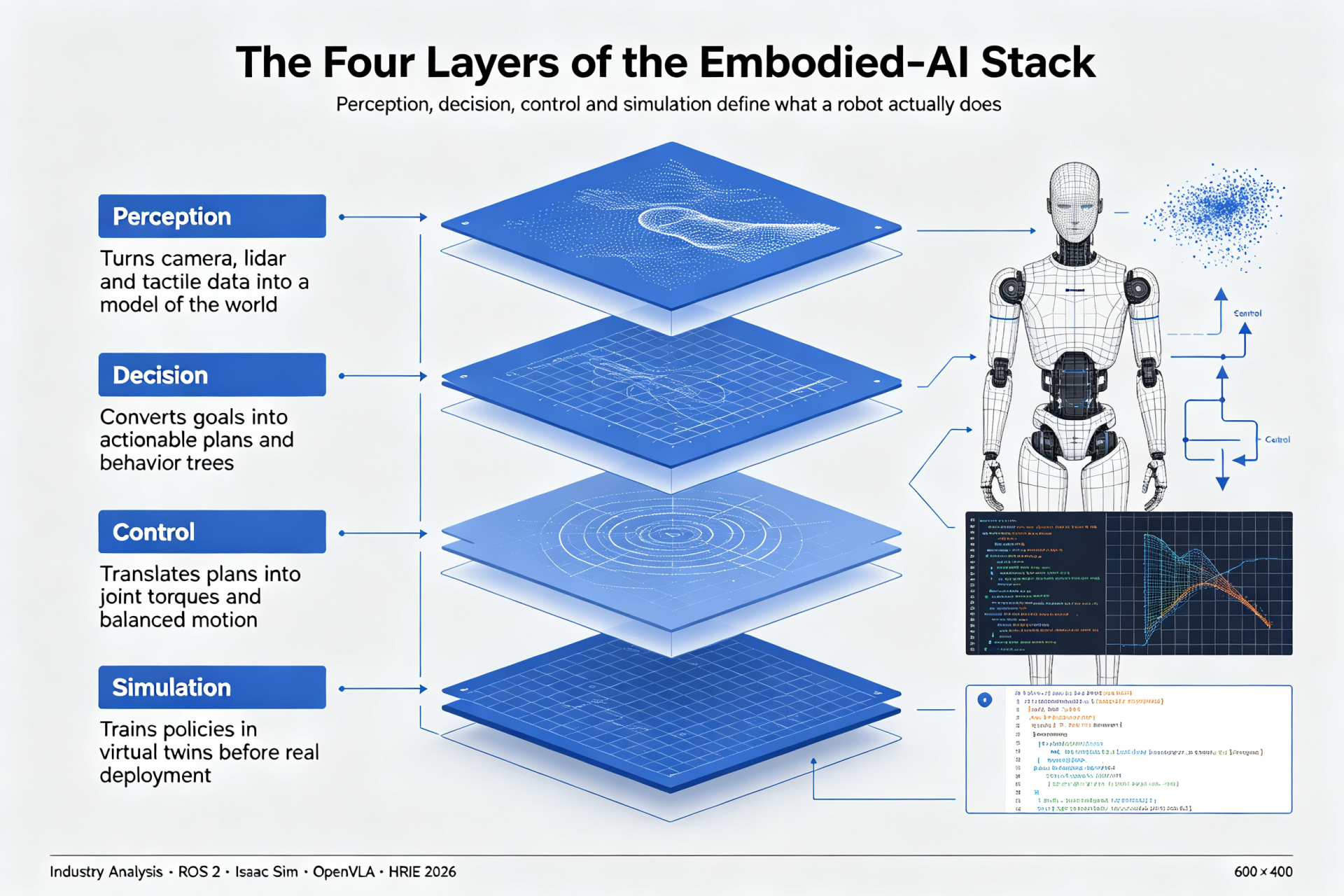
A useful way to understand the humanoid software stack is to split it into four relatively well-defined layers, each with its own tooling and open-source gravity.
Perception. This is the robot's senses: cameras, lidar, force-torque, and tactile inputs are turned into a model of the world. The workhorse libraries remain OpenCV and the Point Cloud Library (PCL), with SLAM providing localization and mapping. Object detection still leans heavily on YOLO-class models. In 2026, the notable change is that perception is increasingly fused with learned models rather than hand-tuned classical pipelines—but the classical backbone is still very much in production.
Decision. Once the world is perceived, the robot must decide what to do. Behavior Trees remain the pragmatic backbone for reactive, debuggable control flow, while task planning handles longer-horizon goals. The big new ingredient is the LLM semantic interface: a natural-language layer that lets a human say "put the cup next to the plate" and have it decomposed into a plan. According to publicly disclosed research, this interface is where much of the recent excitement—and much of the remaining unreliability—lives.
Control. This is where physics meets code. Libraries such as Pinocchio and RBDL handle rigid-body dynamics; whole-body control (WBC) and model predictive control (MPC) turn a plan into joint torques that keep the robot balanced while it reaches, lifts, or walks. This layer is unforgiving: a control bug does not produce a wrong answer, it produces a fallen robot.
Simulation. Gazebo, NVIDIA Isaac Sim, and MuJoCo provide the virtual twins in which locomotion and grasping are trained before a single real motor moves. Simulation is not a layer in the deployment sense—it is the factory in which the other three layers are born. Humanoid-Gym and Isaac Gym standardized large-scale parallel training, making it possible to evolve policies across thousands of virtual bodies at once.
If the stack is the soul, the robot OS is the nervous system that carries it. The middleware conversation used to be simple: ROS (Robot Operating System) won. But according to industry analysis, ROS 2—while still the de-facto standard commercial vendors court developers with—is now evolving, and being challenged, along four axes: toward deterministic real-time kernels, native support for end-to-end neural networks, edge–cloud coordination, and safety isolation so that a misbehaving AI module cannot crash the whole machine.
Notably, Unitree's G1 ships with native ROS 2 support, a sign that even aggressive commercial vendors treat ROS 2 compatibility as table stakes for the developer community. But 2026 is also the year of serious alternatives, and several of the most interesting come from China.
OpenLoong is a ROS 2-based system with humanoid-specific modules and an active community—essentially the open, collaborative end of the spectrum. M-Robots OS, built on OpenHarmony, claims sub-microsecond (under 1μs) hard-real-time multi-machine coordination and a ROS-compatible protocol stack, targeting the kind of deterministic, distributed control that factory floors demand. COSA, from LimX Dynamics, is positioned for embodied agents with cross-time and cross-modal memory, an attempt to give robots a persistent sense of context. And QwikOS is described as China's first general-purpose humanoid OS with an app store and standard-SDK compatibility—the clearest play at an "ecosystem" posture rather than a mere runtime.
The pattern is clear: the OS layer is fragmenting between open ROS 2 derivatives and vertically integrated, safety- and ecosystem-oriented challengers. That fragmentation is healthy competition, but it also raises the stakes for whoever becomes the default.
No single actor is betting more on the software layer than NVIDIA. At GTC Taipei (June 1, 2026), NVIDIA unveiled the Isaac GR00T Reference Humanoid Robot—the first open humanoid reference design on Jetson Thor plus the Isaac GR00T open platform. The design integrates a Unitree H2 Plus body with Sharpa tactile five-finger hands (75 total degrees of freedom), runs on Jetson AGX Thor (a Blackwell GPU delivering roughly 2,070 FP4 TFLOPS), and bundles the Isaac GR00T stack: teleoperation tooling, open foundation models including GR00T N1.6 VLA, Isaac Sim and Isaac Lab, Isaac ROS, and OSMO cloud orchestration.
Crucially, this is not a product so much as a platform invitation. According to publicly disclosed adoption information, the reference design has been taken up by Ai2, ETH Zurich, the Stanford Robotics Center, and UC San Diego. NVIDIA explicitly positions Isaac as the "Android-level full-stack" for general robotics—a complete vertical from silicon to simulation to models, with an app-store-like distribution model implicit in the cloud orchestration.
The strategic logic is powerful. By owning the training stack (Isaac Sim/Lab), the inference silicon (Jetson Thor), and the model layer (GR00T), NVIDIA aims to be the layer every other humanoid builder compiles against. If that succeeds, the robot body becomes a commodity chassis and the value accrues to the stack—exactly the dynamic that defined the smartphone era.
Simulation alone is not enough; the policy has to survive contact with the real world. In 2026, according to industry analysis, the bottleneck shifted from simulation fidelity—making the virtual twin look right—to efficient Sim2Real transfer and cross-embodiment generalization, i.e., training a policy once and having it work across different robot bodies. Humanoid-Gym and Isaac Gym made large-scale training routine; the hard part now is transfer and reuse.
This is where open data changes the game. Google DeepMind, together with 21 institutions, released Open X-Embodiment—more than 1 million real robot trajectories spanning 22 embodiments and 527 skills. That corpus spawned OpenVLA, a 7-billion-parameter open vision-language-action model. Meanwhile, Hugging Face's LeRobot has lowered the barrier to end-to-end learning to the point that a developer can download OpenVLA, fine-tune it with LeRobot, and deploy it to their own hardware—what some have described as a "ChatGPT-grade physical brain" available off the shelf.
The implication is stark: the moat is moving from proprietary data hoards toward the ability to use shared data well, and from closed models toward open, fine-tunable foundations. For smaller humanoid startups, that is liberating. For incumbents who bet on walled gardens, it is a warning.
Platforms win through network effects, and robotics is no exception. The virtuous loop is straightforward: more users produce more models and data, which makes the platform better, which attracts more users. According to industry analysis, the humanoid industry in 2026 sits at an inflection comparable to the eve of Android and iOS—a moment when the default platform is still contestable and the developer ecosystem is the prize.
China's opening is a defining part of this story. The surge of domestic OS efforts—OpenLoong, M-Robots OS, COSA, QwikOS—combined with the country's dense manufacturing base and fast-iterating hardware startups, creates a large, hungry audience for an open, localizable robot-software stack. At the same time, NVIDIA's GR00T reference design pulls global talent into a single, well-documented pipeline. The result is a rare overlap: open platforms, plentiful hardware, and a developer community all maturing in the same window.
For builders deciding where to invest, the lesson of 2026 is that software is not a follow-on task to hardware—it is the product. The team that picks the right stack, contributes to the right OS community, and rides the open-data wave will define what a "humanoid application" even means. The teams that treat software as plumbing will, sooner or later, become chassis suppliers to someone who didn't.
The software stack, the robot OS, and the developer ecosystem will be a technical focal point at the Shanghai International Humanoid Robot and Robotics Industry Chain Exhibition 2026 (December 9–11, 2026, at the National Exhibition and Convention Center, SNIEC, Shanghai), where the contenders for the industry's "Android moment" will be on display side by side. For anyone placing a bet on the next decade of robotics, HRIE 2026 is where the soul of the machine—not just its shell—will be on the table.