
Zhejiang Robot Industry Association
Zhejiang University Robotics Institute
Golden Conference & Exhibition Group
Hangzhou Wisdom Source Exhibition Co., Ltd.
Hangzhou Sequoia Exhibition Co., Ltd.
For three days in 2025, the first World Humanoid Robot Games felt like a glimpse of the future delivered early — robots sprinting, tumbling, and occasionally face-planting in ways that thrilled crowds but left investors wondering whether any of it would ever matter. One year later, the sequel arrived with a different brief. The 2nd World Humanoid Robot Games ran August 22–26, 2026 at the National Speed Skating Oval, the "Ice Ribbon" , in Beijing — and the question on everyone's mind was no longer "can it move?" but "can it work?"
The scale alone signals a maturation of intent. According to official organizers, the 2026 edition drew 666 teams from 16 countries across six continents, fielding 2,056 robots across 51 events and 1,301 matches. Team count grew 138% over the first edition, while the robot count roughly quadrupled. The format itself stretched from 3 days and 6 competitive units in the inaugural games to 5 days and 9 units this year — a telling expansion that reflects not just more participants, but a deliberately broader canvas of capabilities being tested.
The most revealing change in 2026 was not the size but the scoring. Organizers tilted the entire rulebook toward "full autonomy" and "utility." All track and other competitive events had to be completed fully autonomously — no puppeteer behind the curtain. In scenario events, the weighting was even more pointed: autonomous completion carried a coefficient of 1.0, while remote control was discounted to just 0.5. In plain terms, a robot steered by a human was worth half as much as one that solved the problem on its own.
This was a deliberate philosophical shift. The judging bar moved from "can it perform the motion" to "can it adapt to the environment autonomously." A robot that executes a perfect scripted routine is a demo; a robot that recalculates when the floor is slippery, the light changes, or a teammate bumps it is a worker. The Games quietly stopped rewarding choreography and started rewarding robustness — the unglamorous quality that separates a trade-show curiosity from a deployable machine.
Industry observers note that this framing matters because it reframes failure. In a showmanship model, a fall is a blooper. In a utility model, a fall is a data point — evidence about balance, torque margins, and recovery algorithms that engineers will mine for months. The 2026 Games was built, in other words, to produce engineering intelligence, not applause.
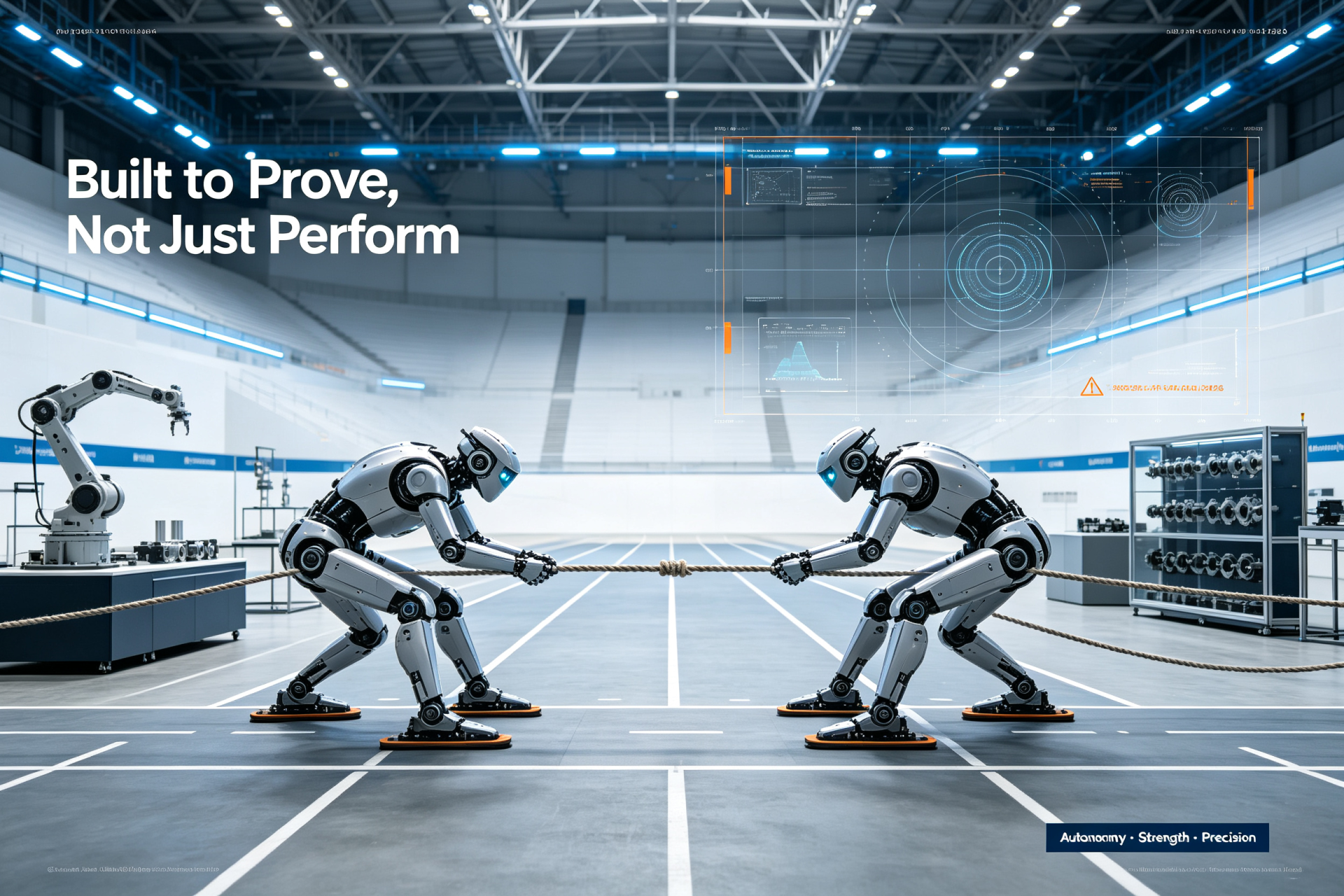
The 2026 program introduced a roster of high-intensity events designed to stress the very systems that matter in the field: long jump, weightlifting, 2-vs-2 tug-of-war, and table tennis. These are not parlor tricks. Long jump and weightlifting test torque stability and force sensing — the difference between a robot that can lift a box and one that can lift it without toppling. Tug-of-war between two teams of two robots tests multi-robot coordination under contested, unpredictable loads. Table tennis, deceptively, is a master class in autonomous AI decision-making: tracking a fast, spinning projectile and returning it demands real-time perception and motion planning that translate directly to sorting, intercepting, and manipulating in dynamic environments.
Reports indicate the scenario events — the closest thing the Games has to a job interview — grew from 6 to 21, and they were mapped tightly to real pain points. Assembly feeding, housekeeping, fire and rescue, and library sorting were all on the bill, each selected to target what organizers in China have long summed up as the scenarios: the tedious, dirty, dangerous, and difficult work that humans would rather delegate. Within the dexterous-hand events, the tasks were almost absurdly precise — powder weighing, tweezers bean-picking, bottle and cap opening — all engineered to test whether a robot can "see clearly, hold steadily, do precisely." That triad is the literal job description for countless factory and lab roles.
A games is only as serious as the people it attracts, and the 2026 field was strikingly industrial. According to official organizers, participants included 157 enterprises and 200 universities and research institutes. Domestic representation was anchored by 641 teams and 1,975 robots, including 27 of China's elite Project 985 universities. The international dimension was equally telling: the United States, Germany, and Japan — traditional robotics powers — were present, as was Brazil, which fielded five RoboCup teams competing as a national squad. In total, 24 international teams crossed borders to compete.
This is the detail that separates the 2026 Games from a science fair. Component vendors, investors, and application service providers all gathered in the same venue as the athletes. The event functioned as an industry "salon" for the whole ecosystem — a place where a dexterous-hand startup could watch its gripper win a bean-picking event in the morning and field an order inquiry by lunch. Organizers framed the logic bluntly: robots that "win a medal get an order; leave the arena and enter the field" . The medal is not the product; the medal is the proof.
There is a longer game here, too. Some competition rules are expected to evolve into practical technical acceptance standards — what organizers describe as "set standards by competition, drive production by standards". If a robot must clear an autonomous housekeeping benchmark to score at the Games, that same benchmark becomes a procurement checklist for a hotel or hospital. The competition, in effect, writes the spec sheet the industry will buy against.
Among the most watched entrants was the Beijing Humanoid Robot Innovation Center, which entered 4 robots across roughly 40 events — from the 100 m and 1,500 m races to tug-of-war, weightlifting, and emergency scenarios. These robots ran on the center's "Huisi Kaiwu" platform, an embodied-AI system explicitly aimed at future logistics, disaster relief, housekeeping, and supermarket restocking.
The choice of events is the strategy. A 1,500 m race is a stress test for endurance and thermal management. Tug-of-war is a proxy for coordinated load handling. Emergency scenarios are rehearsals for disaster relief. None of these are about impressing a crowd; they are about de-risking deployment. When a platform can survive a 5-day, 40-event gauntlet, it has produced exactly the kind of evidence a logistics operator or a municipality needs before signing a contract.
The Games did not happen in a vacuum. The 2026 Humanoid Robot Industry Development Report, released alongside the event, states that in the first half of 2026, China's humanoid robot shipments exceeded 40,000 units, with the country's global share further rising to 97%. Those figures reframe the entire conversation: this is no longer a research niche but a manufacturing volume business, and the Games is the quality-control layer on top of that volume.
Zhang Feng of the China Electronics Society captured the shift in a single line that circulated widely during the event: humanoid robots are "evolving from moving on stage and running on the field, to being used in homes and working in factories." It is a tidy summary of the arc from 2025's novelty to 2026's utility — and a reminder that the arena was always meant to be a waystation, not a destination.
For all the momentum, the closing tone on August 26 was measured rather than triumphant. The narrative had shifted from "sci-fi made real" novelty toward what some called a "performance-tempering" real exam — a grueling, public stress test rather than a victory lap. Some skeptics still dismiss the machines as "big toys," pointing to the occasional stumble, the gap between a controlled event and a chaotic warehouse, the unanswered questions about cost and reliability at scale.
Those skeptics are not wrong to ask. The sector is, by most accounts, in the critical climb from technology validation to scaled deployment — the hardest stretch of any new industry, where hype collides with unit economics. The 2026 Games did not pretend to have arrived. What it did was build the infrastructure for arrival: standardized tests, a procurement-minded audience, and a public record of what these machines can and cannot yet do.
That infrastructure is exactly what the next chapter will showcase. The robots that proved themselves in Beijing's "Ice Ribbon" will soon graduate to a broader audience at the Shanghai International Humanoid Robot and Robotics Industry Chain Exhibition 2026, held December 9–11, 2026, at the National Exhibition and Convention Center (SNIEC), Shanghai. Where the Games tested utility through competition, HRIE 2026 will display the same machines graduating from the arena to real deployment — on the expo floor, in front of the component vendors, integrators, and end users who will decide whether the medal translates into an order.
The throughline is now clear. The 2026 World Humanoid Robot Games was less a circus than a benchmark — a procurement pipeline dressed as a sporting event, pulling humanoid robots out of the demo loop and into the field where the work actually is. The showmanship has not disappeared; it has been put to work.