

Zhejiang Robot Industry Association
Zhejiang University Robotics Institute
Golden Conference & Exhibition Group
Hangzhou Wisdom Source Exhibition Co., Ltd.
Hangzhou Sequoia Exhibition Co., Ltd.
When a building collapses, when a mine tunnel threatens to cave, when a reactor overheats or a river breaches its banks, the first instinct has always been to send in people. That instinct is changing. Across China and beyond, humanoid and quadruped robots are moving from research labs into the places where the margin for human error—or human fragility—is zero. Firefighters, miners, nuclear technicians, and disaster-response teams are increasingly being backed, and in some cases replaced, by machines designed to go where it is simply too dangerous to send a person.
This shift is not a distant science-fiction forecast. According to publicly available information, multiple deployments are already live in 2026, with procurement orders signed and city-scale rollouts underway. The momentum will be on full display at the Shanghai International Humanoid Robot and Robotics Industry Chain Exhibition 2026, held December 9–11, 2026, at the National Exhibition and Convention Center (SNIEC), Shanghai, where hazardous-environment platforms are expected to be among the most-watched exhibits.
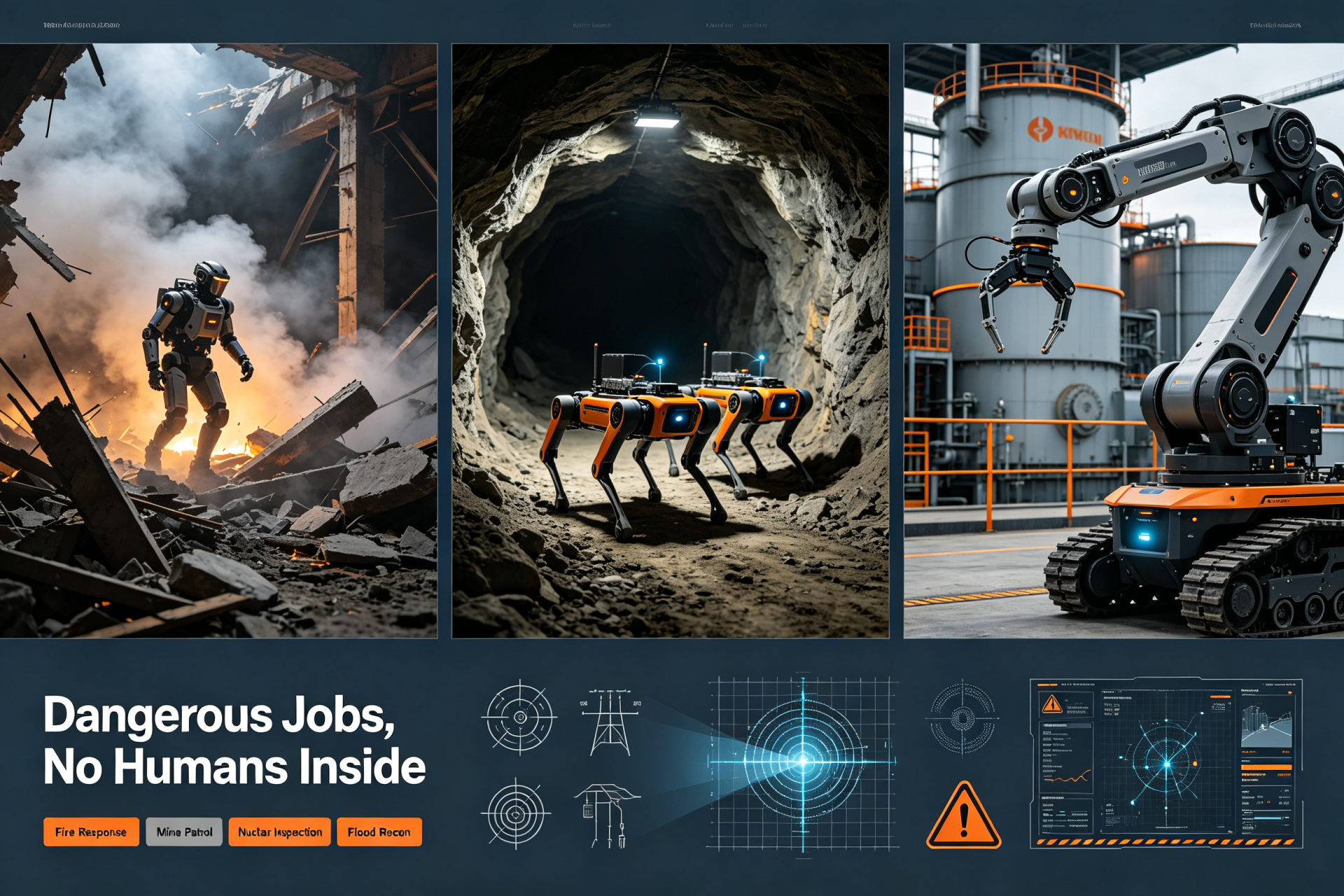
Fire has always been among the most unforgiving environments for human responders. Smoke, heat, structural instability, and toxic gases combine to make even routine rescues a matter of survival. Robotics makers are now targeting exactly this window of vulnerability.
The firefighting humanoid "Linglong" (灵龙) is built to traverse rubble and collapsed structures in search-and-rescue operations, navigating terrain that would slow or immobilize wheeled platforms. Its value is not raw strength but reach: it can get into the gaps and voids of a fallen building where a human rescuer risks being trapped themselves.
At the higher end of thermal tolerance sits the "Tiangong" (天工) firefighting robot. Industry reports suggest Tiangong can operate in roughly 800°C, smoke-filled, high-temperature environments—conditions in which a human would have seconds, not minutes. Notably, according to publicly available information, Tiangong has already secured bulk procurement orders and is planned for deployment across 20 cities during 2026. That is not a pilot; it is a procurement-backed scale-up, the kind of signal that indicates a technology has crossed from demonstration to operational use.
The pattern here is consistent: robots are not replacing the judgment of incident commanders, but they are absorbing the first, most dangerous penetration into a hazard zone.
Mines have long been among the deadliest workplaces on earth, and routine inspection—walking tunnels, checking equipment, watching for gas or instability—still requires people to go deep underground. China Minmetals has moved to change that, deploying quadruped patrol robots in underground mines for routine tunnel and equipment inspection. The stated aim is straightforward: reduce the number of personnel who have to go underground at all.
The quadruped form factor matters. Legged platforms handle uneven rock, stairs, and debris far better than wheels, and they can hold station and scan with sensors where a fixed camera cannot. By shifting routine patrols to machines, operators keep human workers above ground for the tasks that genuinely require human cognition—and reserve the deep, dangerous descent for genuine emergencies.
XCMG's mine-rescue robot pushes further into the active emergency. With a 5-ton-class digging force, it can breach and clear obstacles, and it is reported to operate underwater for roughly two hours—useful for breaching, clearing, and water search in flooded or partially submerged workings. That combination of brute force and amphibious endurance is exactly what a trapped-miner scenario demands in the first critical hours.
Few environments punish error like a nuclear facility. Radiation, heat, and the catastrophic cost of a mis-turned valve make nuclear the natural home for high-precision robotics.
Boston Dynamics' Atlas has, according to public reports, entered nuclear-power scenarios, with reported operation precision on the order of 0.1 mm. That tolerance is what valve operation and equipment inspection inside a plant demand. Plans cited in industry reporting aim to cover ten power stations by 2028, focusing on valve operation and equipment inspection—repetitive, high-consequence tasks where a robot's consistency is an asset rather than a liability.
Domestic efforts are also accelerating. A roughly 4-meter liquid-electric hybrid-drive super-humanoid is reported to be under development for extreme environments such as nuclear power and the deep sea. The scale and hybrid actuation suggest a platform built less for agility than for sustained operation in punishing conditions where cooling, buoyancy, and force all matter at once.
On the grid side, Zhongke Chuangkai's power-inspection robot offers a concrete productivity case. At 500 kV external-line inspection, according to reported figures, it reduces required manpower by about 70% and improves response speed by about 85%. Those numbers point to a dual win: fewer lineworkers exposed to live high-voltage infrastructure, and faster detection of faults before they cascade.
When water rises, the problem shifts from heat and radiation to uncertainty—where are the trapped people, which roads are passable, how do responders stay in contact when the network is down.
Deep Robotics has fielded a cluster of relevant platforms: the DR02, the AI "Flood Warrior," and reconnaissance-and-communication robots used in flood and emergency response. Their roles split cleanly—water patrol to monitor rising levels and swept terrain, trapped-person reconnaissance to locate survivors without sending a team into unstable flood zones, and emergency communications relay to restore the link between isolated responders and command. In a disaster, restoring comms is often the difference between a coordinated rescue and a blind one.
Runke Juneng has taken a different architectural bet: a centaur-form robot paired with a Mars-rover scheme, combining dexterous manipulation with wheeled mobility. The centaur layout—an upper body for handling, a wheeled or hybrid lower body for stability and range—is a pragmatic answer to the tension between "can it manipulate" and "can it move far." For disaster sites that mix debris, distance, and delicate tasks, that hybrid may prove more useful than a pure biped or a pure rover.
The most extreme deployment frontier is the one with no atmosphere at all. A domestic space-capsule maintenance robot is expected to enter service in 2027, handling extravehicular inspection and maintenance to reduce the frequency of astronaut EVAs (extravehicular activities). Every EVA is a risk-laden event—micrometeoroids, suit failure, tether loss—so offloading routine inspection and servicing to a robot directly protects human life while extending the useful work a crew can do.
Closer to home, the aerospace "Renma Xianfeng" rescue robot is positioned for special-scenario emergency response. The centaur designation again signals a design philosophy: a stable, manipulative platform for the awkward, high-stakes environments that defy simple automation.
Earlier generations of rescue and inspection robots tended to be bespoke, teleoperated, and narrow. What is changing in 2026 is the convergence of four trends: legged mobility that handles real terrain, dexterous hands that can actually manipulate valves and tools, improving onboard autonomy that reduces the need for a skilled operator tethered by line-of-sight, and—critically—procurement. The Tiangong orders, the China Minmetals deployments, and the reported Atlas station roadmap all indicate that buyers, not just labs, now believe these machines are ready.
There are, of course, caveats. Public reporting on precision figures, deployment counts, and timelines should be read as indicative rather than guaranteed; real-world hazard response is messy, and a robot that shines in a demo can struggle in a smoke-filled, structurally unsound, radiation-shaded reality. Interoperability, operator training, and failure modes in life-safety contexts remain open engineering and regulatory questions. None of that erases the direction of travel, however.
The clearest near-term window into this sector will be the Shanghai International Humanoid Robot and Robotics Industry Chain Exhibition 2026 (HRIE 2026). The show is expected to showcase exactly the platforms described above—firefighting humanoids, mine and nuclear inspectors, flood-response quadrupeds, and aerospace maintenance concepts—giving operators, procurement officers, and researchers a single place to compare capabilities side by side.
For an industry still defining its standards, that kind of concentrated, public comparison matters. It is one thing for a robot to be described in a press release; it is another for it to stand next to its competitors on a show floor, under the eyes of the people who would actually send it into the fire. If the 2026 deployments hold to their schedules, HRIE 2026 may be remembered as the moment hazardous-environment robotics stopped being a promise and started being a procurement category.