

Zhejiang Robot Industry Association
Zhejiang University Robotics Institute
Golden Conference & Exhibition Group
Hangzhou Wisdom Source Exhibition Co., Ltd.
Hangzhou Sequoia Exhibition Co., Ltd.
The humanoid robot, for years a fixture of science-fiction imagination and research-lab demos, is suddenly becoming a product. Prices that once sat in the millions of yuan are collapsing toward the cost of a mid-range electric car — and in some cases a high-end smartphone. The force behind this abrupt translation from prototype to commodity is not, for the most part, a breakthrough in robotics itself. It is something more mundane and more powerful: a decade of Chinese new-energy-vehicle (NEV) mass manufacturing, now being redeployed into a new machine.
Research firm TrendForce has captured the shift with a phrase that is quickly becoming shorthand for the whole thesis — "From EVs to Robots." The argument is simple. A ten-year sprint in NEV volume production has quietly built up a capability base — design know-how, manufacturing process, quality control, supplier networks, and engineering talent — that humanoid robots can now inherit almost directly. The car is no longer just a customer for robotics; in China, the car is becoming the robot.
It is worth being precise about why this crossover works now and not five years ago. The NEV boom did not merely produce cars; it produced a vast, cost-optimized supplier ecosystem — battery cells, traction motors, precision reducers, controllers, camera modules, wiring harnesses, and the engineering teams that integrate them at scale. When humanoid demand arrived, that ecosystem did not have to be invented. It was already there, hungry for new volume, and it absorbed the robot industry almost overnight. The hidden engine behind the humanoid cost collapse is not a new algorithm. It is the accumulated, unglamorous capability of making complicated electro-mechanical products cheaply, reliably, and at scale — and the willingness of automakers to point that capability at a new product.
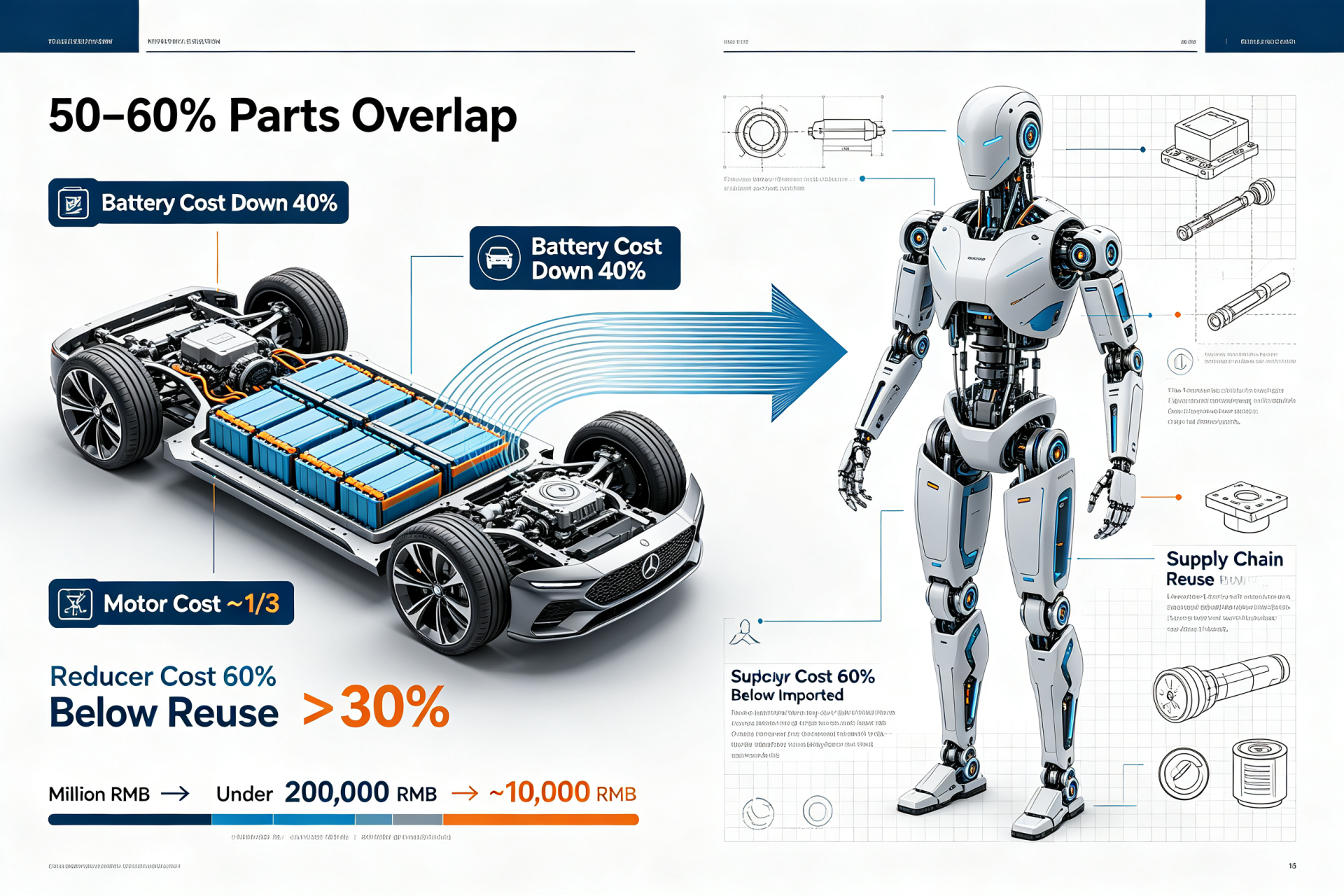
The numbers from 2026 are striking. At the 2026 World Robot Conference, humanoid robot pricing dropped sharply across the board. Consumer-grade models now appear at around 10,000 RMB, while mainstream industrial models fell from the million-RMB range to under 200,000 RMB. Public reports suggest Chinese humanoid robot prices have broadly fallen into the ~30,000 RMB band. Unitree's G1 starts at 85,000 RMB, while Songyan Dynamics' Bumi is priced at 9,998 RMB — a figure that, a few years ago, would have bought little more than a single robotic actuator.
This is not a cosmetic discount. The drop is structural, driven by the reuse of components and supply chains that were engineered for automobiles at enormous scale and brutal cost pressure. According to industry estimates, parts overlap between NEVs and humanoid robots now sits at roughly 50–60 percent, and supply-chain reuse contributes over 30 percent to the total cost reduction seen across the category.
What makes the move significant is the reference point it breaks. For most of the past decade, a capable humanoid was a six-figure-dollar research instrument, affordable only to labs and a handful of deep-pocketed industrial pilots. Crossing below 200,000 RMB for an industrial unit — and toward five figures for a consumer-class machine — moves the conversation from "can it walk" to "where do we deploy a hundred of them." That is the threshold at which total cost of ownership, rather than sticker shock, starts to govern buying decisions, and it is the threshold at which robots begin to compete with human labor on the factory floor.
The clearest evidence for the "From EVs to Robots" thesis is the lineup of car companies that have shipped, or are shipping, humanoids built on their own automotive foundations.
Xiaomi's "Iron" directly reuses Xiaomi Auto's power-battery solution, in-vehicle servo motors, and vision-perception supply chain. The robot is, in effect, a dressed-down car platform on two legs. Xpeng's IRON goes further on the electronics side: it uses the same Turing AI chip and XNGP eagle-eye vision system as Xpeng cars, while batteries and motors come from automotive-grade supply chains. As reported, about 70 percent of its technology is reused from the automotive business. Chery's "Moja" fully adopts Chery Auto's supply chain and, according to public reports, delivered over 2,000 units globally within 18 months of founding — a pace that would have been unthinkable without an existing auto-parts network behind it.
These are not one-off experiments. Over 10 automakers have now entered the humanoid robot field. The strategic logic was stated bluntly by BYD's Wang Chuanfu, who argued that "vehicle intelligence is embodied intelligence" — the same AI, sensing, and actuation stack that makes a car drive itself can make a robot walk and work.
The pattern repeats because the economics repeat. Once a carmaker has already amortized the development of a battery pack, a motor family, a vision stack, and a chip, dropping those into a humanoid is a sourcing decision, not a research program. The marginal cost of entry is low, the time-to-market is short, and the supplier relationships already exist. That is why the "From EVs to Robots" movement looks less like a coalition of believers and more like a rational reallocation of existing assets — assets that happen to be perfectly shaped for a two-legged machine.
The trickle-down of automotive component solutions is where the savings get concrete. The deployment of automotive LFP (lithium iron phosphate) battery solutions into robots cut robot battery cost by over 40 percent, according to industry estimates, while at the same time improving operating range. Automotive motor suppliers now serve robots at roughly one-third the cost of traditional bespoke robotics solutions. Domestic core-component localization has exceeded 70 percent, and BYD's self-developed reducers cost about 60 percent less than imported equivalents.
This matters because the cost of a humanoid robot is overwhelmingly a bill-of-materials problem. Arms, legs, torso, and head are collections of motors, reducers, batteries, sensors, and controllers. When those parts already exist in automotive volumes — and when the factories that make them are running at NEV scale — the marginal cost of a robot part falls toward the marginal cost of a car part. The supply chain, not the lab, is doing the cost engineering.
Localization deepens the advantage. With domestic core-component localization exceeding 70 percent, Chinese robot makers are less exposed to the long lead times and currency swings that burden imported bespoke parts. BYD's self-developed reducers, costing about 60 percent less than imported equivalents, are a representative example: a component that was once a specialty import is now a domestically produced, volume-priced line item. The more of the bill of materials that can be sourced inside the existing NEV ecosystem, the less the robot pays the "robot tax" of low-volume specialty manufacturing.
There is a second-order effect worth noting. As robot volumes climb, they in turn pull automotive suppliers toward even higher scale, which feeds back into lower car-part costs — a reverse trickle that strengthens the original NEV base. The two industries are not in a one-way handoff but in a reinforcing loop, and that loop is precisely what makes the Chinese humanoid cost curve look durable rather than promotional. Competitors importing bespoke parts cannot easily replicate a feedback cycle that is, at its core, a manufacturing-volume story.
Beyond price, the NEV crossover is changing what a "production robot" can be trusted to do. Automotive-grade standards — for instance, motors specified to remain stable from -40°C to 85°C — are reshaping robot reliability and pushing up the mass-production ceiling. A component qualified to survive a car's lifetime under the hood does not flinch at a factory floor.
Xpeng's full-chain mass-production base targets scaled production by the end of 2026. That framing is important: the bottleneck for humanoids was never the idea, it was the factory. Bringing automotive-grade process discipline — SPC, traceability, supplier audits, line balancing — to robot assembly is what converts a press-release prototype into a unit that ships by the thousand.
The reliability dividend is not only about uptime. Automotive qualification also forces documentation, failure-mode analysis, and batch-level consistency that the robotics startup world historically skipped. A motor rated for -40°C to 85°C has already survived thermal cycling, vibration, and salt-fog testing that a lab actuator never faced. When that part lands in a robot, the robot inherits a decade of field learning from the road. The result is a machine that can be warrantied, serviced, and recalled in the same disciplined way a car can — the unglamorous prerequisites for true mass production.
The loop closes neatly. The same auto industry supplying robot parts is also the first and largest customer for the robots themselves, creating a "scenario validation → optimization → mass production" flywheel. CATL's battery lines already have humanoid robots working in batches. BYD's humanoids entered deep validation at its Zhengzhou base in August, and UBTECH's Walker S2 achieved a 47 percent single-process efficiency gain at a BYD factory — a concrete data point showing the validation loop paying off in real throughput.
For automakers, the timing is strategic as well as technical. National Bureau of Statistics data shows China's auto industry profit margin fell to 3.2 percent in Q1 2026, squeezing the very manufacturers best positioned to build robots. With vehicle margins compressing, carmakers are actively seeking a second growth curve, and humanoids — built on the capabilities they already own — are the obvious candidate.
The validation loop also de-risks the next generation. Every hour a Walker S2 or a BYD unit spends on a real line generates motion, torque, and failure data that a show-floor demo never will. That data flows back into actuator design, balance control, and battery sizing, tightening the gap between what a robot is promised to do and what it reliably does. In this sense the auto industry is both the supplier and the toughest customer of the robot industry — and the pressure of the factory floor is exactly what turns a clever machine into a dependable tool.
The convergence is broad enough that no single company tells the whole story — it runs from cells to chips to complete machines. That is exactly the appeal of an event built around the complete industrial chain rather than a single product category. The Shanghai International Humanoid Robot and Robotics Industry Chain Exhibition 2026, held December 9–11, 2026, at the National Exhibition and Convention Center (SNIEC), Shanghai, is positioned on precisely this "full industry chain" framing: battery and motor suppliers, reducer makers, vision and AI-chip vendors, and the automakers-turned-robot-makers all under one roof. For anyone trying to understand how NEV manufacturing capability is crossing over into humanoids, HRIE 2026 is the ideal stage to watch the synergy play out in person — and to see whether the cost curve has further to fall.