
Zhejiang Robot Industry Association
Zhejiang University Robotics Institute
Golden Conference & Exhibition Group
Hangzhou Wisdom Source Exhibition Co., Ltd.
Hangzhou Sequoia Exhibition Co., Ltd.
China now hosts what is widely described as the world's most dynamic humanoid robot ecosystem. Industry estimates suggest there are more than 200 original equipment manufacturers (OEMs) working on humanoid or embodied-intelligence hardware, a figure that would have seemed fanciful only a few years ago. What is striking is not merely the count but the geography: roughly 56% of these firms are concentrated in just three cities — Beijing, Shanghai, and Shenzhen — with Hangzhou rising fast as a fourth pole.
The timeline matters. 2025 was widely called China's "mass production year" for humanoids, the moment when prototypes began shipping in non-trivial volumes. 2026 is now being framed as the "scenario landing year" — the period in which these machines are supposed to stop being conference attractions and start doing useful work in factories, labs, and public spaces. The shift in vocabulary, from production to scenarios, signals a maturation of expectations.
This is not happening in a vacuum. More than 21 provinces named "embodied intelligence" in their 2026 government work reports, a remarkable degree of top-down alignment for a technology still in its commercial infancy. And the momentum is visible at scale: at the 2026 World Robot Conference, held August 19–23 in Beijing's Yizhuang district, more than 300 embodied-intelligence enterprises gathered under one roof.
The pattern that emerges is one of deliberate regional differentiation — Chinese policymakers and firms call it, or "staggered development," a strategy of avoiding redundant competition. Each city is carving out a distinct role in the value chain rather than all chasing the same prize. The result is less a single national champion and more a federation of specialized clusters, each feeding the others. The concentration reflects a mix of historical industrial base, university density, local-government incentive design, and the gravitational pull of existing supply chains — where Shenzhen had contract manufacturing, robotics firms followed; where Shanghai had precision-component suppliers, integration firms collected; where Beijing had labs, the algorithms followed.
Beijing positions itself as the academic and technical cradle of the industry. Its strengths lie upstream: algorithms, motion control, and key components. This is where many of the foundational breakthroughs originate before they are industrialized elsewhere.
The roster is telling. Xiaomi, with its CyberOne humanoid, anchors a consumer-electronics giant's ambitions in embodied AI. Galbot (Geometric Robotics) has pushed boundary-pushing work in dexterous manipulation and general-purpose grasping. Robotera (Xingdong Jiyuan) has emerged as a notable startup focused on expressive, interactive humanoids. The common thread is a research-heavy DNA — Beijing's density of universities, national laboratories, and AI talent makes it the natural home for the hard problems of perception, control, and learning.
In cluster terms, Beijing is the source of the "technology" leg of the value chain. It is less concerned with being the fastest place to ship a product than with being the place where the next generation of capabilities is invented. That creates a complementary relationship with the manufacturing-focused cities to the south: breakthroughs validated in Beijing can be industrialized in Shanghai or Shenzhen.
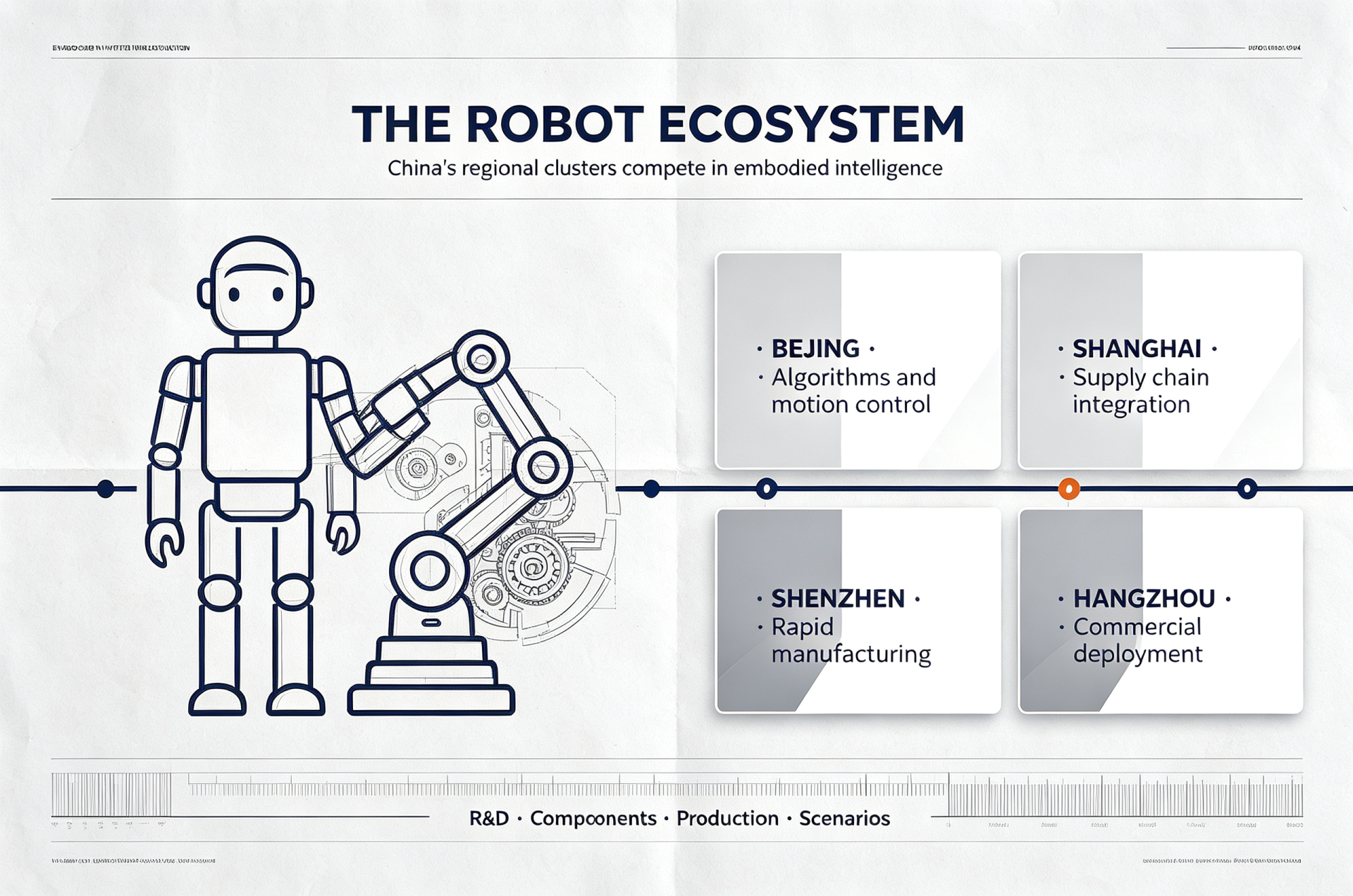
If Beijing is the cradle, Shanghai is the coordinator — the city that turns research into supply chains. Industry observers have taken to calling it "the easiest and fastest city to mass-produce" humanoid robots, and the reasons are concrete.
Within a radius of roughly 150 kilometers around Shanghai, analysts note that reportedly 100% of the needed core parts — motors, reducers, sensors, controllers — plus the relevant data resources and control algorithms, can be sourced locally. That is an extraordinary claim about industrial density, and it points to why Shanghai matters. Fourier Intelligence, with its GR-1 humanoid, is among the city's flagship whole-machine makers. ZhiYuan Robotics (Agibot) has become one of the country's most watched embodied-intelligence startups. JAKA represents the collaborative-robot and component side of the ecosystem.
The physical footprint is substantial. Zhangjiang's robot valley hosts more than 90 firms, forming a dense innovation district. Lingang, the sprawling southern manufacturing and free-trade zone, has built a roughly 20,000 square-meter test and validation base where robots can be exercised at scale before deployment. Together these assets make Shanghai the platform city — the place where a startup can find component suppliers, test infrastructure, and downstream customers without leaving the metropolitan region.
Shanghai's role is therefore integrative. It is where the "manufacturing" and "industrial ecology" legs of the closed-loop ecosystem are strongest, and where the platform logic of cluster development is most visible.
Shenzhen tells a different story — one of consumer hardware and rapid iteration. The numbers here are staggering. The city is home to more than 74,000 robot-industry firms and has surpassed 200 billion RMB in annual robotics output, reportedly ranking first in China for nine consecutive years. UBTECH, one of the country's best-known humanoid makers, is based here, and the city's supply chain is deeply integrated with Zhejiang's Unitree and Deep Robotics.
Nanshan district's "Robot Valley" has developed what locals describe as a 15-minute parts circle — roughly 90% of core components can be procured within an hour. That proximity compresses the physical distance between design and production in a way that few other places on earth can match. It is the logistical expression of Shenzhen's core advantage: not necessarily inventing the future first, but building it fastest and cheapest once the shape is known.
The policy backing is explicit. Humanoid and embodied intelligence sit within Shenzhen's "20+8" strategic industry framework, and a 10 billion RMB fund supports the sector. The operational payoff is measurable: the loop from R&D to engineering to mass production that once took around 18 months has been compressed to roughly 6–10 months. That is the difference between a technology that stays in the lab and one that reaches customers while the window is still open.
Shenzhen has also produced a telling retail innovation: the world's first robot "6S store" in Longgang, a sales-and-service outlet that reframes humanoids as consumer-durable products with warranties, service, and showrooms. Whether the consumer market is ready or not, the format signals a belief that robots will sell like electronics — and that Shenzhen intends to be where they sell first.
Hangzhou has quietly become the most interesting "fourth pole." Its signature firm is Unitree, which reportedly shipped more than 5,500 units in 2025 — a volume that places it among the global leaders. Unitree has had its STAR Market IPO approved, claims more than 90% self-made parts, and is described as the first profitable whole-machine humanoid firm, with its G1 model priced at around 99,000 RMB. Deep Robotics rounds out the city's strength in quadruped and outdoor-mobility robotics. Hangzhou's edge combines these hardware champions with the city's unmatched e-commerce and venture-capital networks, an innovation ecosystem that turns research into commercial traction quickly.
Beyond the big four, the national map is thickening. Guangdong's Foshan contributes manufacturing muscle and is associated with 10,000-unit-volume ambitions. Sichuan, centered on Chengdu, is pushing industrial embodied intelligence. Jiangsu brings a strong component and integration chain. Jilin is exploring automotive-manufacturing robotics, leveraging its existing industrial base. The picture is of a country where nearly every major economic region has been assigned — or has claimed — a robotics role.
The Chinese clustering is best understood against a global backdrop. In the United States, Figure AI and Agility Robotics have drawn the most attention, with a clear industrial and warehouse focus — humanoids and bipeds designed to move boxes and perform structured logistics tasks. The contrast in emphasis is instructive. Chinese firms, by and large, are prioritizing government, security, and consumer scenarios, where procurement paths are arguably clearer and where domestic demand is large and state-supported. Omdia reported that 2025 global humanoid shipments reached roughly 13,000 units, with the top positions held by Chinese makers — a data point that, if accurate, would confirm China's early lead in volume even as Western firms lead in certain high-value industrial niches.
But the real competition, analysts note, is shifting. It is no longer about "who has the best demo" — the flashy videos of robots walking, dancing, or folding laundry that dominated 2023 and 2024. The question is now "who builds the first fully closed-loop ecosystem": the integration of technology, manufacturing, capital, scenarios, and industrial ecology into a single functioning system. A brilliant prototype that cannot be sourced, funded, deployed, and serviced at scale is, in this framing, a dead end.
This is precisely why cities — not just companies — have become the unit of competition. A cluster that controls all five legs of the loop can out-execute a rival with a better individual robot but a thinner ecosystem. Beijing supplies the algorithms; Shanghai supplies the supply chain; Shenzhen supplies the speed; Hangzhou supplies the commercial model. The differentiation is the strategy.
The "scenario landing year" framing for 2026 captures the stakes. A demo robot proves a capability; a deployed robot proves an ecosystem. The Chinese bet is that by distributing the hard parts of the value chain across complementary cities, the country as a whole can land scenarios — in factories, care facilities, security, and homes — faster than any single company or any foreign rival attempting to build the whole stack in one place. Whether that bet pays off will depend less on engineering brilliance than on the unglamorous work of coordination, procurement, and service.
That convergence of regional strengths is what makes the coming showcase significant. The Shanghai International Humanoid Robot and Robotics Industry Chain Exhibition 2026 (December 9–11, 2026, at the National Exhibition and Convention Center (SNIEC), Shanghai) is positioned as the venue where these cluster ecosystems — Beijing's research depth, Shanghai's platform density, Shenzhen's iteration speed, Hangzhou's commercial reach, and the broader national map — will meet, compare, and converge. For international observers, HRIE 2026 offers a rare flat view of an entire national ecosystem at once: not one robot on a stage, but the full chain of who builds what, where, and why.
The city that first closes the loop will not just win a market. It will set the template for how embodied intelligence is produced at scale — and, increasingly, where.