
Zhejiang Robot Industry Association
Zhejiang University Robotics Institute
Golden Conference & Exhibition Group
Hangzhou Wisdom Source Exhibition Co., Ltd.
Hangzhou Sequoia Exhibition Co., Ltd.
For decades, the robots that captured the public imagination — the walking, grasping, human-shaped machines of film and research lab — remained stubbornly out of reach. That is changing fast. In 2026, humanoid and embodied-intelligence robots moved from demonstration videos to factory floors, logistics warehouses, and research roadmaps. But as the hardware matures, a quieter and more decisive constraint has come into view: who will build, program, and maintain these machines at scale?
The answer, increasingly, is being written inside universities. In 2026, nine Chinese universities launched the country's first batch of undergraduate "Embodied Intelligence" majors, admitted their first students, and began constructing cross-disciplinary programs that bridge mechanical engineering, control science, computer science, and artificial intelligence. The list reads like a who's who of Chinese engineering education: Harbin Institute of Technology, Beihang University (BUAA), Beijing Institute of Technology, Shanghai Jiao Tong University, Zhejiang University, Xi'an Jiaotong University, Northeastern University, Beijing University of Posts and Telecommunications, and Nanjing University of Aeronautics and Astronautics.
This is not a cosmetic rebranding of legacy robotics degrees. According to university sources, these programs were designed from the ground up to reflect how the field actually works: at the seams between disciplines that have historically trained their students separately. A humanoid robot is, after all, a control problem, a mechanical-design problem, a perception problem, and an AI problem simultaneously. Training someone to own that whole stack is the explicit goal.
The timing matters. The launch of these majors in 2026 coincides with a perceptible shift in the robotics industry from "can it move?" to "can it work?" — from research curiosities toward machines expected to perform useful, repeatable tasks in unstructured environments. That shift raises the bar on the people building them. A demo can be choreographed; a deployable robot must tolerate variable lighting, slippery floors, unpredictable humans, and the thousand small failures that never appear in a polished video. Educating for deployment, rather than for demonstration, is what distinguishes these new programs from the robotics tracks that came before.
It also reflects a maturing consensus about where value will accrue. In earlier AI cycles, talent clustered around software and models. Embodied intelligence redistributes that attention toward the physical world, where mechanics, materials, and control theory reassert their importance. The nine universities are, in effect, betting that the next generation of robotics leaders will be trained as generalists across the physical and computational domains, not as specialists in one.
What makes this first wave notable is its coordination. Rather than every school chasing the same narrow definition of "embodied intelligence," the nine institutions appear to have adopted a strategy of differentiated positioning — a deliberate or staggered layout, that plays to each university's existing strengths.
Some schools are leaning into the "body." Harbin Institute of Technology, long a powerhouse in robotics systems, brings its state key laboratory in robot technology and a track record in extreme-environment and space robots. Beihang University contributes its deep expertise in flight vehicle design and control. Xi'an Jiaotong University — the only approved school in western China — admitted a first class of roughly 30 students and built a co-training model with partners including GM, Huawei, and Unitree. Its philosophy is described as "mechanical-first, control-as-soul," a full-stack path that runs from the physical body to the computational brain. Northeastern University, meanwhile, focuses on process industries, with special robots for mining and metallurgy.
Other schools are betting on the "brain." Shanghai Jiao Tong University has built what it describes as a full chain spanning perception, decision-making, control, and body design, anchored by a four-year full-stack development core course. Notably, its graduation requirement is not a thesis alone: students must debug a working, task-executing robot before they leave. Zhejiang University is converging brain science with artificial intelligence, emphasizing an "embodied brain and human-robot interaction." Beijing Institute of Technology brings its control-science heritage to autonomous intelligent robot systems.
A third group is staking out connectivity and emerging domains. Beijing University of Posts and Telecommunications is focused on group intelligence and the "agent internet" — multi-agent communication — while Nanjing University of Aeronautics and Astronautics is linking embodied intelligence to the low-altitude economy and eVTOL autonomous control. The effect is a national portfolio: complementary, not redundant.
Capital has flooded into humanoid robotics. Prototypes have multiplied. Yet industry reports consistently flag a shortage that money alone cannot close: a lack of "software-hardware integrated" engineers. According to industry reports, the gap rate for embodied-intelligence composite talent reportedly exceeds 40 percent, with a supply-demand ratio of roughly 1:8. In plain terms, for every qualified candidate, there are about eight roles waiting. Firms describe the scarcity of engineers who can move fluently between writing control code and understanding a mechanical joint as severe.
This is the real bottleneck. A walking robot is not a software product that can be iterated entirely in the cloud, nor is it a mechanical product that can be shipped without intelligence. It demands a composite skill set that traditional degree programs were never structured to produce. As Shanghai Jiao Tong University vice dean Lu Cewu has noted, there is an urgent need for software-hardware composite talent, and the university is sharing high-end hardware platforms, datasets, and engineers with leading robotics firms to help close the gap.
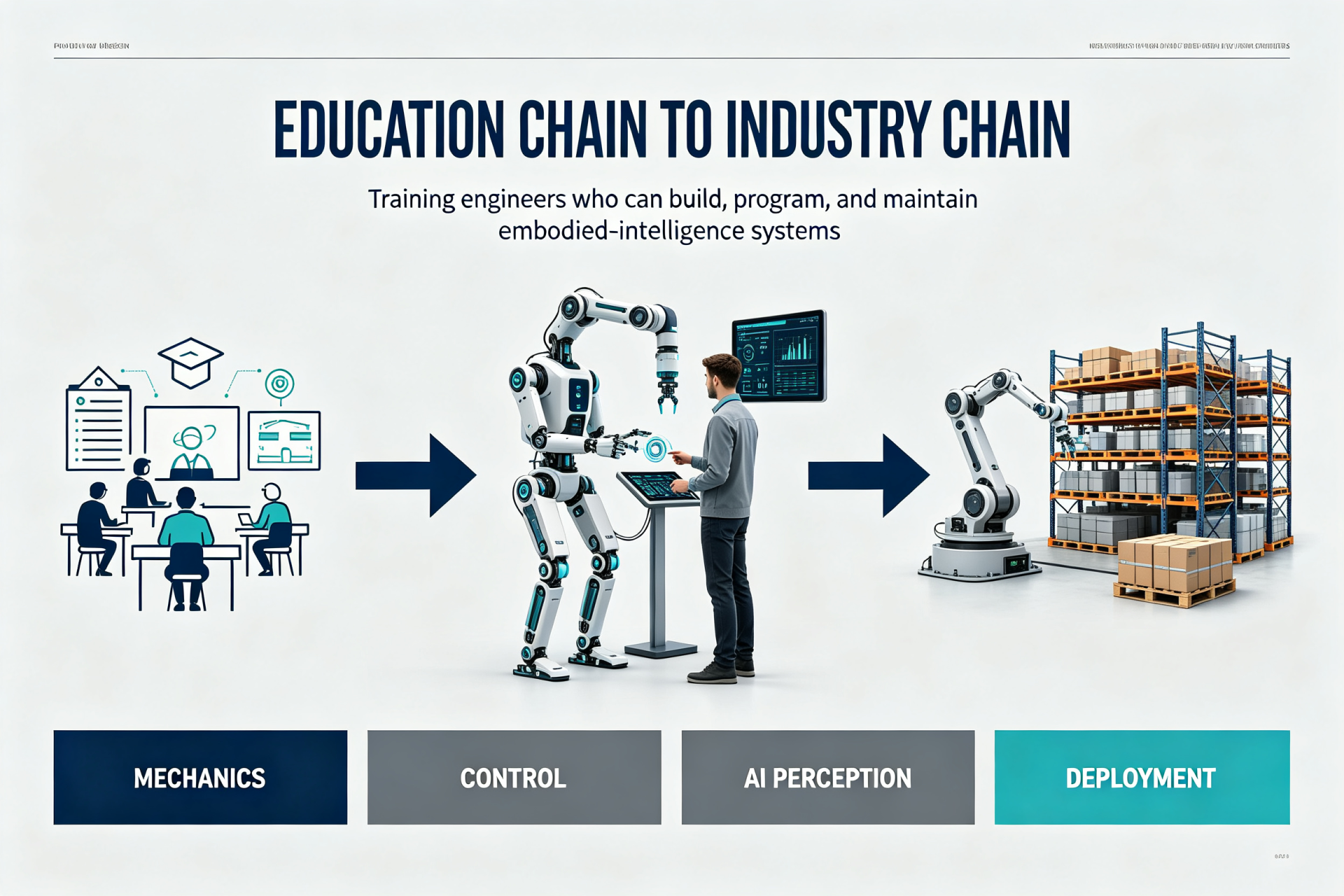
The implication is strategic. The countries and companies that scale humanoid robotics will not necessarily be those with the most capital or the flashiest demos. They will be those that solve the talent pipeline first. The logic chains together cleanly: the education chain feeds the talent chain, and the talent chain feeds the industry chain. Break the first link, and the rest stalls.
There is a second-order effect worth naming. A thin talent pool does not merely slow production; it raises the cost of every experiment. When composite engineers are scarce, each hiring decision is high-stakes, each project is understaffed, and the risk of building the wrong thing grows. Firms report that the shortage is not of coders or of mechanical designers individually, but of people who can translate between the two — who can read a control loop and a CAD assembly with equal fluency. That translation skill is precisely what the new majors are structured to produce, which is why industry partners have been willing to open their labs and datasets to universities rather than hoard them. The pipeline benefits everyone upstream.
If the diagnosis is a skills gap, the prescribed cure is pedagogy. Across these programs, a common thread is project-based, enterprise-embedded learning. Instead of treating industry as a destination reached only after graduation, the companies are pulled into the classroom: real corporate projects become coursework, competitions drive the learning loop, and industry mentors serve as tutors alongside faculty.
At Xi'an Jiaotong, the co-training arrangement with GM, Huawei, and Unitree means students are exposed to production-grade problems early. At SJTU, the requirement to graduate with a working robot turns abstract coursework into a concrete deliverable. The model borrows from the best of engineering education everywhere: you learn a robot by building one, debugging it, and watching it fail in ways no lecture can predict.
This enterprise-embedded approach also solves a quieter problem — the hardware gap. High-end robotic platforms are expensive, and few universities can match the scale of a leading robot maker's lab. By sharing platforms and engineers with industry, universities give students hands-on access to the same tools they will use on the job. That shortens the distance between a degree and productive work.
China is not alone in rethinking robotics education, and it is worth placing this wave in a wider frame. Around the world, universities are adding robotics and AI curricula, and a critical enabler has emerged that changes how students train: simulation. Platforms such as NVIDIA Isaac Sim and Isaac Lab let students and researchers train policies at scale in virtual environments before ever touching physical hardware. A robot can attempt a task ten thousand times overnight in simulation, learning from failure cheaply and safely, then transfer that learning to a real machine.
This is the international parallel to China's enterprise-embedded model. Where one approach pulls real hardware and real company projects into the curriculum, the other scales experience through simulation. In practice, the leading programs are blending both: simulated training for breadth and speed, physical robots for the messy reality of friction, latency, and uncertainty. For students anywhere, the barrier to meaningful robotics experience is lower than ever — provided the curriculum is built to use it.
The global lesson is the same as the local one. Talent scales when experience scales, and experience scales when institutions remove the cost and distance between a learner and a working robot.
The thrust of all this activity is convergence — of disciplines, of campus and company, of simulation and hardware. The "education chain → talent chain → industry chain" linkage is no longer a slogan; it is being instantiated in admissions cohorts, shared labs, and graduation requirements. The universities that launched embodied-intelligence majors in 2026 are, in effect, placing a bet on the next decade of the industry. If the bet pays off, the graduates emerging over the next four years will be among the first engineers trained from day one to think across the body and the brain.
That convergence will be on public display at the Shanghai International Humanoid Robot and Robotics Industry Chain Exhibition 2026 (December 9–11, 2026, at the National Exhibition and Convention Center (SNIEC), Shanghai). There, universities, shared research platforms, and robot makers are expected to showcase the co-built talent pipelines described above — the labs, the curricula, and the working machines that students helped bring to life. For an industry whose hardest problem is not building one impressive robot but building the people who can build many, HRIE 2026 offers a glimpse of the pipeline itself, not just the product.
The machines will draw the crowds. But the more enduring story may be the students behind them — the first generation trained to make humanoid robots not a demonstration, but a discipline.