
Zhejiang Robot Industry Association
Zhejiang University Robotics Institute
Golden Conference & Exhibition Group
Hangzhou Wisdom Source Exhibition Co., Ltd.
Hangzhou Sequoia Exhibition Co., Ltd.
For years, humanoid robots were show pieces. At the world's two biggest industry stages this year — the World Artificial Intelligence Conference (WAIC) 2026 and the 2026 World Robot Conference (WRC), held in August at Beijing's Yizhuang complex — the headlines have measurably changed. The choreographed backflips and dance routines that once defined a robot's "launch" have dropped sharply. In their place, exhibitors are running real warehouse tasks in front of buyers.
The numbers underline the pivot. According to organizers and trade press, WAIC 2026 featured 208 embodied-intelligence terminals and more than 300 first-shown machines, while WRC 2026 brought together over 300 companies and 3,000-plus products. The center of gravity has moved from "can it dance" to "can it work." As Xu Xiaolan, chair of the Chinese Electronics Society, summarized in remarks carried by Chinese industry media, the field is moving past the "small-batch trial" phase and into "large-scale deployment." That phrasing matters: in 2026 the conversation is no longer about prototype spectacle, but about repeatable shifts.
If humanoid robots are going to live inside a logistics site, their bodies have to match the building. That is why the dominant new shape in 2026 is not a bipedal walker but a wheeled base topped with a humanoid upper body — bipedal agility is sacrificed, but stability, runtime, and payload capacity are not.
Several commercial systems have converged on this layout:
AgiBot Genie G2 Max, deployed alongside JD Logistics in a real warehouse, is quoted at a single-arm payload of 18 kg, a dual-arm standard of 38 kg, and a peak of 50 kg — the kind of headroom needed to move totes and cartons around a sort aisle.
MagicAtom MagicBot D1, also a wheeled base with a humanoid torso, has been running inside a Dreame manufacturing plant. At WRC 2026, MagicAtom paired the platform with its XGZ1 humanoid for a mini-warehouse demo where 3D-vision grasping and stacking reached a reported 99% sortation success rate, according to the company.
Fourier GRW is a high-load wheeled dual-arm unit, notable for a roughly 585 mm shoulder width that lets it operate in the narrow-aisle footprints common to legacy warehouses.
Geek+ Gino 1 combines a wheeled base with humanoid arms and a "Gravity 4D" brain, designed not just to pick and transport but to coordinate with fleets of Geek+'s existing autonomous mobile robots.
Jia Zhi rounds out the field with the NERA-P omnidirectional chassis, the EMMA 400K for box transport, the NAVIAI-WA2 wheel-arm humanoid, and the NERA-A, a precision FOUP-grasping unit for wafer handling with a quoted ±1 mm repeatability.
The throughline is pragmatic: keep the wheels where the work is, keep the arms where the dexterity matters, and stop trying to make every robot walk.
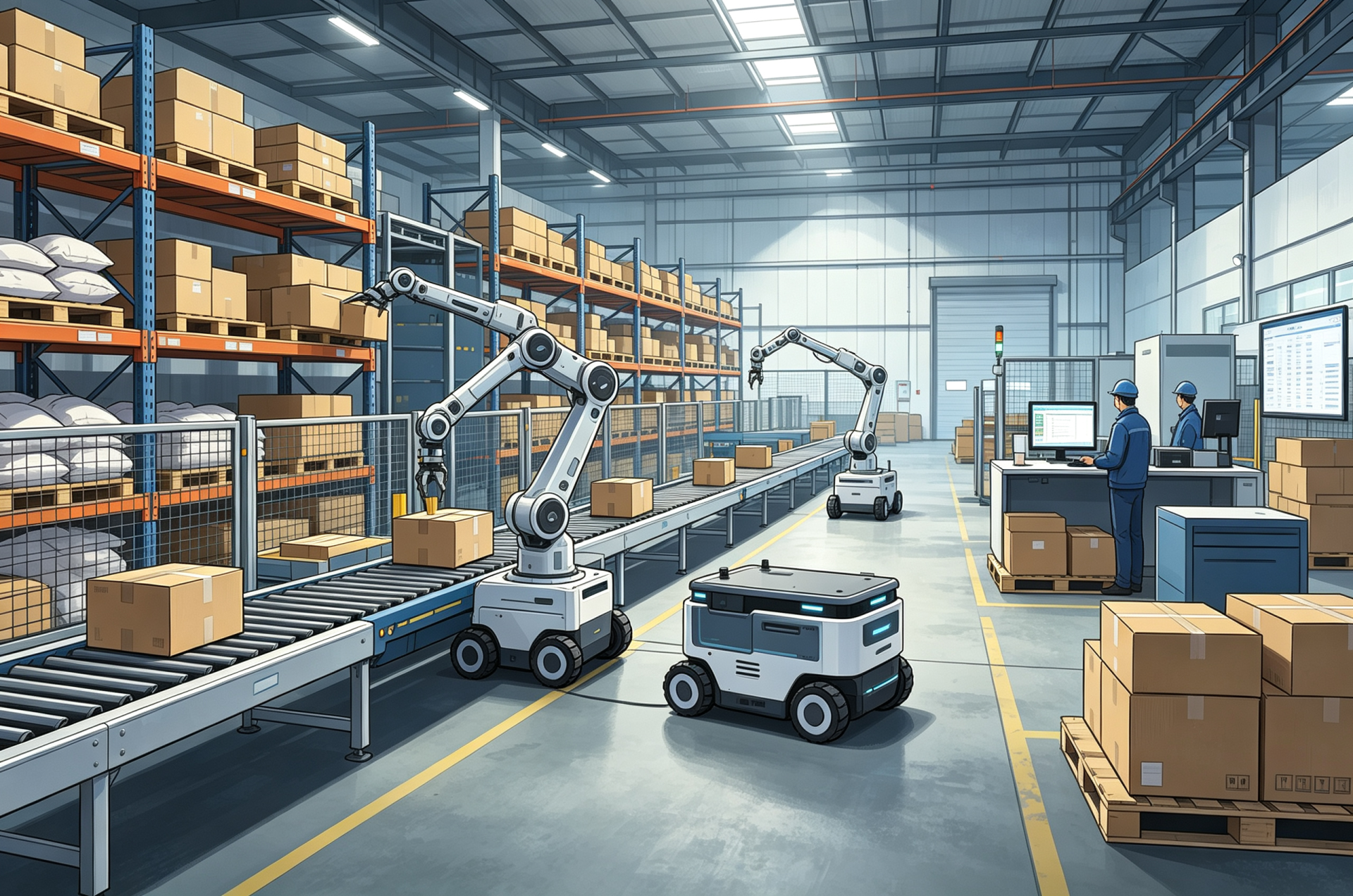
The clearest proof of the pivot is not a slide deck but a sortation floor.
Xingdong Jiyuan is now operating in more than ten logistics centers nationwide, according to the company. On April 27, 2026, it closed a funding round exceeding $200 million, led by SF Express, one of China's largest parcel networks. Its Xingdong M7 has been deployed at China Post Guangzhou since May 2026, paired with a self-developed all-direct-drive five-finger dexterous hand and an embodied "ERA-42" brain. The company has disclosed that the system reaches efficiency above 85% of a human operator on its target tasks — a number that, if it holds at scale, is more commercially interesting than any demo video.
Sorting volume is also being reported, not just demo rates. One widely cited figure: three Xingdong units together sorting roughly 250,000 parcels over 200 hours in real operating conditions.
A second, very different workflow is being cracked by Xinghai Tu , in partnership with JD. The task is front-warehouse autonomous fulfillment: the robot navigates between shelves, locates the right goods, retrieves them, and — hardest of all — performs the "open-bag, pack-bag" step autonomously on soft plastic bags in under two minutes. Underpinning this is Xinghai Tu's G0.5 embodied foundation model, which lets the same model handle navigation, manipulation, and the deformable-object task that has historically broken traditional automation.
Outside pure logistics, Galaxy General is showing how broad the embodied-AI template already is — folding clothes, shelf-picking, making breakfast — and is running drug-sorting robots in around 100 pharmacies across more than ten cities, according to company disclosures and trade reporting.
Capital and procurement are following the field results. JD led investment in three embodied-AI firms in July 2025, explicitly targeting supply-chain use cases — parcel handling, warehousing, and last-mile operations. Within JD's own network, AgiBot's Genie G2 completed an 8-hour real-line livestream at the Longqi factory and has now crossed more than 140 cumulative stable hours of operation. UBTech's Walker S2 is being positioned for both automotive manufacturing and smart logistics.
Analysts quoted by Chinese industry outlets — including delivery and logistics expert Zhao Xiaomin — have described 2026 as a "key leap year" for logistics-robot deployment, with broad industry rollout expected the following year. That framing lines up with the JD, SF Express, and China Post timelines above: 2026 is when pilots converted into funded deployments; 2027 is when the industry expects scale.
It is worth saying out loud what these robots are and are not doing. Humanoid platforms are not, on present evidence, replacing the high-throughput fixed automation that already dominates conveyor sortation, cross-belt sorting, or barcode scanning at scale. Where they do add value is in the awkward middle: the steps that traditional automation cannot cost-effectively handle, and the labor markets that are genuinely thin.
The most-cited example is parcel supply , the upstream stage at a sortation line where mixed, stacked, irregularly shaped parcels need to be inducted. Fixed induction equipment struggles with the long tail of size and shape variance; humans handle it well but are hard to staff during peak shifts. Embodied robots — with 3D vision, dexterous hands, and learned policies — are an obvious fit. The same logic applies to soft-bag packing in front warehouses, to pharmacy drug retrieval, and to bin-to-picker flows that span non-standard SKUs.
The economics are still a real constraint. Industry estimates place a top-end humanoid such as the US-built Figure 03 around $30,000 per unit, against Chinese warehouse labor costs that are a small fraction of that. China's express-delivery sector runs on thin margins, which makes ROI sensitivity very high: a robot has to be reliable, multi-shift, and cheap to maintain, or the unit economics do not close. The 2026 deployments are best read as the first credible ROI tests — not as a final verdict.
This is also why the "fill the labor gap, cover the automation blind spot" framing has become the consensus inside Chinese industry circles. It is less viral than "humanoids replace workers," but it matches what the technology is currently good at and what the labor market is currently short of.
A few signals will define whether 2026's leap year converts into 2027's broad rollout:
Hours, not demos. Operators will be judged on cumulative shift hours, not on-stage success rates. Longqi-style 140-hour streaks are the new benchmark.
Closed-loop ROI. Whether Xingdong M7, MagicBot D1, and Xinghai Tu's G0.5-based units show published cost-per-parcel numbers that beat the labor baseline.
Foundation-model generalization. Whether the "G0.5"-class embodied foundation models hold up across sites, across SKUs, and across the messy variations of real warehouses.
Standardization. Whether procurement teams begin to converge on a few dominant form factors (wheeled + humanoid torso is the early favorite).
For readers who want to see these systems in person rather than on a press release, the calendar is straightforward. The industry will gather at the Shanghai International Humanoid Robot and Robotics Industry Chain Exhibition 2026 (December 9–11, 2026, at the National Exhibition and Convention Center (SNIEC), Shanghai) — HRIE 2026 in shorthand — where the leading platforms quoted above, alongside the embodied foundation-model stacks now running real sortation and fulfillment work, are expected to be demonstrated under one roof. If 2026 is the year the demos became work, December in Shanghai is where the receipts will be on display.