Zhejiang Robot Industry Association
Zhejiang University Robotics Institute
Golden Conference & Exhibition Group
Hangzhou Wisdom Source Exhibition Co., Ltd.
Hangzhou Sequoia Exhibition Co., Ltd.
For two years, China's humanoid sector has been a fast-money frontier of demo videos and conference keynotes. In summer 2026, it became a listed asset class. The trigger was Unitree Robotics , the Hangzhou-based full-stack player that turned quadrupeds and bipeds into a serious hardware business. According to its prospectus and reporting by TechTimes, Unitree cleared China's securities regulator in roughly 104 days — a record pace from acceptance to CSRC registration approval on July 2, 2026 — after passing the listing committee on June 1. It will trade on the Shanghai STAR Market as the first pure-play humanoid whole-machine stock on A-shares.
The numbers are striking. Unitree plans to raise roughly ¥4.202 billion at an implied valuation near ¥42 billion. Prospectus data show 2025 revenue of ¥1.708 billion, up about 335% year-on-year, with net profit of ¥288 million. The three-year revenue trajectory — ¥159 million in 2023, ¥392 million in 2024, ¥1.708 billion in 2025 — matches consumer-electronics upstarts. Q1 2026 non-GAAP net profit reportedly came in around ¥40 million. Gross margin expanded from 44.2% in 2023 to 56.4% in 2024 and 60.3% in 2025, with humanoid-segment gross margin reportedly 87.7% in 2023 and roughly 62.9% by Q3 2025. Unitree shipped more than 5,500 humanoid units in 2025.
Demand has been ferocious. Reports cite oversubscription of roughly 8,288x on the retail tranche, and IPO pricing reportedly works out to about 219x earnings and 36x sales — multiples that set the psychological benchmark for every subsequent humanoid listing in China. The strategic shareholder list reads like a map of China's AI industrial policy: DeepSeek, Tencent, CNPC, China Southern Power Grid, China Telecom, CITIC, and the National Social Security Fund are all reportedly on the cap table, with HongShan (Sequoia China) at roughly 7.11% and Meituan the largest external holder at about 9.65%.
The prospectus also tells investors what Unitree intends to do with the money. Roughly ¥2.02 billion — about half the raise — is earmarked for an "intelligent robot model" R&D program, what the company calls the "brain." Unitree launched its WVLA 2.0 embodied model in late May 2026 and continues to emphasize a full-stack approach spanning the robot body, a "cerebellum" motion-control layer, and a multimodal brain. The allocation signals that even the sector's most credible hardware-first company sees the next leg of value creation in software.
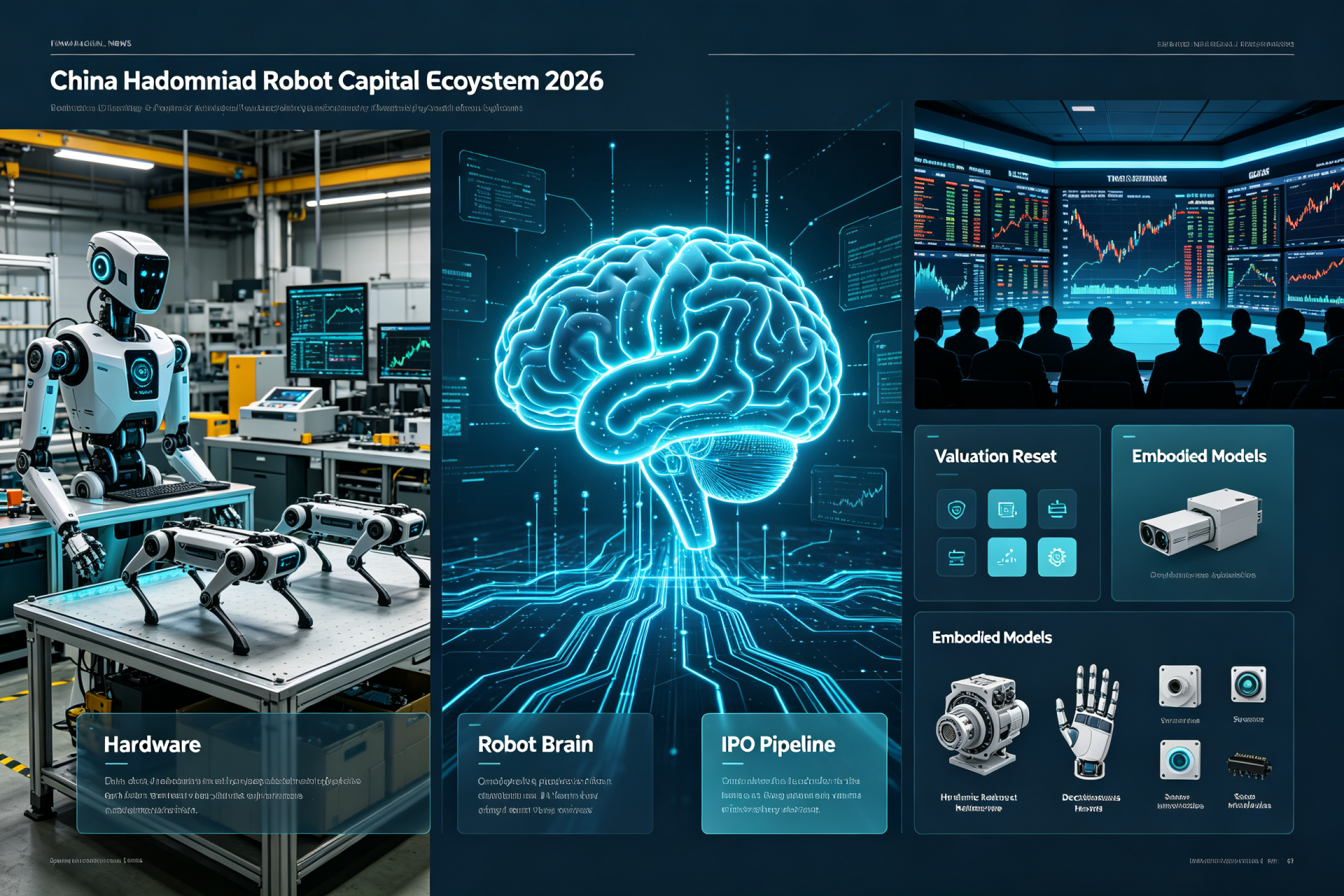
Unitree did not list alone — it opened a gate. Industry analysts now count 20 to roughly 50 humanoid and embodied-AI companies moving toward A-share, STAR, ChiNext, or Hong Kong listings.
On mainland boards, Leju Robotics was accepted on ChiNext around May 19, 2026, at a reported pre-IPO valuation near ¥6 billion. Deep Robotics has filed for STAR at a reported valuation around ¥4.5 billion. Fourier Intelligence is reportedly in STAR coaching above ¥8 billion. On the Hong Kong side, AgiBot is said to be planning an H2 2026 filing — cumulative shipments over 15,000 units, valuation north of ¥22 billion — while EngineAI has reportedly submitted a confidential application. Xingdong Jiyuan recently closed a ¥2.5 billion pre-IPO round at ¥10.5 billion. Galaxy General is reportedly valued above ¥5 billion.
The component layer is listing too. Laifu Harmonic became the first dedicated harmonic-reducer stock on the Hong Kong Exchange in June 2026, linking Chinese humanoids directly to global precision-motion supply chains. Huandong Tech (RV reducers) has reportedly filed on STAR. Weita Dongli and Boshi Zhidong — the latter specializing in electronic skin for dexterous manipulation — round out a picture in which the public market is funding not just the humanoids but the entire mechanical and sensory stack beneath them.
According to ThinkChina, roughly 370 embodied-AI startups have been founded in China over the past two years, with around 50 pursuing listings. At least five are reportedly valued above ¥20 billion and another six above ¥10 billion; some have doubled within months on pre-IPO rounds. 2026 will not be remembered as the year one Chinese robot company listed — it will be remembered as the year a sector did.
The capital inflows are extraordinary — and increasingly disconnected from commercial revenue. Unitree's own filing has been interpreted, in coverage by TechTimes and industry analysts, as candidly acknowledging that current-generation humanoids cannot yet perform broadly useful real-world work. The company sells the hardware. Whether it produces labor — the actual economic product the sector ultimately promises — is a different question.
That gap is now being priced. In the United States, Figure AI was reportedly valued at around $39 billion in a September 2025 funding round on near-zero disclosed revenue. That figure sits uncomfortably next to Goldman's widely cited projection of a roughly $38 billion total addressable market for humanoids in 2035 — a market in which, by the bank's framing, no single company captures anything close to a $39 billion equity value. The valuation of private leaders implies either extraordinary share concentration or extraordinary market expansion. Public-market investors are now being asked to choose.
Two of China's most experienced robotics investors have put the moment in plain terms. Qiming Venture Partners partner Alex Zhou calls the sector "exceptionally bullish" because it may be the only industry combining smartphone-scale unit volumes with car-like prices. But Zhou cautions that "when the first one or two list, scarcity lets them reap oversized capital dividends" — the easy money accrues to early bellwethers, not the long tail. Lanchi Partners partner Cao Wei goes further: embodied AI may eventually produce hundreds of listed companies — a pattern familiar from China's innovative-drug and smart-manufacturing waves — but only five to ten dominant players are likely to capture most of the economics.
The implication for 2026 and 2027 is a public-market reality check. Investors are asking what a robot can perform at scale that a wheeled AMR, a fixed cobot arm, or a human worker cannot. The honest answer, in mid-2026, is a small and growing list of demonstration tasks in controlled environments, with significant teleoperation underneath. That is not commercial usefulness, and the prospectus language reflects that tension.
If the public market is asking harder questions about metal and motors, the private market has already answered. The clearest signal of 2026 is not which humanoid can do a backflip — that was 2025's marketing staple — but which "brain" company can train the foundation model every humanoid will need.
The benchmarks are global. Fei-Fei Li's World Labs reportedly raised around $1 billion in 2025, with Nvidia and AMD both participating. Yann LeCun's AMI Labs reportedly closed a roughly $1.03 billion seed round, reported as a European record. Skild AI reportedly raised a $1.4 billion Series C led by SoftBank at a valuation above $14 billion, marketing itself as an "omni-bodied" model layer. Physical Intelligence reportedly closed about $1 billion at a valuation above $11 billion in 2026. None sells a robot. All are valued at multiples that would have been absurd for any robotics software business twelve months ago.
The thesis is reshaping the unit economics of the sector. Robot foundation models — large multimodal systems trained on cross-embodiment data — may capture more long-run value than any single hardware platform. If right, the durable moat in humanoids is data, model weights, and integration with frontier-model providers, not actuators. If wrong, hardware-first players like Unitree retain pricing power because they ship the bodies the brains must run on.
The Chinese ecosystem is hedging both ways. Unitree's half-billion-dollar "brain" allocation is the most explicit bet that hardware incumbents must own the model stack. Meanwhile, China's frontier-model labs — DeepSeek among them, and reportedly a strategic investor in Unitree — are positioning to provide the underlying intelligence any humanoid will need. The line between "robot company" and "AI company" is dissolving on both sides of the Pacific, and 2026 valuations are starting to reflect that.
The 2026 capital cycle in Chinese humanoids is doing four things at once.
First, it is creating an asset class. With Unitree pricing on STAR and twenty to fifty names behind it, Chinese humanoid and embodied-AI exposure will soon be tradeable across STAR, ChiNext, Hong Kong, and pre-IPO secondaries. For international allocators, the question is no longer whether to gain exposure but through which vehicle and at which multiple.
Second, it is widening the gap between profitable hardware and pre-revenue software. Unitree's prospectus — revenue, margin expansion, unit shipments, named strategic investors — is the kind of document a public investor can underwrite. Many of the names behind it are not. That dispersion is likely to widen as the queue clears.
Third, it is rotating capital from "body" to "brain." The world's most richly funded robotics deals of the past twelve months have been foundation-model companies without factories. Chinese investors are following the same signal, through direct bets on model labs and through "brain" allocations inside humanoid IPO prospectuses.
Fourth, it is forcing a conversation about commercial usefulness. The next eighteen months will determine whether humanoids can move from controlled demos to repeatable, billable work in factories, warehouses, and eventually homes — the single biggest variable in the next round of valuations, on both sides of the Pacific.
That conversation will be on full display at the Shanghai International Humanoid Robot and Robotics Industry Chain Exhibition 2026 (December 9–11, 2026, at the National Exhibition and Convention Center (SNIEC), Shanghai). HRIE 2026 has become the annual focal point where the sector's listed bellwethers, pre-IPO hopefuls, component suppliers, frontier-model labs, and global investors meet on the same floor. If 2025 was the year Chinese humanoids learned to backflip, and 2026 the year they learned to file prospectuses, HRIE 2026 will be where the market decides whether — and how quickly — they learn to do the work.