


Zhejiang Robot Industry Association
Zhejiang University Robotics Institute
Golden Conference & Exhibition Group
Hangzhou Wisdom Source Exhibition Co., Ltd.
Hangzhou Sequoia Exhibition Co., Ltd.
By 2026, the global conversation about humanoid and companion robots has shifted — almost without anyone noticing — from stage performances to the corridors of nursing homes. The shift is being driven by demographics that no industrial policy can wish away, and accelerated by a generation of machines that are, for the first time, genuinely useful in long-term care settings. This article looks at what is actually deployed today, what is being standardized, and where the technology still falls short of the marketing.
China provides the clearest lens on the trend because the numbers are unavoidable. The country's population aged 60 and above now stands at roughly 320 million — about 23% of the total, according to official figures cited by researchers and policy analysts in 2025 and 2026. Projections, reported by multiple Chinese institutions and echoed in international coverage, suggest that the number of disabled or semi-disabled elderly will approach 100 million by 2050, with an average disability period of around 11 years.
The professional caregiver workforce, meanwhile, has remained chronically short. In cities as in rural counties, care homes operate with lean staff rosters, and family caregivers — overwhelmingly adult children — shoulder the rest. It is against this backdrop that robots have moved from novelty to tool. They are not replacing nurses; they are absorbing the repetitive, the physically taxing, and the constantly-attentive tasks that human staff cannot be everywhere at once.
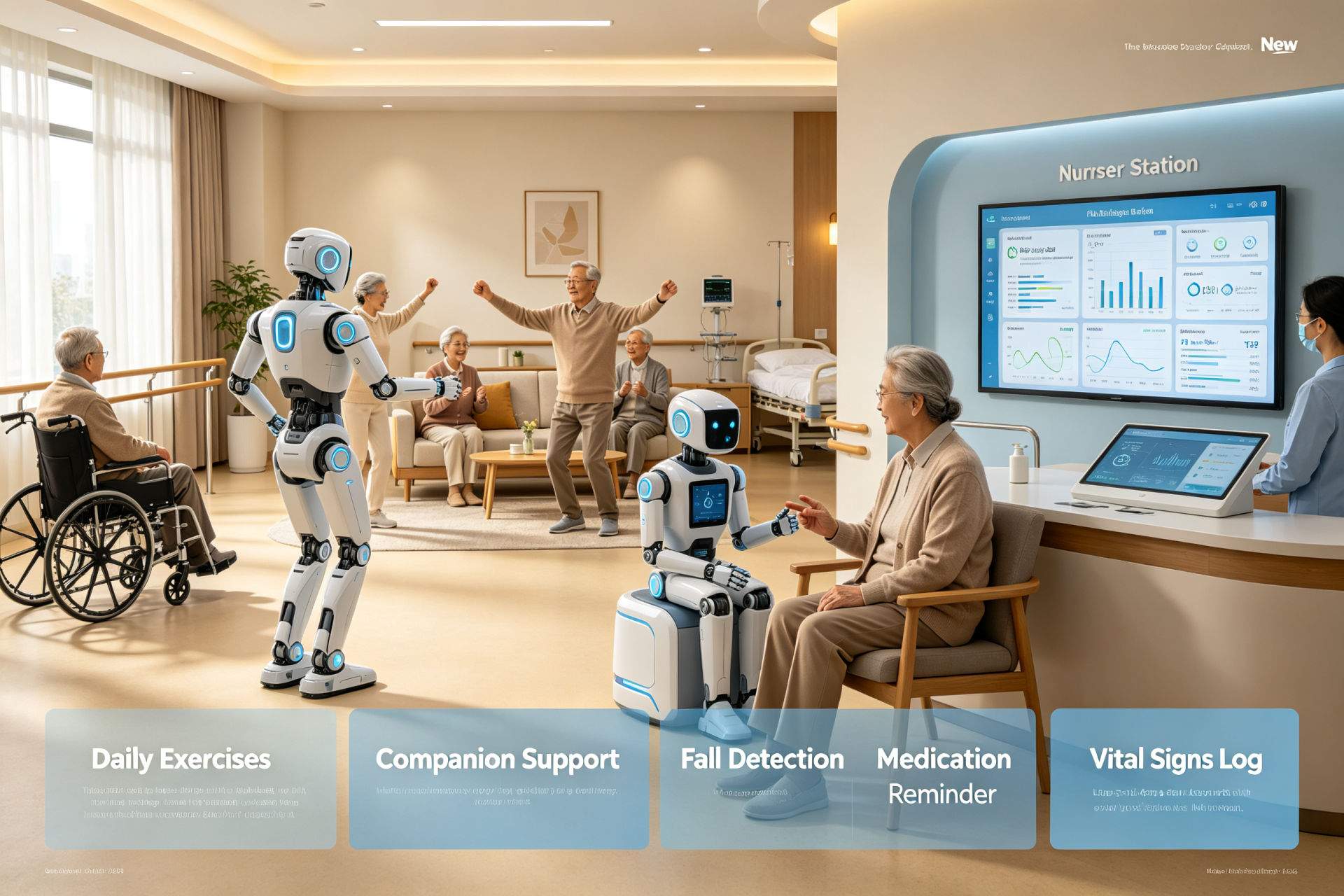
In the Xihu district of Hangzhou, a community nursing home of just thirteen residents — average age 86, most with some degree of cognitive impairment, around 70% classified as fully dependent — has integrated a humanoid robot nicknamed "Rouqing" into daily life. According to reports from Chinese state media and local press in 2026, the robot leads morning finger and fitness exercises for the residents.
The machine is built for the realities of a shared care space. It carries two 6-DOF arms and an 11-DOF dexterous hand, with pneumatic stiffness control that releases pressure on contact — a deliberate safety choice to prevent injury during physical interaction with elderly users. On its head, a high-resolution camera paired with millimeter-wave radar watches for falls and pushes real-time alerts to staff. Between exercise sessions, the robot follows nurses on rounds and delivers medication to residents' rooms. It is, in effect, a multipurpose aide rather than a single-purpose gadget.
In March 2026, Beijing's Yizhuang district opened what has been described as the world's first "smart eldercare robot care station." Spanning roughly 1,100 square meters, the facility hosts more than 40 robot products from 24 companies, covering dining, leisure, and care scenarios. The station functions as a living showroom: families and care-home operators can walk through, observe robots performing realistic tasks, and assess which machines might suit their own settings. For an industry that has long struggled to bridge the gap between trade-show theatrics and everyday usefulness, the care station is a deliberate attempt to make the technology tangible.
At WAIC 2026 in July, Benzi Juzhi, a spinoff from Fudan University, presented what it describes as a "human-machine-object ternary collaborative embodied model" — effectively a unified brain and operating system that lets a single robot move between very different care tasks. Researchers said the system can learn Tai Chi and Baduanjin (a traditional Chinese qigong form) directly from therapists and then reverse-teach the routines to elderly patients.
The same platform incorporates a spatial-interaction algorithm that allows the robot to focus on one speaker in noisy rooms and to read gestures from patients whose speech has become unclear — both common challenges in elder care. Hardware-wise, the unit runs on a six-hour battery with a 30-minute recharge window, and the company uses device rotation to keep robots on duty 24/7. A long-term deployment is already running in the lobby of a Shanghai rehabilitation hospital, where the robot handles guidance, companionship, and rounds.
Companionship, long treated as the softest and most easily dismissed category of care robotics, has begun producing evidence of its own value. In Guangzhou, a nursing-home companion robot reportedly recalled what an elderly resident had said days earlier and continued the conversation seamlessly. The resident later wrote a thank-you letter to the care team — a small moment, but one that captures something the technology is genuinely beginning to offer. As the letter put it, simply and directly: elders need someone who listens.
Other deployments are more clinical but no less real. The Guanggu Dongzhi "Lumen U1" elder-care robot, equipped with a care-AI model, supports casual conversation while automatically logging blood-pressure and glucose readings to the cloud, and is being piloted at Hubei Rongjun Hospital. In Shenzhen, Hongmeng Zhihu care home has built what staff describe as a "non-sensing" safety net, with fall detection and anomaly alerts running in the background. Hangzhou, meanwhile, has piloted instant fall alerts pushed directly to nurses and family members.
In February 2025, China led the publication of IEC 63310 — the world's first international standard specifically for elder-care robots. The standard does not by itself make a robot safe, but it does something more strategic: it establishes a shared vocabulary and a baseline of expectations across safety, performance, and user experience. For an industry that had previously operated in a patchwork of vendor-specific claims, IEC 63310 gives procurers — care-home operators, hospital procurement teams, government agencies — something concrete to measure against.
This matters beyond pride. Standards shape which products can be exported, which can be reimbursed by insurance schemes, and which can be admitted into publicly funded care networks. By anchoring the global standard for elder-care robotics, China has positioned its domestic industry at the center of how the category will be evaluated.
It would be a mistake to read the deployments above as a sign that elder-care robots are ready for every home. They are not, and the people building them say so.
Home environments remain stubbornly complex. Apartments, bedrooms, and kitchens vary in layout, lighting, and clutter; a robot that navigates a care-home corridor cleanly can still get confused by a throw rug, a low table, or a family pet. Force-control precision — how gently and accurately a robot pushes, lifts, or assists — still needs improvement, particularly for the delicate physical contact that elder care often requires. Costs remain high: a capable humanoid is still a capital purchase that few families and even some care operators can justify without subsidy.
Penetration, by industry analysts' own estimates, remains below 5% of relevant care settings. And beneath the engineering questions sits an ethical one that the technology is only beginning to confront. Adult children consistently report wanting to monitor their aging parents' health — but they do not want 24/7 surveillance. The line between caring and watching is one the industry will have to help draw, not blur.
The trajectory for the rest of 2026 and into 2027 is reasonably clear. Expect more care stations, more standardized procurement, more careful pricing, and a sharper conversation about which tasks robots should own and which they should only support. Expect also, increasingly, to see robots in roles that look almost ordinary: leading the morning exercises, pushing a medication cart, sitting quietly with a resident who has not had a visitor that week.
For those who want to see the state of the art in person, the Shanghai International Humanoid Robot and Robotics Industry Chain Exhibition 2026 (December 9–11, 2026, at the National Exhibition and Convention Center (SNIEC), Shanghai) — widely referred to as HRIE 2026 — will be a venue where elder-care robots, the emerging care-tech ecosystem, and the standards now shaping them are showcased side by side. It will be one of the best opportunities of the year to look past the demos and ask the harder question: which of these machines would you actually want beside your own family?