
Zhejiang Robot Industry Association
Zhejiang University Robotics Institute
Golden Conference & Exhibition Group
Hangzhou Wisdom Source Exhibition Co., Ltd.
Hangzhou Sequoia Exhibition Co., Ltd.
The conversation about humanoids used to live almost entirely in factories and warehouses. That is changing fast. At the industry frontier, the most compelling near-term stage for walking, dexterous machines may not be the assembly line but the field, the greenhouse, and the orchard. For decades, agricultural automation meant massive single-purpose machinery — combine harvesters, spray drones, autonomous tractors — built for scale and speed. Humanoids represent a different bet: generalist machines that adapt to the small, fiddly, human-scale tasks that machinery never quite solved. It is a quieter revolution, but potentially a deeper one.
The clearest signal yet will be on display at the Shanghai International Humanoid Robot and Robotics Industry Chain Exhibition 2026 (December 9–11, 2026, at the National Exhibition and Convention Center (SNIEC), Shanghai), where the latest agricultural humanoids are expected to demonstrate just how far "scenario-driven" deployment has progressed from lab curiosity to working prototype.
The shift from demo to deployment is no longer anecdotal. According to public reports from the 2026 World Robot Conference in Beijing, the agricultural robotics section drew unusual attention: picking humanoids, crop-monitoring robot dogs, and even biomimetic fish were on show, illustrating a broader move from concept machines to "scenario-driven" deployment — robots designed around a concrete task in a real environment rather than a generic platform in search of a use.
This matters because agriculture is unlike the controlled factory floor. Terrain is irregular, crops are delicate and non-standard, and labor is increasingly scarce. A robot that can only operate on a flat, mapped aisle has limited value in a hillside orchard or a muddy greenhouse row. The agricultural narrative for humanoids, then, is not "a cheaper worker" but "a worker that can go where wheels cannot."
There is also a data dimension. Every pick, prune, and patrol generates information — ripeness distributions, pest hotspots, yield maps — that feeds back into planting and resource decisions. A humanoid is not just a laborer; it is a sensor platform that learns the specific geometry of a farm over a season. That feedback loop is what separates a one-off automation from a genuinely smarter production system.
The rural labor shortage is the headline driver, but it is not the only one. Farming also faces intense pressure to reduce resource waste — water, fertilizer, pesticides, and spoiled produce all represent losses that precision robotics can tighten. Humanoids are positioned as a flexible answer on two fronts.
First, mobility. Wheeled and tracked vehicles slip on slopes, sink in soft soil, and — in the worst cases — crush shallow roots. Bipedal or foot-based walking, the argument goes, handles slopes, furrows, and uneven ground that conventional vehicles cannot safely cross. For smallholders on hilly or mountainous land, that difference is the difference between automation being possible and being impossible.
Second, manipulation. Dexterous hands paired with tactile sensors enable damage-free picking of delicate fruit — the kind of no-damage harvest that mechanical shakers and rigid grippers struggle to achieve. A strawberry, a peach, a tomato: each demands a grip tuned to fragility. The combination of vision, touch, and articulated fingers is what makes a humanoid plausible where a claw is not.
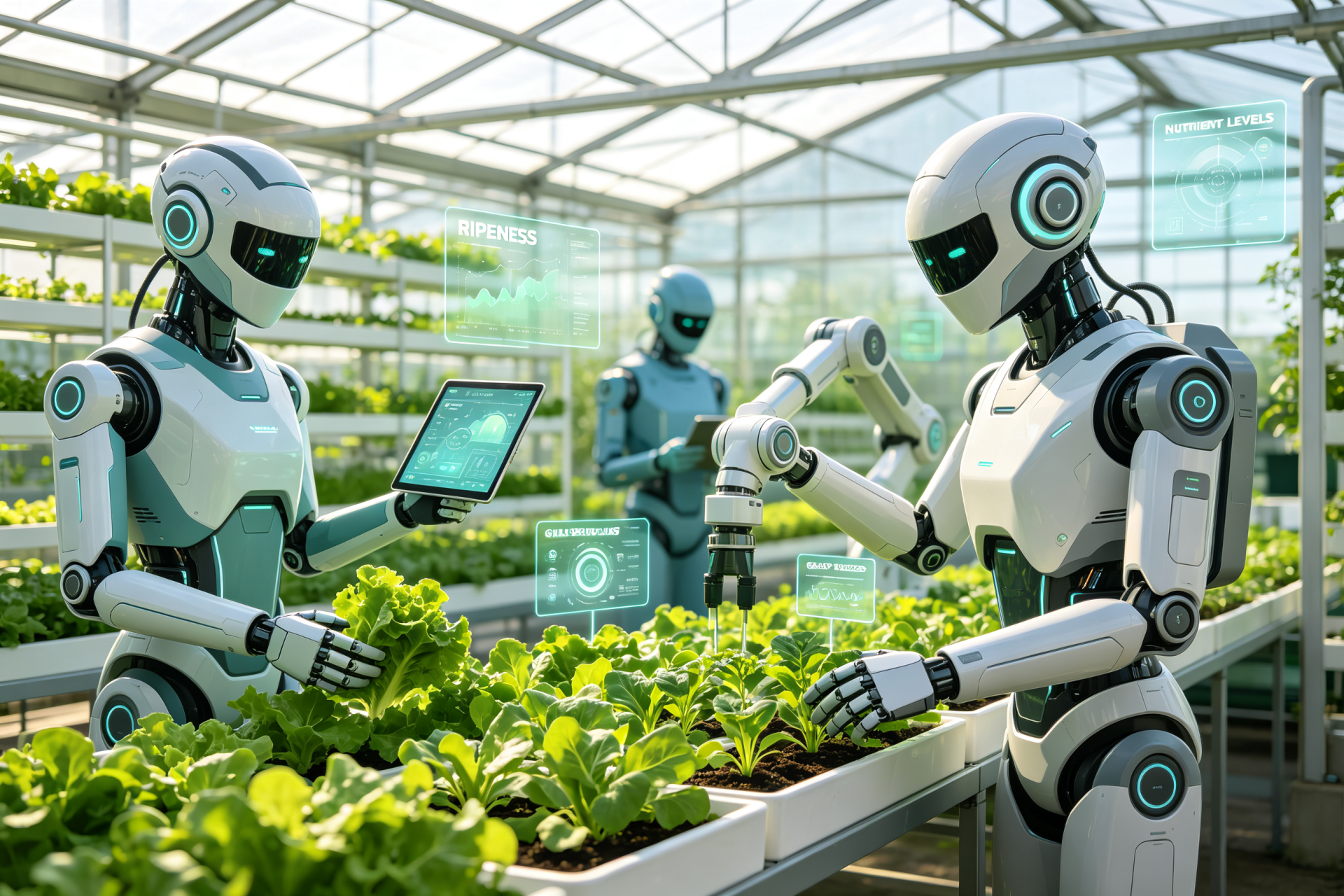
If there is a "beachhead" for agricultural humanoids, most observers point to controlled environments. Greenhouses and vertical farms offer predictable lighting, contained space, and repeatable tasks — ideal for early robots learning to be reliable.
At a greenhouse in Xiongan, Hebei, a humanoid picker reportedly uses machine vision to judge ripeness, then picks, prunes, and transports produce along a defined workflow. The tasks are structured but require the kind of fine, adaptive manipulation that defines a human hand.
Deals are following the demos. UBTECH's Walker S, working with Malaysian agri-tech firm Agroz (announced December 2025), was deployed in vertical farming for seedling transplanting, nutrient monitoring, leafy-green harvesting, sorting, and cleaning. In the United States, Apptronik's Apollo has been piloted in Texas greenhouses, with publicly cited specifications of roughly 25 kg payload and about 4 hours of battery life, plus hot-swappable batteries for continuous operation. These are not science projects; they are service trials measuring throughput and uptime.
Orchards present a harder problem — height, density, and variability. Northwest A&F University has developed "twin" apple-picking robots: a tall unit for fruit above 1.5 meters and a short unit for low-hanging fruit, reportedly achieving about 7.5 seconds per fruit, with a planned rollout in autumn 2026. The twin design is a neat acknowledgment that a single form factor cannot cover a whole tree canopy efficiently.
At Shanghai University, a dual-arm humanoid tomato picker has been reported at roughly 90% picking success. Tomatoes are deceptively difficult — ripe fruit is soft, clusters tangle, and vines resist — so a sub-95% result on a research rig is a meaningful data point rather than a marketing claim.
These open-field and orchard cases remain earlier-stage than greenhouse work, but they define the ambition: robots that move through rows, reach across canopies, and return produce without bruising it.
Beyond generalist humanoids, a wave of specialized "embodied" agricultural robots is emerging — machines built for one crop but engineered to do it remarkably well.
QiWu Tech launched its H1 agricultural embodied robot at Hannover and at Mushroom Days 2026 in the Netherlands (April), featuring a QiO Brain VLA end-to-end model, dual arms, and a reported peak harvest rate of 43.2 kg/h — roughly double a human worker — with over 99% recognition accuracy, over 95% grasp success, and under 5% damage. The system reportedly adapts across mushrooms, blueberries, and strawberries, and the company has cited European orders.
AgiBot deployed its A2 tea-picking robot at Hangzhou Longjing, while Unitree has been demonstrated in tea gardens simulating the prized "one bud two leaves" pluck. Tea is a precision crop where hand-selection defines quality, so robotic plucking is as much about grade as throughput. Separately, (Weijing Intelligence) has shown a humanoid picker featured on CCTV, with reported shipments exceeding 1,500 units — a striking volume figure that, if accurate, would make it among the most widely deployed agricultural humanoids to date.
The humanoid opportunity is not limited to growing crops. In livestock, robots are being applied to barn cleaning and animal-health monitoring — tedious, repetitive, and sometimes hazardous work. Post-harvest, the same dexterity that picks fruit can sort, grade, and pack delicate produce, reducing bruising and waste at exactly the moment margins are thinnest.
Seen together, these applications suggest a robot that participates across the production cycle: from seedling to harvest to handling. That continuity is what turns a clever machine into an infrastructure layer for farming.
Crucially, livestock and post-harvest work is where ROI may first become undeniable. Barn cleaning is dangerous and unpopular; animal-health monitoring is relentless; grading and packing are labor-intensive at exactly the moments when margins are thinnest. Because these tasks are repeatable and contained, they are easier to standardize than open-field harvesting, and they give vendors a revenue stream while the harder outdoor problems are still being solved. The pragmatic path, then, is to earn trust indoors before conquering the orchard.
The hardest question is not capability but economics. Humanoids carry high one-time costs, and few farms can absorb capital expenditure for unproven throughput. The prevailing answer is "agriculture-as-a-service" — leasing, managed operations, and per-mu pricing that converts a capital cost into an affordable operational service. A farmer pays for picking by the acre rather than buying a robot; the vendor owns the asset and earns recurring revenue.
This model, however, depends on rural digital infrastructure: 5G connectivity, BeiDou positioning, and IoT sensing that let robots localize, communicate, and report. Without that backbone, even a capable humanoid is isolated. Building the network is therefore as strategic as building the robot.
Step back, and the pattern is larger than labor substitution. Robots are reconstructing agriculture's productive factors — land, labor, capital, and data — into a new configuration. In the Chinese policy framing, this sits squarely within "new quality productive forces" and contributes to food-security resilience by reducing dependence on scarce manual labor at critical harvest windows.
It is worth tempering the enthusiasm with realism. The gap between a controlled demo and a season of reliable field work is wide. Dust, rain, variable lighting, and the sheer unpredictability of living plants will test any system. Throughput claims measured in kilograms per hour must survive peak harvest pressure, and grasp-success rates must hold when fruit is misshapen or hidden by foliage. The vendors winning long term will be those who treat agriculture as a harsh, specific engineering problem — not a stage for impressive video.
The technology is not finished, and cautious attribution is warranted: many figures above are reported or estimated, and real-world reliability under weather, dust, and peak-season pressure remains to be proven at scale. But the direction is clear. The machines that will define the next chapter of farming — walking, reaching, and picking with a human touch — are precisely the ones that will be demonstrated at HRIE 2026, where the agriculture-humanoid story moves one step closer from scenario to soil.