
Zhejiang Robot Industry Association
Zhejiang University Robotics Institute
Golden Conference & Exhibition Group
Hangzhou Wisdom Source Exhibition Co., Ltd.
Hangzhou Sequoia Exhibition Co., Ltd.
When an earthquake tears open a mountainside town, the first 72 hours decide who lives. For decades those hours belonged to human rescue workers who climbed into unstable rubble, breathed smoke, and absorbed radiation no body should tolerate. That calculus is changing. Across China and abroad, humanoid and humanoid-adjacent robots are shifting from conference-stage novelties toward genuine deployment in the dirtiest, most dangerous, and most difficult assignments — what Chinese engineers increasingly describe as "life substitution" : putting steel where flesh used to go, so that fewer people have to risk their lives. This transformation will be on full display at the Shanghai International Humanoid Robot and Robotics Industry Chain Exhibition 2026 (December 9–11, 2026, at the National Exhibition and Convention Center (SNIEC), Shanghai), where the latest special-rescue humanoids are expected to take the floor alongside their industrial cousins.
The appeal is not technological bravado. It is arithmetic measured in injuries and lives. Emergency agencies have long tracked a grim pattern: the rescuers who rush in first are themselves exposed to secondary collapse, flashover, toxic release, and radiation. Each category of hazard has a human cost that compounds with every minute on scene. Robots change the denominator. They let the operation continue when a human would have been pulled back, and they let the risky work proceed when a human would never have been sent at all.
The philosophical frame is simple but powerful. In rescue, firefighting, and hazardous-environment work, human casualties are not a side effect — they are an occupational constant. Every collapsed building, every blazing compartment, every radioactive corridor takes its toll on the people sent in. The "life substitution" thesis argues that wherever a machine can absorb the danger, it should. A robot does not panic, does not need to breathe, and does not leave a grieving family behind.
This is not abstraction. At the 2026 World Robot Conference in Beijing, NORINCO unveiled its "Fuxi" special-purpose humanoid robot, reportedly about 180 cm tall and weighing between 85 and 90 kg. The machine is unapologetically built for the environments humans flee. Its designers frame the mission around substitution rather than assistance: not a tool a worker carries, but a stand-in for the worker at the worst point of the job. That distinction shapes everything downstream — the sensor suite, the thermal tolerance, the dexterity required to manipulate a valve or clear a blockage under stress.
The framing deserves a moment. Dirty, dangerous, difficult work has historically been treated as inevitable human labor, often performed by those with the fewest alternatives. Robotic substitution reframes that social contract. If a machine can take the dirty and the dangerous, then sending a person is a choice rather than a necessity — and the default should tilt toward steel. Built on a full-stack "brain + cerebellum" embodied-AI system and fitted with 6-DoF dexterous hands, Fuxi is designed precisely for the roles where human exposure is most costly: reconnaissance and patrol, riot control, nuclear-radiation operations, and fire-scene work. Its teleoperation solution, dubbed an external avatar, reportedly lets an operator kilometers away map their body movements onto the robot in real time — a human mind at a safe distance, a steel body at the point of danger.
Fuxi's most telling resume item comes from the field. According to public reports, prototype units were deployed in the 2025 Jishishan (Gansu) earthquake response, where they reportedly located four survivor heat sources within 72 hours and logged more than 11 hours of operation inside high-risk zones. If accurate, that is a meaningful proof point: the robot did not merely demonstrate; it worked alongside a real rescue effort under real conditions.
The teleoperation model matters because fully autonomous behavior in chaotic disaster environments remains hard. Earthquakes do not follow scripts. By keeping a human in the cognitive loop while removing them from the physical hazard, Fuxi offers a pragmatic bridge between today's AI limits and tomorrow's autonomy. An operator can judge a partially collapsed stairwell, interpret ambiguous sensor data, and decide whether a void contains a survivor — all without standing on the debris.
That blend of teleoperation and embodied intelligence points to where the category is heading: not human replacement in the philosophical sense, but human displacement from the lethal position. The body on the scene is steel; the judgment stays human, at a distance.
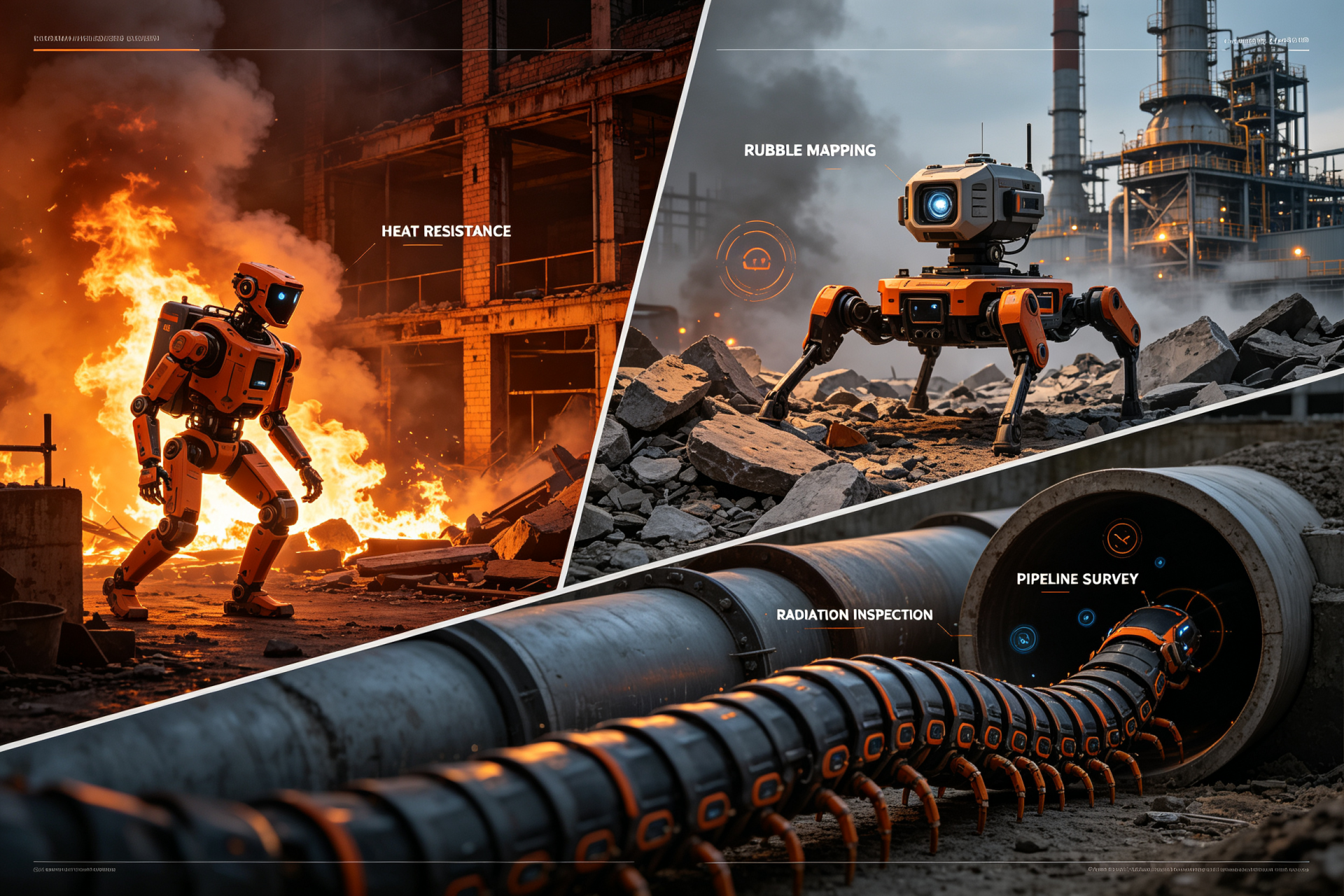
Fire is where the case for life substitution is most visceral. According to public reports, a "Tiangong" fire robot has been demonstrated sustaining operation in smoke and heat of roughly 800°C, with batch procurement orders already in place and planned deployment to around 20 cities in 2026. These numbers should be treated as reported estimates rather than certified ratings, but even read conservatively they mark a shift from research curiosity to municipal procurement — a category crossing from lab to line item.
What makes the firefighting cohort noteworthy is its composition. Rather than a single do-everything robot, the field is filling with specialized forms matched to the steps of a fire: entry, mapping, suppression, supply. That modular logic reduces the burden on human crews precisely where flashover and smoke inhalation do the most damage, and it lets departments scale capability city by city as budgets allow. Such figures should be read as reported estimates rather than certified specifications, but even with caution they sketch a compelling trajectory: localized, repeatable, heat-impervious presence inside fire compartments that today still send firefighters inward.
Complementing Tiangong, the "Linglong" fire humanoid is built to traverse rubble and complex terrain for post-disaster search, while canine-form recon platforms extend the same logic. Recon dogs reportedly build 3D maps of rubble fields; water-cannon dogs carry a 60-meter-plus range for what operators describe as "zero-casualty" firefighting; and transport dogs carry roughly 30 kg across broken ground to deliver supplies where vehicles cannot pass. The pattern is consistent — modular, multi-form machines that specialize in the steps of a rescue that are most likely to kill a human.
Some of the most consequential deployments sit in environments humans simply should not enter. Boston Dynamics' Atlas, according to public reporting, is being steered toward nuclear scenarios with reported precision on the order of 0.1 mm, with plans for deployment at roughly 10 plants by 2028. China's power-inspection robot, meanwhile, reportedly performs 500 kV live-line inspection that cuts required manpower by about 70% and improves response times by roughly 85% — figures that, if substantiated at scale, reframe inspection economics rather than merely reducing risk.
The ambition stretches further. At WRC 2026, Qingzhuo Dynamics unveiled a roughly 4-meter liquid-electric hybrid "super-humanoid" with 41 active degrees of freedom, explicitly targeting nuclear operations and maintenance, deep-sea work, mining, high-altitude tasks, and emergency rescue. The liquid-cooling and electric-hybrid architecture is a telling engineering choice: it hints at the thermal and endurance budgets required to stand inside a reactor hall or descend toward the deep sea, where human tolerance is the binding constraint.
Crucially, these nuclear and power deployments are measured not only in safety but in uptime. A plant or grid segment that can be inspected without de-energizing — or with far less manual exposure — keeps power flowing while shrinking the human-risk surface. The figures, if borne out, suggest the business case can be made on efficiency alone, with safety as the dividend rather than the entire argument. The design intent is not to mimic human form but to exceed human strength and tolerance — a machine built for endurance and force no flesh-and-blood worker could match. That reframing — from imitation to augmentation beyond human limits — may prove the more durable definition of the category's value in hazardous domains.
Not every hazardous job is dramatic. China Minmetals has deployed quadruped inspection robots underground in mining operations, while XCMG's mine-rescue robot reportedly brings about 5 tons of digging force and roughly two hours of underwater operation. At Harbin Institute, a centipede-style soft robot weighing around 350 grams performs in-pipe inspection, shortening the time required for pipeline checks that once demanded human entry into confined, gas-prone spaces.
These quieter deployments matter because they reveal the real deployment logic: robots earn their place not by replacing a hero, but by removing a human from a thousand small, repeated, dull-and-dangerous tasks. Cut enough of those, and the cumulative casualty reduction dwarfs any single dramatic rescue. The "life substitution" doctrine, in other words, compounds.
Autonomy is also advancing. "Embodied Tiangong 3.0" reportedly won a global robot warrior challenge in Beijing with fully autonomous — no remote control — runs through earthquake-ruins and chemical scenarios. That is the signal that the teleoperation bridge described earlier is already being crossed in controlled benchmarks, even if field deployments still lean on human oversight.
The throughline of this whole movement is a shift in status. For years, humanoid robots in rescue contexts were props — impressive at expos, absent in emergencies. What has changed is not any single breakthrough but a convergence: capable embodied-AI stacks, maturing dexterous hardware, and — critically in China — a complete domestic supply chain paired with open, willing deployment scenarios. The supply chain point is underrated. When actuators, controllers, and sensors can be sourced and iterated domestically, the cost curve flattens and the deployment loop shortens; when cities and plants are willing to field prototypes, the data flywheel starts turning.
There is also a standardization story emerging. As batch orders arrive and multiple vendors target the same scenarios, expectations around interfaces, telemetry, and operator training begin to crystallize. That is how a collection of demos becomes an industry: shared assumptions about what "deployable" means, and a procurement language buyers can actually use. When operators are eager to field prototypes in actual earthquakes and fire departments are placing batch orders, the feedback loop tightens. Every real deployment generates data that the next model is trained on.
The frame, then, is no longer "can a robot do this?" but "which position on the front line should steel hold first?" Reconnaissance, fire entry, nuclear inspection, mine rescue, pipeline checks — the list grows because the economics and the ethics both point the same way. A machine that takes the danger is a machine that saves a life, and the arithmetic is brutally simple.
Humanoid robots will not make rescue workers obsolete; the judgment, the empathy, and the command decisions remain human. But the lethal position — the one inside the smoke, the rubble, the radiation — is increasingly being handed to steel. At HRIE 2026, visitors will see these special-rescue humanoids not as promises but as working tools, the first line of defense taking shape in metal and code.