


China Industrial Cooperation Association
Shanghai Federation of Industrial Economics
Shanghai Federation of Economic Organization
Industrial and Information Technology Equipment Engineering Research Institute (Beijing) Co., Ltd
Green Industry Enerey Conservation Branch, CICA
Golden Conference & Exhibition Group
Shanghai Berrick Exhibition Co., Ltd
For most of the last decade, the humanoid-robot conversation was dominated by a single obsession: hardware. How many degrees of freedom? How much torque? How long does the battery last? The implicit assumption was that if we could just build bodies that were strong, cheap, and durable enough, intelligence would follow. 2026 broke that assumption. This year, the industry's real bottleneck migrated from the metal to the mind. The decisive question is no longer can a robot walk, but can a robot think, learn, and generalize across bodies — and an increasingly fierce platform war has erupted over who controls the "brain."
At the center of this shift stands a surprising protagonist. NVIDIA, long the chipmaker behind everyone else's robots, has spent 2026 repositioning itself as the architect of the robot software stack itself. Its open foundation model, Isaac GR00T 1.7, has become the reference point against which every closed, in-house effort is now measured. Alongside it, a parallel and partly competing movement — China's "world model" push — has reframed the same problem in its own terms. The result is a rare moment of genuine platform competition in embodied AI, and a new consensus phrase that keeps appearing in labs from California to Chengdu: one brain, many bodies.
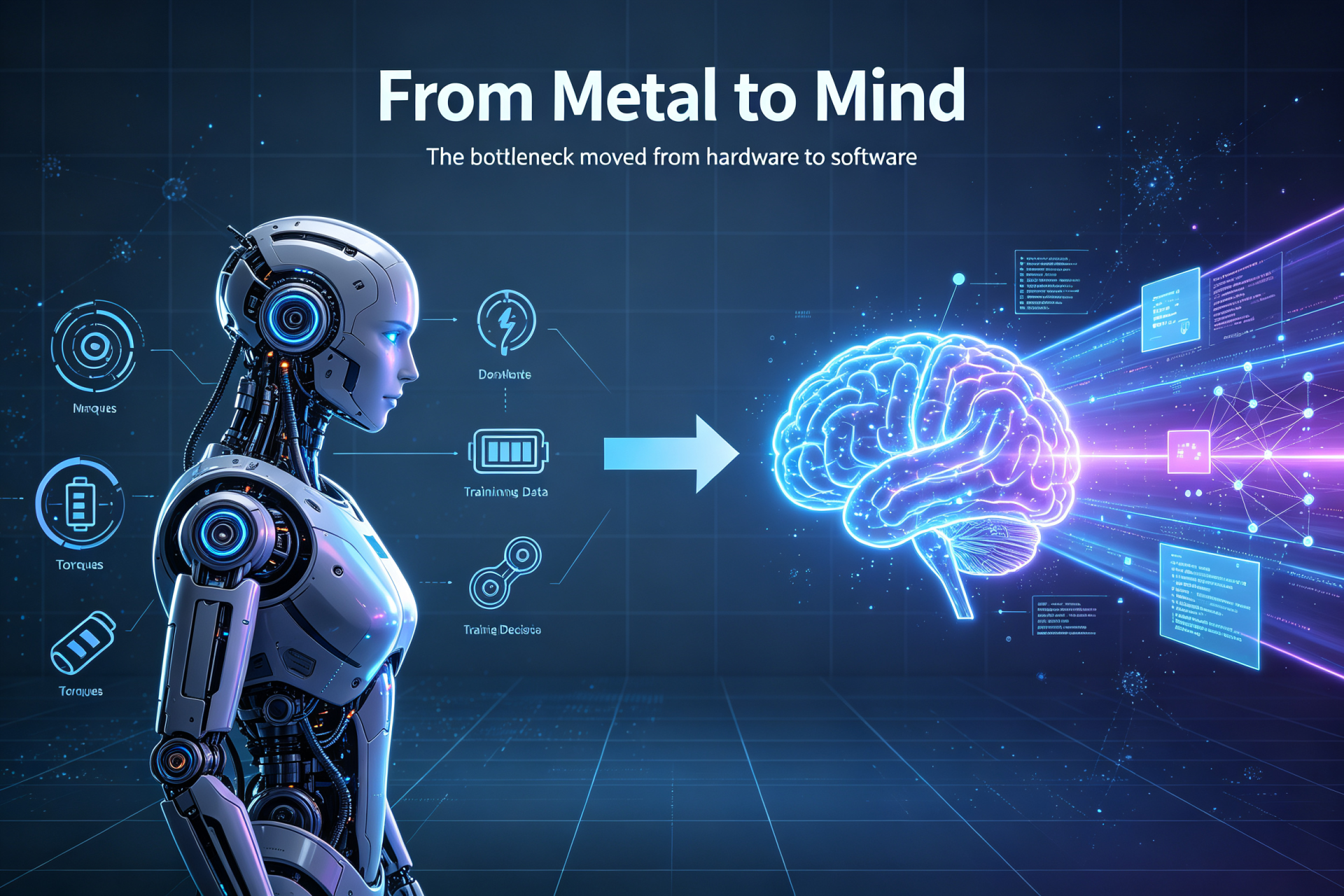
For years, the hard part of building a useful humanoid was mechanical. Actuators were expensive, control stacks were fragile, and a robot that could reliably stand up was a headline achievement. That challenge has not disappeared, but the cost curve of hardware has improved faster than the capability curve of software. Today, a growing number of manufacturers can produce a physically competent biped or bimanual torso. What they cannot reliably do is make that machine perform useful, novel tasks in unstructured environments without bespoke engineering for every single scenario.
This is the inflection point of 2026. The constraint is no longer can we build the body but can we give the body a brain that transfers. Public data shows that the cost of collecting and curating training data — and the inability of one robot's learned skills to move to another robot — became the dominant bottleneck. Analysts note that the portability of neural networks across different hardware platforms, once considered a distant research problem, was a major bottleneck cleared only in 2026. That single technical unlock is what made a "foundation model for robots" plausible rather than poetic.
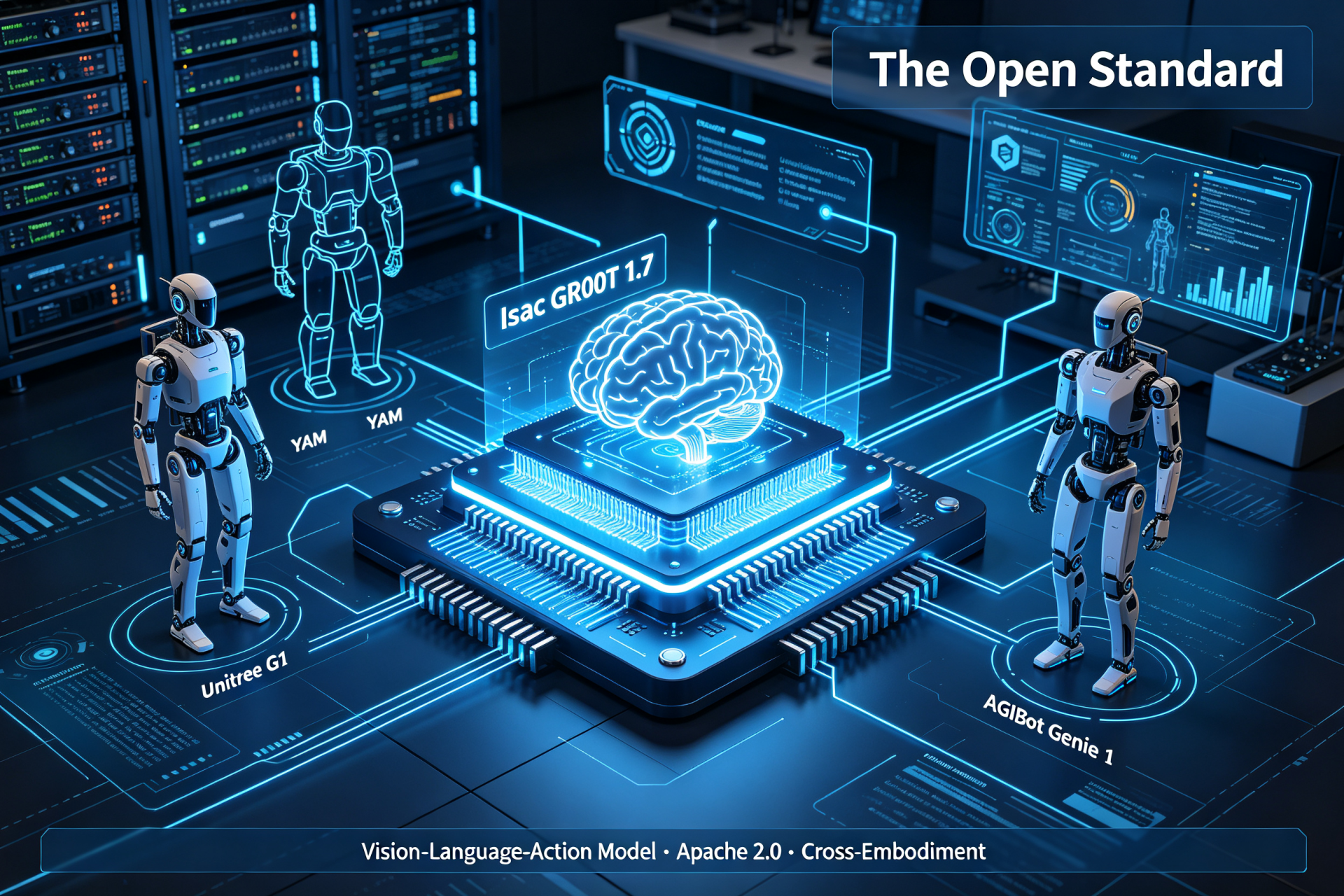
The clearest signal of the new era arrived with NVIDIA's Isaac GR00T 1.7 (also referenced internally as N1.7). The company describes it as the first open, commercially usable vision-language-action (VLA) model for generalized humanoid skills. Crucially, it was released under the Apache 2.0 license, a permissive choice that lets commercial adopters build on it without surrendering their own IP — and that sets it apart from the proprietary stacks of the robot makers competing with NVIDIA at the hardware layer.
Under the hood, GR00T 1.7 is built on a 3-billion-parameter base checkpoint whose backbone is Cosmos-Reason2-2B, itself derived from the Qwen3-VL architecture. It was pretrained on roughly 32,000 hours of real human-demonstration and ego-centric data, supplemented by about 8,000 hours of simulated rollouts. The model's architecture is perhaps its most interesting design decision: an "Action Cascade" dual-system structure borrowed conceptually from the fast/slow thinking lineage of modern AI.
System 2 is the high-level reasoner, a vision-language model that performs task decomposition and planning. System 1 is a 32-layer diffusion transformer that turns those plans into real-time motor commands — the kinds of sub-second, continuous control signals a body actually needs. The split matters because it separates slow, expensive reasoning from fast, cheap execution, allowing the same high-level "understanding" to drive very different low-level actuators.
GR00T 1.7 did not arrive in a vacuum; it was accompanied by a pretraining dataset and a remarkable empirical claim. NVIDIA's EgoScale pretraining corpus spans approximately 20,854 hours of human egocentric video across more than 20 task categories — manufacturing, retail, healthcare, and home environments among them. From this data, the company reports the first "dexterity scaling law": that feeding a model more human ego-centric data yields predictable, consistent improvements in dexterous manipulation.
The headline figure is striking but should be read with the caution the company itself applies: going from roughly 1,000 hours to 20,000 hours of data more than doubled average task completion. If independently confirmed at scale, a predictable scaling relationship for manipulation — analogous to the well-known scaling laws for language models — would be a genuine scientific milestone, because it would tell engineers exactly how much data they need to buy a given level of skill.
Validation was demonstrated across loco-manipulation, tabletop, and bimanual tasks on the Unitree G1, the bimanual YAM, and the AGIBot Genie 1 — three distinct hardware platforms, which is precisely the cross-embodiment point the model is built to prove. Deployment runs through NVIDIA's Isaac ROS on Jetson Thor edge hardware. Public data shows the adopter list already includes 1X, Agility, ANYbotics, Skild AI, Stanford, and ETH Zurich — a mix of startups, established robotics firms, and leading academic labs that together lend the open model unusual credibility.
NVIDIA's openness is the exception that defines the rule. Most robot makers with the resources to do so are keeping their stacks stubbornly in-house, betting that a vertically integrated "brain plus body" will outperform any shared standard.
Tesla remains the most closely watched example. According to public statements, the company is migrating its Full Self-Driving end-to-end AI approach from cars to robots, with its Grok model handling task scheduling and voice interaction. Its next-generation AI5 inference chip is slated to debut first on the Optimus robot, with a public timeline pointing to around mid-2027. The Tesla bet is that autonomy experience from millions of vehicles is a transferable asset — a thesis only 2026's cross-embodiment breakthroughs made credible.
Figure takes a different route with Helix 02, described as a "pixels-to-actions" VLA model that is fully end-to-end and has been deployed at BMW. The appeal of end-to-end systems is simplicity of the training story — perception in, motion out — but they typically demand enormous data and offer less interpretability than dual-system designs. UBTech, 1X, and Sanctuary AI round out the in-house camp, each pursuing its own internally controlled stack rather than licensing a foundation model.
The strategic tension is clear: an open standard lowers the cost of entry for everyone but commoditizes the intelligence layer, while a proprietary stack protects differentiation at the risk of reinventing what a shared model already solves. Industry reports suggest the balance is shifting toward openness for smaller players who cannot afford a research organization the size of Tesla's or Figure's.
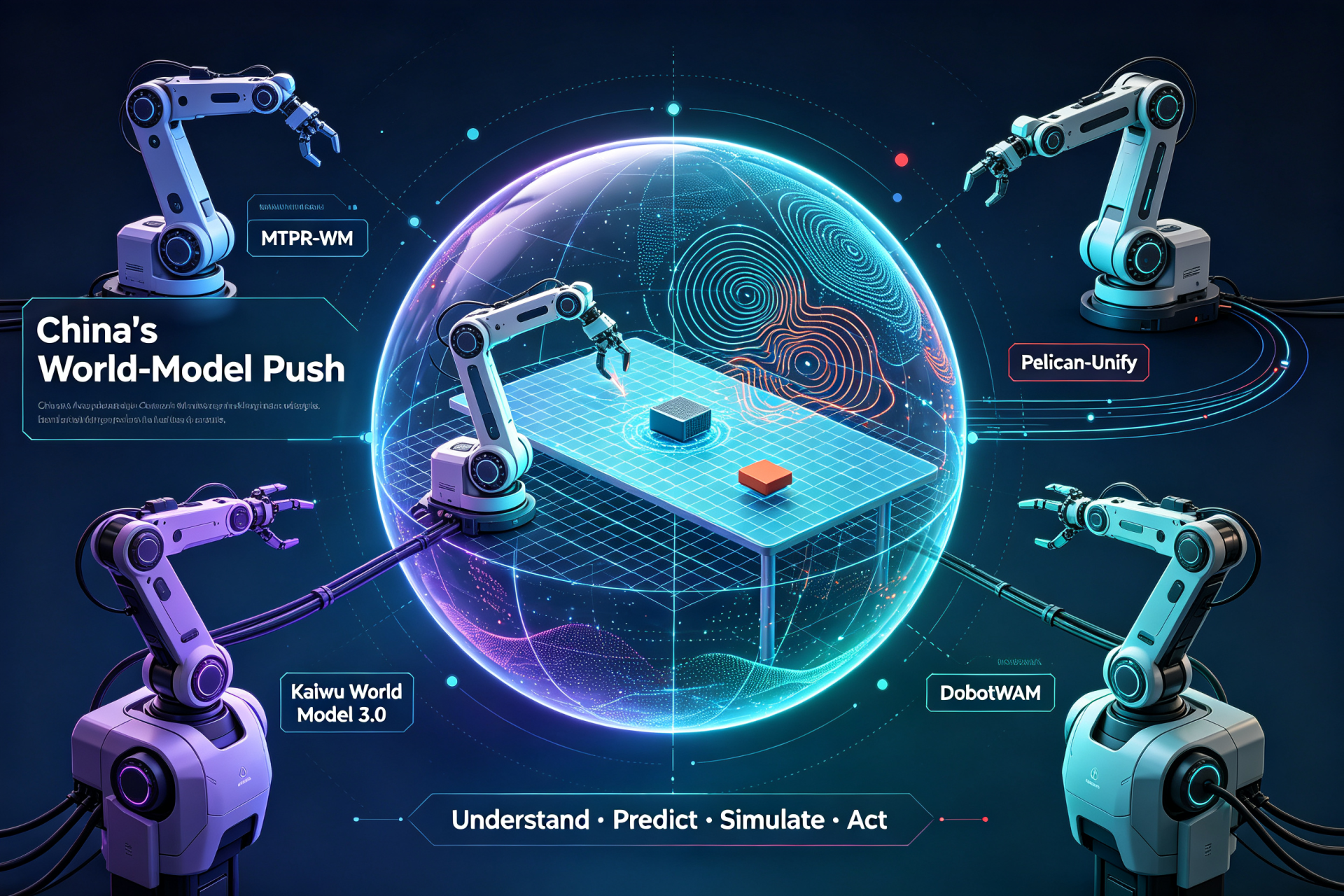
While the West debates open versus proprietary VLA models, China's robotics institutions have framed the problem around "world models" — systems that explicitly simulate or predict the physical and interaction dynamics of an environment, not merely react to it.
On May 12, 2026, the Chengdu Humanoid Robot Innovation Center released MTPR-WM, which it describes as China's first manifold-topology-preserving robot world model. The "manifold-topology-preserving" framing signals an emphasis on keeping the geometric and physical structure of the real world intact inside the model's internal representation — a theoretically grounded approach to avoiding the physically impossible predictions that plague naive generative systems.
Separately, Daxiao Robotics released Kaiwu World Model 3.0, a multimodal model that fuses understanding, generation, and prediction while incorporating vision, touch, and force feedback. The inclusion of tactile and force modalities is notable: most Western VLA models are vision-and-language-first, whereas the Chinese world-model effort places richer physical sensing at the core.
The Beijing Humanoid Robot Innovation Center contributed "Pelican-Unify" , a model designed to close the "understand–reason–plan–act" loop so that robots can, in the center's framing, "preview the future, then execute precisely." And Dobot demonstrated its DobotWAM embodied large model built around a "one brain, many bodies" platform — a direct statement of the cross-embodiment thesis from a Chinese hardware maker.
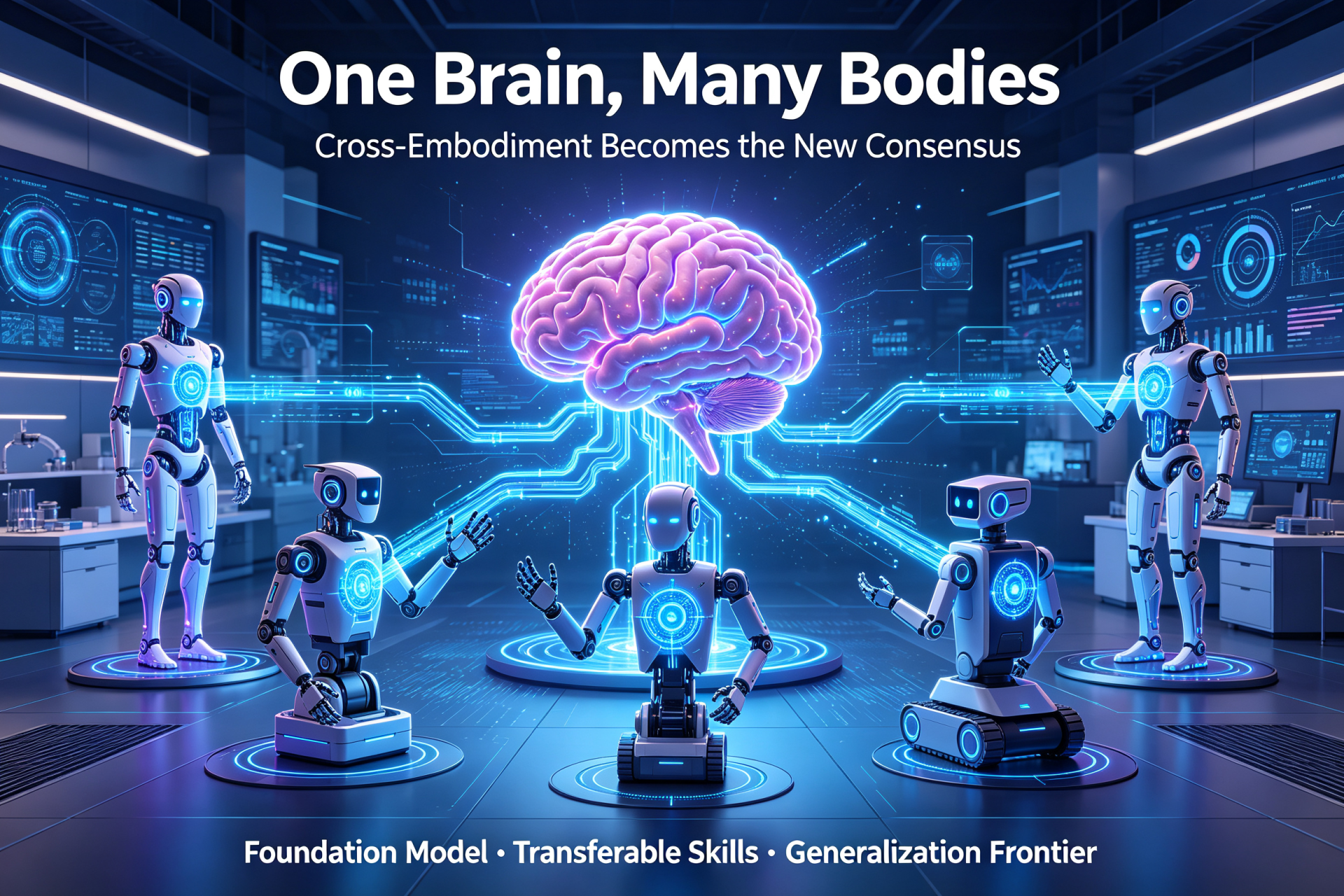
Strip away the branding, and a remarkable convergence emerges. The industry is moving away from "one robot, one model" toward "one brain, many forms" — expressed in Chinese as 一脑多用 or 一脑多形. The economic logic is irresistible: training a separate neural network for every SKU of robot is unsustainable, whereas a single foundation model that adapts to many bodies drastically reduces the data needed to scale a product line.
This is the year the thesis became operational rather than aspirational. GR00T 1.7 running on three different platforms, Dobot's platform, and Pelican-Unify's unified loop all point the same direction. The remaining hard problem, everyone agrees, is generalization. Public data and demonstrations show high task success within a fixed, trained scene — but a sharp drop in performance when objects or environments change. Closing that gap, rather than building yet another capable but brittle demonstrator, is now the field's central research frontier.
A necessary note of caution: much of the performance data cited above, especially from proprietary camps, is self-reported and has not been independently verified. The dexterity scaling law, the BMW deployment of Helix, the mid-2027 AI5 timeline — these are claims advanced by the parties building the systems, and the robotics field has a long history of impressive demos that do not survive contact with uncontrolled environments. The open models at least permit third-party reproduction; the closed ones ask for trust.
This platform war will not be settled in a whitepaper. It will be settled on the exhibition floor, where open and proprietary stacks can finally be compared doing the same tasks on similar hardware. That is exactly what the Shanghai International Humanoid Robot and Robotics Industry Chain Exhibition 2026 — held December 9–11, 2026, at the National Exhibition and Convention Center (SNIEC), Shanghai — is positioned to showcase.
At HRIE 2026, visitors will be able to compare open versus proprietary embodied-AI stacks from global and Chinese players side by side: NVIDIA's open GR00T-powered ecosystem next to Tesla-style, Figure-style, and UBTech in-house brains, alongside China's world-model entrants from Chengdu, Beijing, Daxiao, and Dobot. For engineers deciding which stack to build on, for investors weighing the open-versus-closed bet, and for policymakers tracking the strategic split between ecosystems, HRIE 2026 offers a rare single venue to watch the robot brain race in real time — not as a future promise, but as a competition already underway.