


China Industrial Cooperation Association
Shanghai Federation of Industrial Economics
Shanghai Federation of Economic Organization
Industrial and Information Technology Equipment Engineering Research Institute (Beijing) Co., Ltd
Green Industry Enerey Conservation Branch, CICA
Golden Conference & Exhibition Group
Shanghai Berrick Exhibition Co., Ltd
The humanoid robot industry has spent the better part of a decade promising a future where machines walk among us on the factory floor, in the warehouse, and eventually in the home. In 2026, that future arrived—not as a finished product, but as a manufacturing surge. Across China and the United States, assembly lines are being retooled, order books are filling, and cumulative unit counts that once took years to accumulate are now being added in months. Yet a stubborn gap has opened between the number of humanoids being built and the number actually earning their keep. The machines are rolling off lines faster than ever. Whether they are paying for themselves is a different question—one the industry has not yet answered.
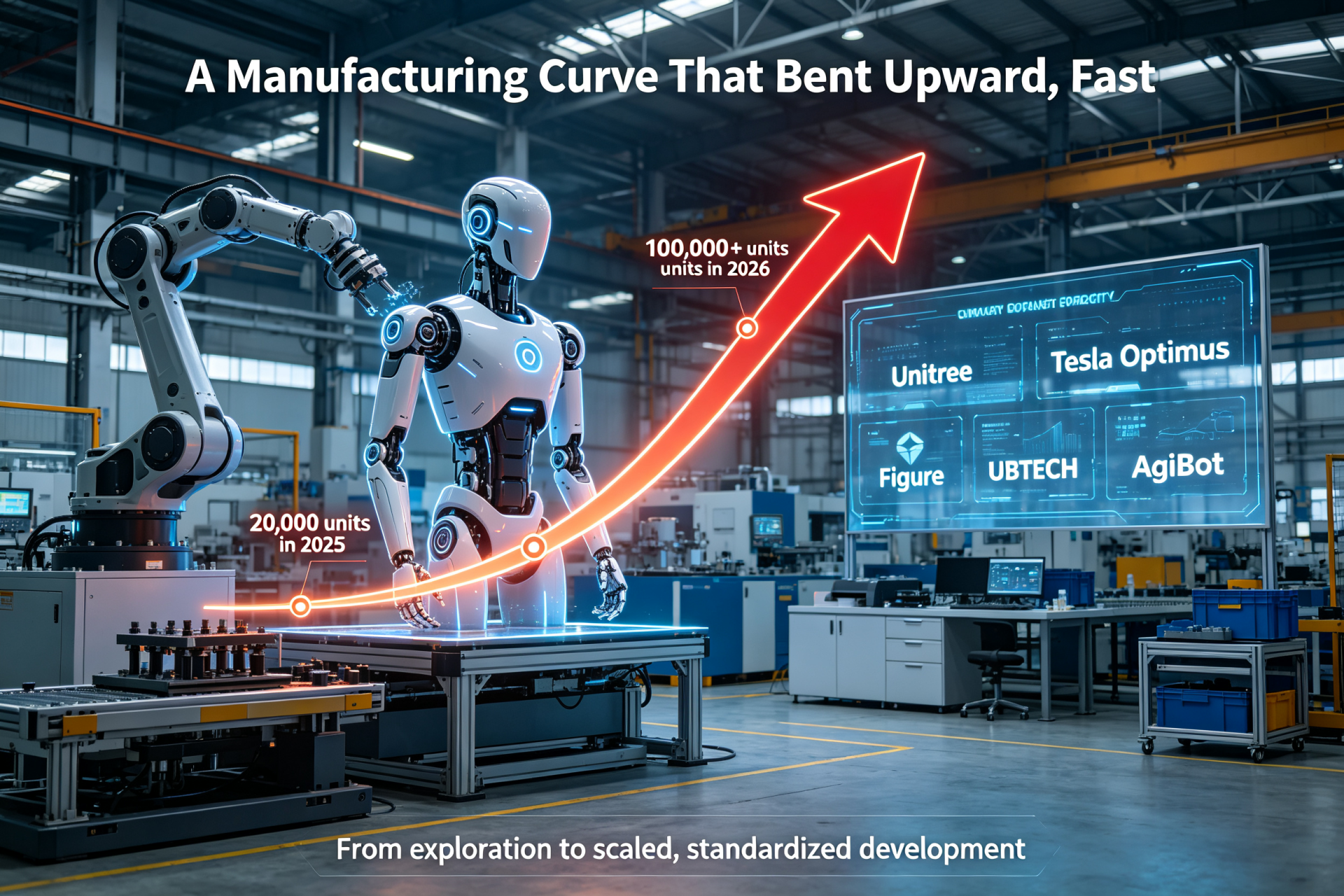
The clearest signal of the 2026 boom came from Beijing. At the July 2026 World Artificial Intelligence Conference (WAIC) press conference, the Ministry of Industry and Information Technology (MIIT) projected that full-year 2026 humanoid output would exceed 100,000 units—roughly a fivefold jump from approximately 20,000 units in 2025. Deputy Minister Ke Jixin framed the figure as evidence that humanoids are moving from "exploration" to "scaled, standardized development." Public data shows the sector is treating the projection less as a stretch goal and more as a baseline to beat.
Individual manufacturers have posted numbers to match the mood. Unitree reported in July 2026 that it had shipped a cumulative 18,000 bipedal humanoids—6,500 of them in 2025, roughly 11,000 by May 2026, and an additional 7,000 in just two months. The company's G1 model carries a list price around $16,000, and its capacity target is on the order of 30,000 units per year. AgiBot (Zhiyuan) reached 15,000 all-category units by June 2026, though only about 7,000 were pure bipedal machines, with the remainder wheeled platforms. UBTech had shipped approximately 3,000 units—a total that, industry reports suggest, pushed it to fourth place in shipment ranking, a slip that signals inventory or delivery lag rather than demand weakness.
The slip in ranking is itself informative. UBTech falling to fourth in shipments, according to industry reports, points less to collapsing demand than to the classic hazards of scaling—production ramps that outrun delivery, or inventory that accumulates ahead of deployment. It is a small but telling sign that "units shipped" and "units working" are diverging even among the leaders. AgiBot's wheeled-heavy mix tells a parallel story: when a meaningful share of "humanoid" output is actually wheeled platforms, the category's bipedal deployment base is smaller than headline totals imply.
Across the Pacific, the build-out is no less serious. Tesla converted its former Model S/X line at Fremont—cleared in roughly 46 days in early May 2026—into an Optimus Gen-3 production facility, with output beginning in late July or August 2026. Figure, meanwhile, has established its BotQ factory with a stated capacity near 12,000 units per year and had built more than 350 Figure 03 units. The long-term targets are striking: Tesla has discussed Fremont reaching 1 million units annually and Giga Texas 10 million.
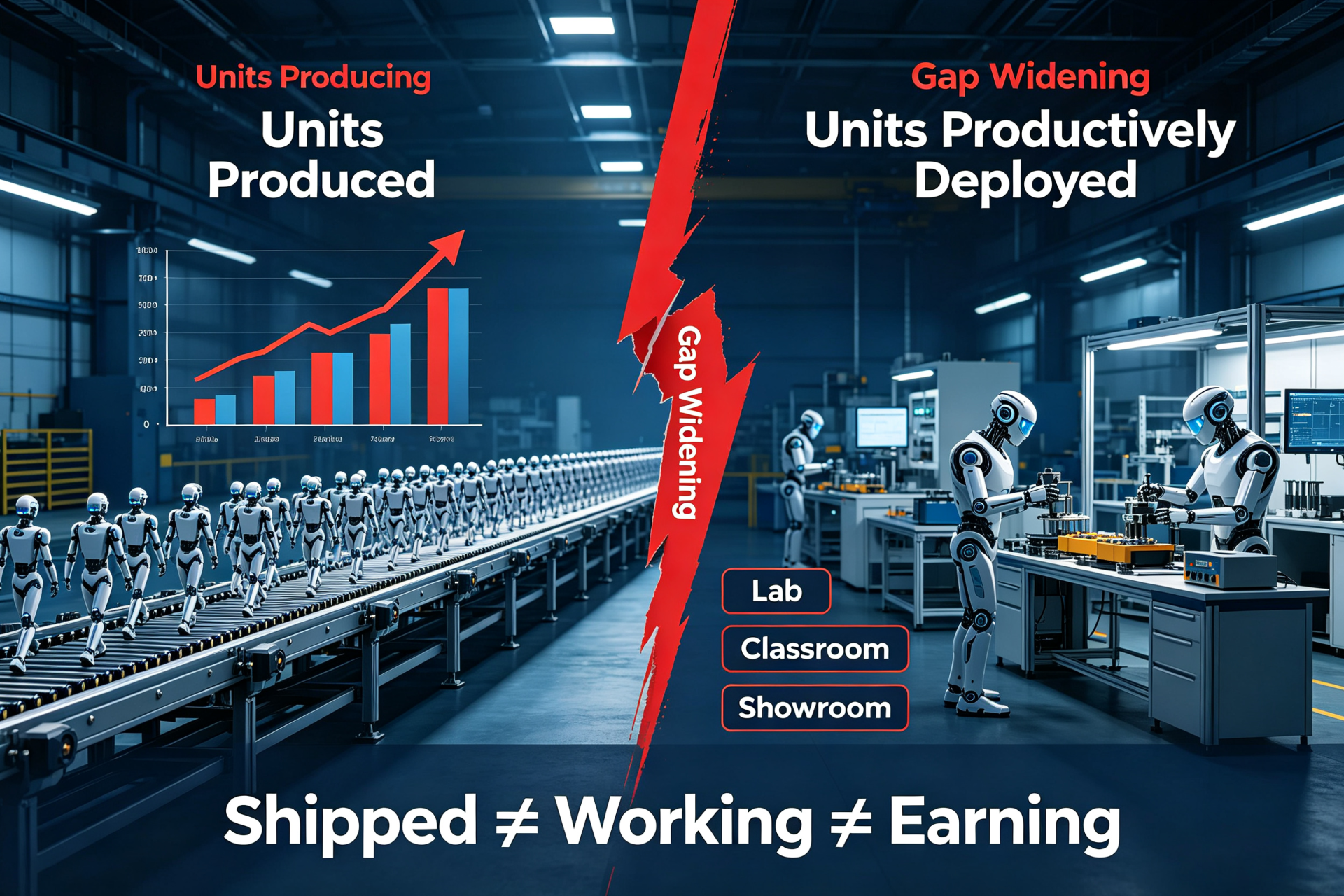
Here is the uncomfortable counterweight to the production story. According to public data, a large share of the humanoids being built are not, in fact, doing paid work. They are sitting in laboratories, classrooms, and showrooms.
Unitree's own revenue mix tells the tale. Through the third quarter of 2025, more than 70% of the company's humanoid revenue came from research and education, with industrial use accounting for only about 9%. In other words, most shipped robots are demonstrating capability, not performing it. AgiBot's deployment is broader—spanning seven real scenarios including line loading, industrial handling, logistics sorting, guiding, retail, security patrol, and cleaning—but its 7,000 bipedal units are a fraction of the all-category figure, and the wheeled majority points to where the practical, billable use currently lives.
Tesla's Optimus Gen-3, despite the headline capacity, had deployed roughly 1,000–1,200 units internally by mid-2026 for learning and data collection—not external sales. Elon Musk, speaking at Davos in January 2026, set a consumer target price below $20,000, with external sales possibly arriving in the second half of 2027. Current manufacturing cost sits somewhere between $50,000 and $100,000 per unit, a spread that underscores how far the economics still have to travel. UBTech's U1 full-size consumer humanoid drew 13,361 orders at ¥169,800, but those consumer orders are not counted in industry output figures—a reminder that pre-orders and working robots are not the same thing.
The pattern repeats: capacity is being announced and even built, but "capacity" and "actual output" are frequently conflated, and many deployment numbers are self-reported. A cautious read of the data suggests the gap between units produced and units productively deployed is widening, not closing. That is not a contradiction of the production boom so much as a description of its stage: the industry is investing in the ability to make machines faster than the market is proving it can use them.
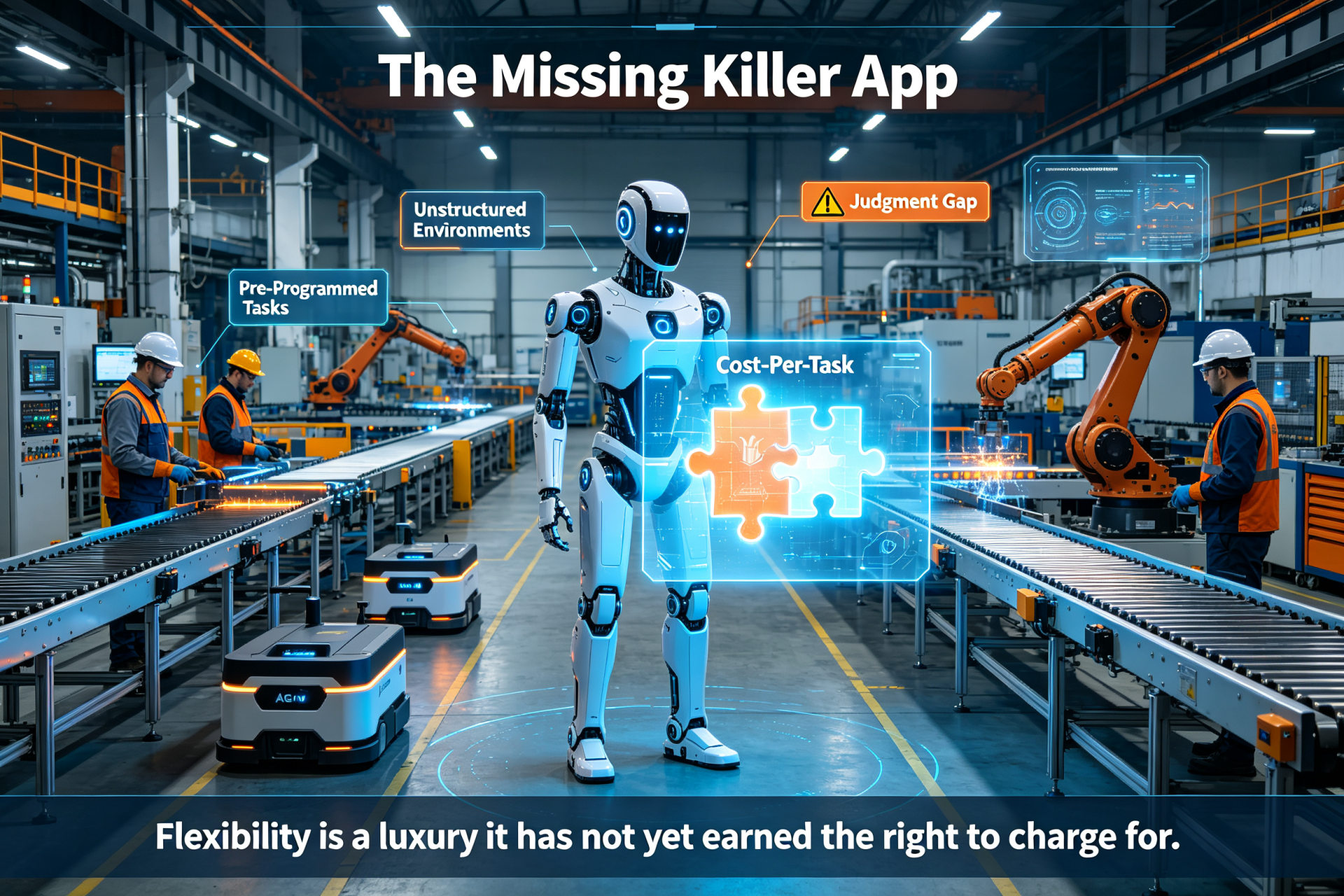
Why aren't more humanoids at work? The honest answer is that no single "killer app" has emerged—no task where a humanoid clearly beats the alternatives on cost-per-task. They are competing against automated guided vehicles with arms, fixed conveyors, and, still, human labor. When a warehouse can solve a problem with a conveyor or an AGV-plus-arm cell, the generalist humanoid's flexibility is a luxury it has not yet earned the right to charge for.
This is where the deployment bottleneck truly lives: in software and intelligence, not in metal and motors. The primary adoption constraint is what observers have begun calling the "intelligence gap"—the embodied-AI layer that must make a robot reliable in the unstructured, unpredictable conditions of a real workplace. Humanoids today are dependable at pre-programmed, well-bounded tasks and markedly weaker on novel or unstructured ones. They can repeat a calibrated motion; they struggle when the part is upside down, the light is wrong, or the cart is parked at an awkward angle. The gap is not one of dexterity alone but of judgment: knowing what to do when the expected does not happen. Until that improves, every deployment is a bespoke integration rather than a turnkey hire.
Figure's work at BMW's Spartanburg plant illustrates both the promise and the perimeter. Its Figure 03 is running a "sequencing" logistics use case built on the Helix 02 whole-body control system—grasping parts with both hands while stepping and repositioning to pull a cart. The prior Figure 02 contributed to 30,000 cars in 2025. That is real, paid deployment. But it is also a carefully chosen, tightly scoped task. The leap from a validated single use case to a general laborer remains the unsolved equation.
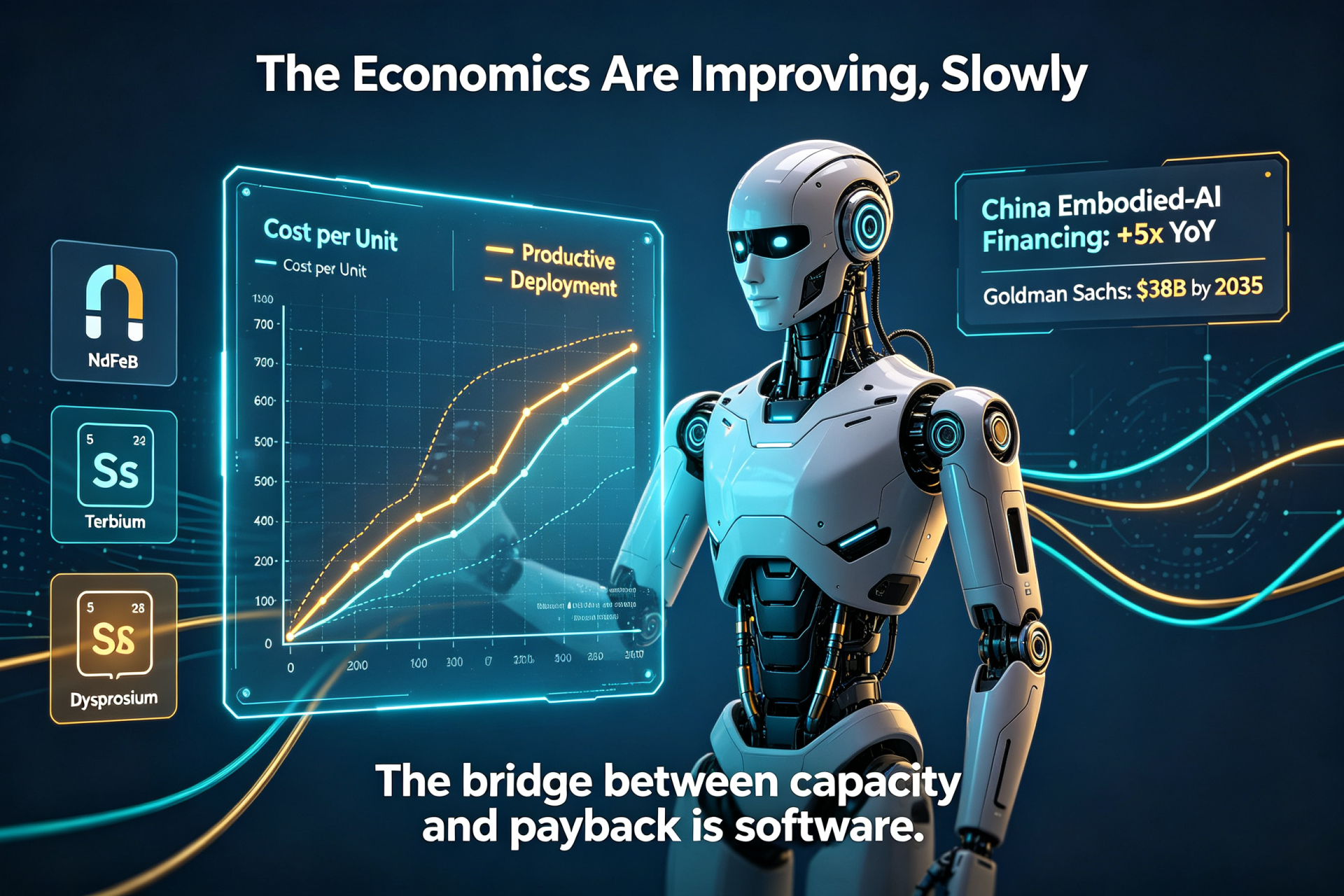
None of this means the thesis is broken. The financing and market signals point the other way. Industry reports suggest China's embodied-AI financing exceeded 93.5 billion yuan in the first half of 2026, up roughly fivefold year over year. Analysts at Goldman Sachs project a humanoid market approaching $38 billion by 2035, and Bank of America projects industry-wide shipments of about 90,000 units in 2026 rising to roughly 1.2 million by 2030. Notably, even the more conservative of those shipment forecasts—some 90,000 units in 2026—lands below MIIT's 100,000-plus output projection, a gap that itself hints production may run ahead of what the market absorbs.
Those curves depend, however, on closing the intelligence gap faster than the cost gap. The supply chain carries its own risk: each humanoid uses about 3.5 kilograms of neodymium-iron-boron (NdFeB) magnet material spread across 40-plus actuators, and NdFeB servo magnets rely on rare-earth elements such as terbium and dysprosium. Export controls on rare earths therefore represent a non-trivial supply risk for the very production lines now scaling up—a reminder that the boom has geopolitical exposure as well as engineering exposure.
The year's verdict will not be written in unit counts alone. A fivefold production jump is a manufacturing achievement; it is not yet a commercial one. The question "Can humanoid robots pay for themselves in 2026?" has, for most deployments, an honest answer of "not quite"—and for many, "not yet." The robots that are earning money tend to be in narrow, well-defined roles, often in research, education, or a single validated industrial task. The broad, general-purpose payback remains a function of embodied-AI progress that the calendar alone cannot guarantee.
That tension—between the factory's ability to produce and the workplace's willingness to pay—is exactly what will define the next phase of the industry. The production lines are real. The demand is real. The bridge between them is the software, and in 2026 that bridge is still under construction.
It is a tension that will be on full display at the Shanghai International Humanoid Robot and Robotics Industry Chain Exhibition 2026, held December 9–11, 2026, at the National Exhibition and Convention Center (SNIEC), Shanghai. There, manufacturers racing to hit capacity targets will stand beside integrators and end users still searching for the task that justifies the robot. HRIE 2026 will be less a celebration of volume than a live test of whether the production boom can find its deployment. For anyone trying to judge whether humanoids will pay for themselves this year—or simply build the case for next—the exhibition floor will offer the clearest evidence yet of where the industry actually stands.