


China Industrial Cooperation Association
Shanghai Federation of Industrial Economics
Shanghai Federation of Economic Organization
Industrial and Information Technology Equipment Engineering Research Institute (Beijing) Co., Ltd
Green Industry Enerey Conservation Branch, CICA
Golden Conference & Exhibition Group
Shanghai Berrick Exhibition Co., Ltd
For five days in late August, Beijing's National Speed Skating Arena—the "Ice Ribbon" built for the 2022 Winter Olympics—hosted a different kind of athlete. The 2nd World Humanoid Robot Games, held August 22–26, 2026, drew more than 600 teams, mostly from Chinese universities, research institutes, and robot firms, to compete in events that ranged from the 100-meter sprint to the supper table.
The headline moments were undeniably cinematic. A humanoid built by one manufacturer reportedly ran the 100 meters in 8.64 seconds—nearly a second faster than Usain Bolt's 9.58-second world record set in 2009. The same brand's champion at the 2025 edition had needed 21.5 seconds, meaning raw sprint performance more than doubled in a single year. Another robot was said to have achieved a 3.4-meter standing vertical high jump. And in a piece of theater engineered for maximum contrast, robots played an exhibition table-tennis match against an Olympic medalist.
Yet behind the spectacle lies a more complicated story. The Games were not only a showcase of athleticism; they were a stress test of whether humanoid robots can do useful work. And the results suggest that the industry is rapidly mastering the arena while still fumbling the assembly line.
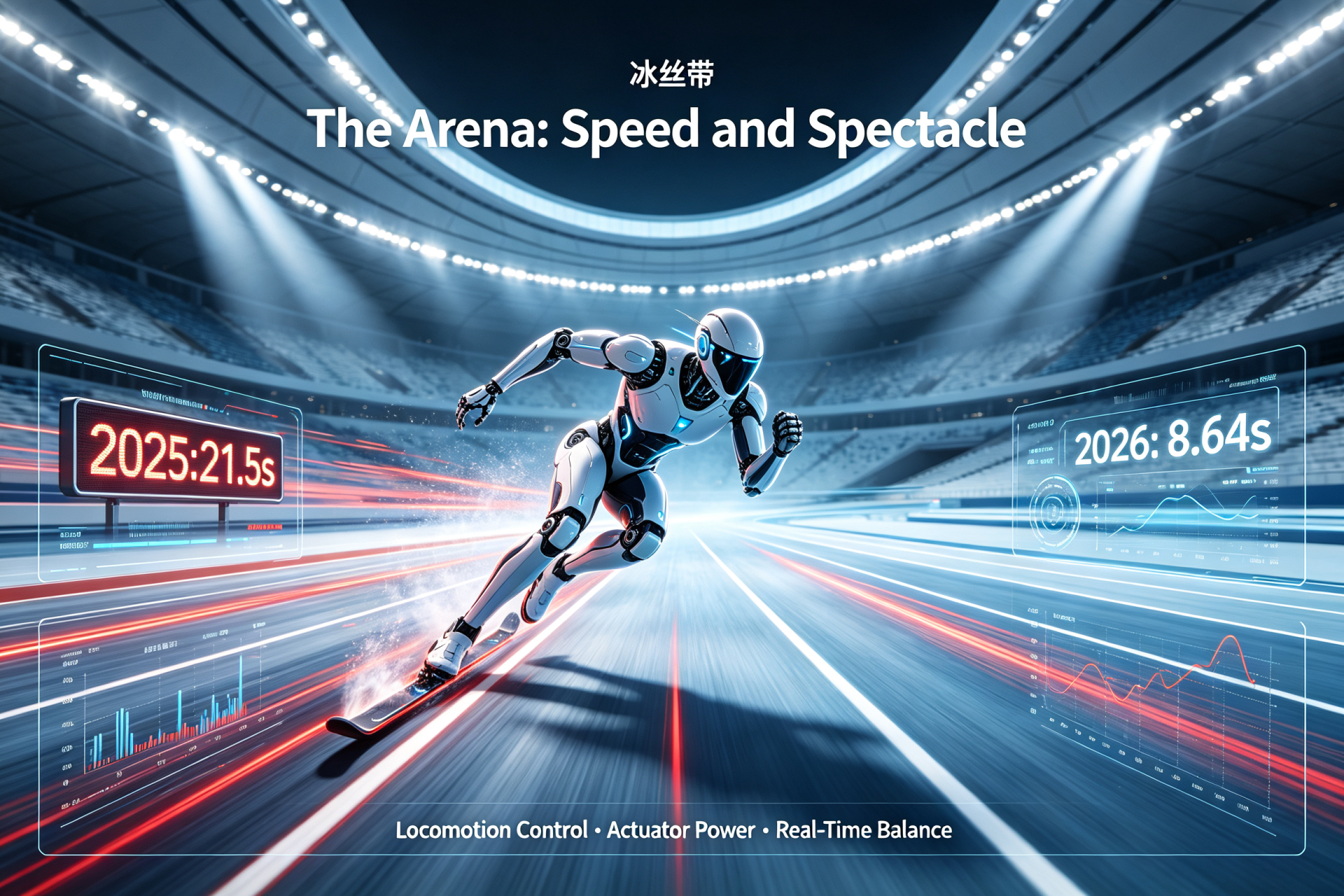
Athletic competition is, in many ways, the friendliest possible environment for a humanoid robot. The rules are fixed, the surfaces are predictable, and failure usually means a stumble rather than a costly mistake. It is also where progress is easiest to measure and most satisfying to watch.
The sprint figures tell the story of a field moving fast. Public data shows that the gap between the 2025 and 2026 champions of the same event collapsed from 21.5 seconds to 8.64 seconds—an improvement so steep that it reads less like incremental engineering and more like a breakthrough in locomotion control, actuator power density, and real-time balance. A standing vertical jump reported at 3.4 meters, if verified under the Games' own measurement protocol, would indicate a level of explosive power that few legged machines could claim even a year ago.
But athletics is also where the gap between "impressive" and "useful" is widest. A robot that runs fast on a track is a long way from a robot that can navigate a cluttered warehouse aisle without knocking anything over. The Games' organizers seemed to understand this, which is why they structured the event around far more than medals.
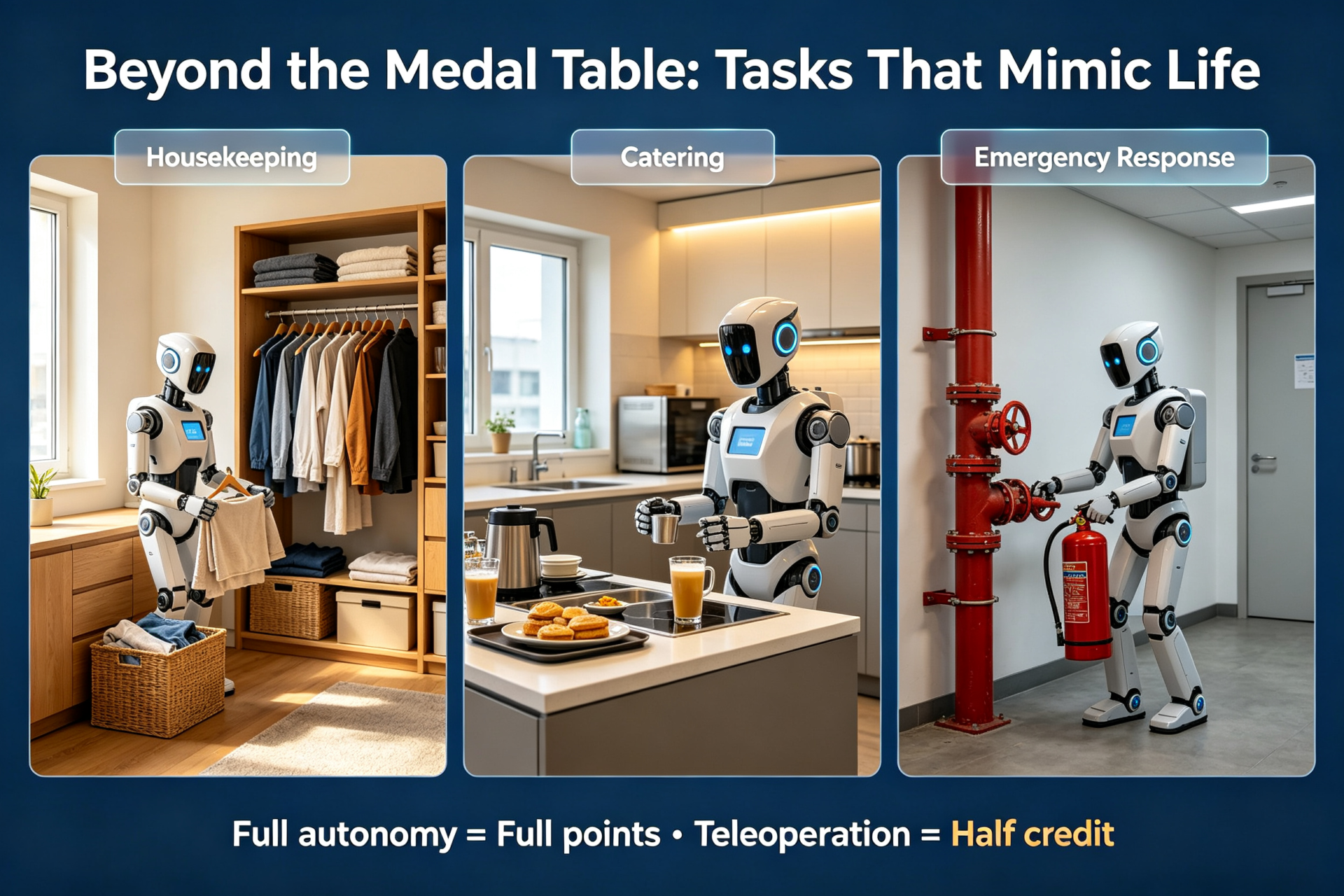
Of the 51 events at the 2026 Games, 21 were scenario competitions designed to replicate real environments—homes, hotels, industrial sites, catering operations, and emergency response. This was the most revealing part of the program, because it shifted the question from "how fast can you run?" to "can you actually help?"
The scoring system encoded a clear philosophy. Full autonomy earned full points; teleoperation—where a human controls the machine remotely—earned only half credit. In other words, the Games quietly penalized the very trick that makes most robot demos look good on stage: a person in the loop, smoothing over every hesitation.
Some of the tasks were almost domestic in their mundanity. In the home "housekeeping" challenge, a robot had to sort items, tidy a space, do laundry, and hang clothes across a living room, bedroom, bathroom, and balcony—then respond correctly when new instructions were inserted mid-task. The catering events required food pickup, heating, and drink making. These are precisely the chores that fill human days and that robotics has spent decades failing to automate reliably.
The most instructive event may have been the fire and emergency scenario. A robot had to identify hazards, shut off valves, and grab a 4.5–5 kg fire extinguisher—a load that sits beyond the comfortable limit of most commercial end-effectors. One team's solution was telling: rather than engineer a custom gripper, they added a wrist structure and a bucket tilted at 20 degrees to scoop and carry the cylinder. It was a pragmatic, almost unglamorous fix that solved a real constraint through mechanical cleverness rather than brute-force grasping.
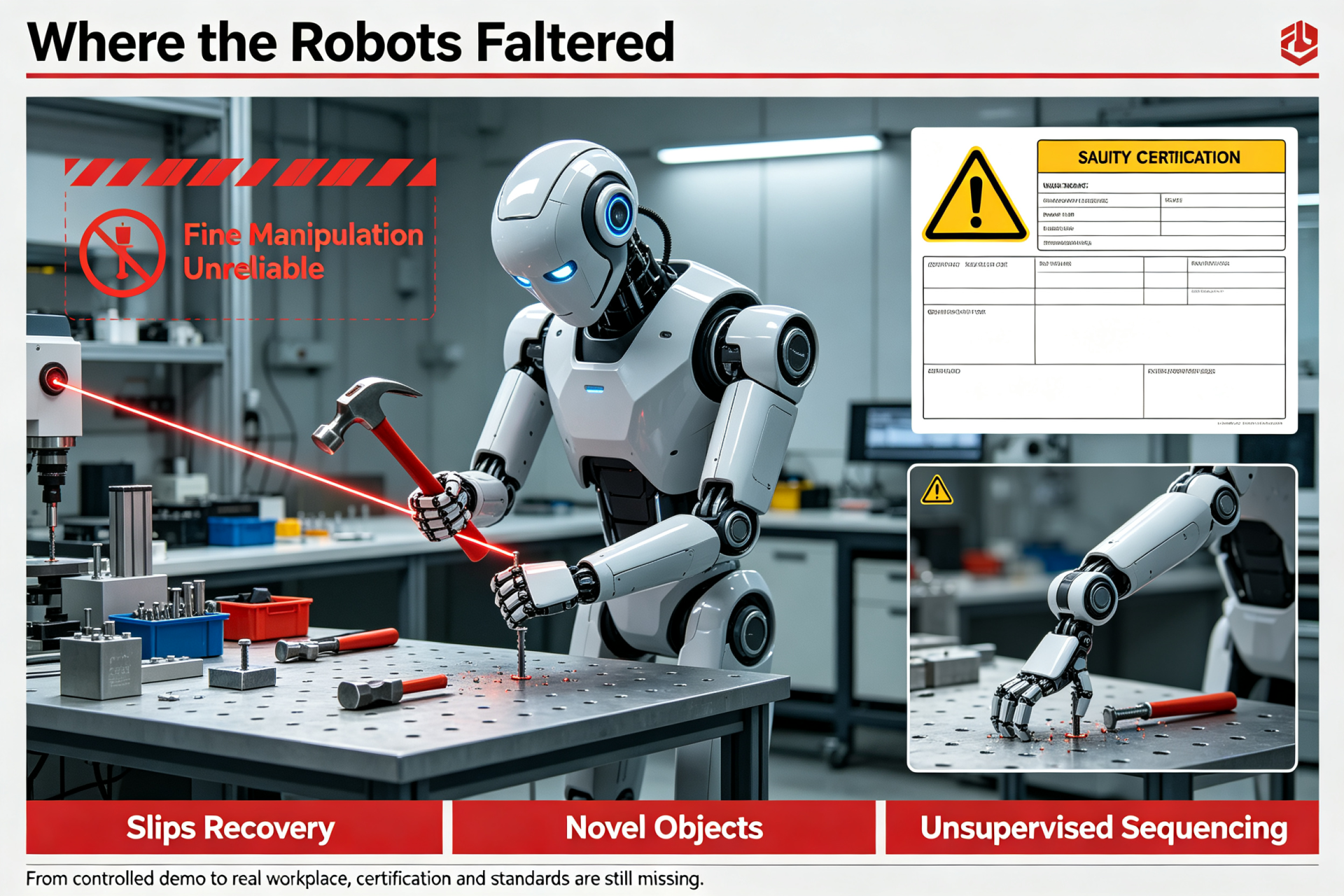
For all the wins, the Games also exposed the seams. Nature News, in a report published August 27, 2026, under the headline "Robot Olympics reveal humanoids' rapid progress—and flaws," noted that practical tasks remained stubbornly difficult. Hammering a nail, even with sensor-equipped gloves and teleoperation assistance, was still hard for the machines on the floor.
That is the kind of detail that should temper the hype. A nail hammered crookedly is a minor inconvenience in a lab; in a home or a construction site, it is a sign that fine manipulation—the genuinely hard part of physical intelligence—has not arrived yet. Running is a solved-enough problem. Grasping an unfamiliar object, applying the right force, recovering from a slip, and sequencing a dozen small actions without supervision is not.
Safety is the other unresolved question. CMU's Chris Atkeson, quoted in the same Nature report, warned that large robots that fall could injure people, and that unsupervised use will require regulations and standards to come first. This is not a Luddite objection. A 60-kilogram machine toppling onto a child is a real risk, and the path from "controlled demo" to "loose among humans" runs directly through certification, liability, and testing regimes that barely exist today.
The Games did not happen in a vacuum. They landed in the middle of a remarkably active Chinese robotics moment. The 2026 World Robot Conference (WRC), held in Beijing August 19–23, gathered more than 300 companies, showcased over 2,000 exhibits, and hosted 150-plus new product launches. Notably, it introduced a "Procurement Day" where roughly 50 state-owned enterprises brought real engineering scenarios—a signal that buyers, not just researchers, are starting to show up.
The commercial scale is also climbing. According to the 2026 Humanoid Robot Industry Development Report, China's humanoid robot shipments in the first half of 2026 exceeded 40,000 units. MIIT data indicates that the robotics industry's above-scale revenue surpassed 300 billion yuan in 2025, with a five-year compound annual growth rate above 20 percent; in the first half of 2026 alone it reached 165.5 billion yuan, up 24.5 percent year on year.
These are large numbers, but they deserve cautious reading. Shipments are not the same as deployments that work. Revenue growth reflects manufacturing and investment momentum as much as it reflects robots earning their keep in the field. The headline story of 2026 is less "humanoids have arrived" and more "humanoids are being produced and staged in volume, while their real-world competence is still being proven."

This is the central tension the Games laid bare. The industry has gotten very good at the demo: a robot that walks, waves, and completes a choreographed task under ideal conditions. It is far less good at deployment: a robot that performs the same task thousands of times, in variable lighting, with unfamiliar objects, without a handler standing by.
Industry framing captures the shift neatly. Analysts at BOCOM International, among others, suggest the evaluation bar is moving from "can it be built?" to "can it stably and economically complete tasks?" That second question is brutally practical. A prototype that impresses a crowd is one thing; a machine that a factory manager will pay for because it lowers cost per unit is another. The autonomy-weighted scoring at the Games was, in effect, a miniature version of this new standard: the value is in letting go of the human controller.
The 21 scenario events matter for exactly this reason. They are a proxy for the unglamorous truth that the money—and the impact—will come from tasks like laundry, food service, valve shutoff, and hotel housekeeping, not from sprint medals. The robots that win the future may be the ones that quietly succeed at the boring 0.5×-or-full-credit chores, not the ones that beat Bolt on a track.
There is a subtler lesson in the scoring, too. By weighting autonomy at full value and teleoperation at half, the Games refused to let teams hide human intelligence behind the machine. In commercial settings the same logic applies with even less mercy: a robot that needs a trained operator for every task inherits the operator's labor cost and limited attention span, defeating the economic case for the robot in the first place. The half-credit penalty was, in miniature, the market's own verdict. What buyers ultimately pay for is not the illusion of capability but the transfer of that capability away from people and onto the machine—reliably, repeatably, and at a price that beats the alternative.
If the Beijing Games were a snapshot of where humanoids stand today, the next clear vantage point is the Shanghai International Humanoid Robot and Robotics Industry Chain Exhibition 2026 (HRIE 2026), to be held December 9–11, 2026, at the National Exhibition and Convention Center (SNIEC), Shanghai. Where the Games emphasized competition, HRIE 2026 is positioned as the place to see the next generation of these robots and the companies racing from arena to factory floor—the full industry chain, from actuators and sensors to the integrated machines and the buyers who will put them to work.
For anyone trying to judge whether the demo-to-deployment gap is closing, HRIE 2026 will be worth watching closely. The interesting exhibits will not be the fastest sprinter or the highest jumper. They will be the robots that can do the laundry, carry the extinguisher, and hammer the nail—and, crucially, do it without a person holding the controls. The arena showed us what humanoids can already do. HRIE 2026 is where we will learn what they can actually deliver.