


China Industrial Cooperation Association
Shanghai Federation of Industrial Economics
Shanghai Federation of Economic Organization
Industrial and Information Technology Equipment Engineering Research Institute (Beijing) Co., Ltd
Green Industry Enerey Conservation Branch, CICA
Golden Conference & Exhibition Group
Shanghai Berrick Exhibition Co., Ltd
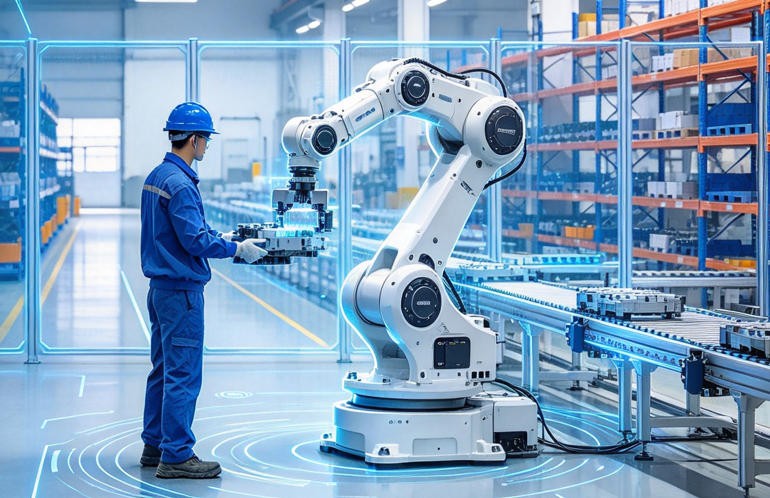
For the better part of a decade, the humanoid robot was a creature of the cage. It could walk, grasp, and sort — but only behind galvanized steel, a tripwire of safety light curtains, and a control logic whose first instinct, on any human intrusion, was to freeze. The fence was not a design choice; it was a confession that the machine could not yet be trusted in shared space. In 2026, that confession is quietly being withdrawn. Across warehouses, distribution centers, and automotive lines, deployments are proving a humanoid can work a few feet from a person without a barrier — and that removing the fence, more than any new gait or gripper, is the milestone that turns a demonstration into a deployable product. The shift will be on full display at the Shanghai International Humanoid Robot and Robotics Industry Chain Exhibition 2026 (HRIE 2026), to be held December 9–11, 2026, at the National Exhibition and Convention Center (SNIEC), Shanghai.
1. Why the Fence Was Always the Real Bottleneck
The safety cage solved the liability problem but created three others. It fixed the robot to a single, pre-mapped cell; it forced factories to rip out and re-pour floor space to install a dedicated enclosure; and it sharply limited the variety of work a humanoid could actually do, because the moment a task required the robot to traverse a real, occupied aisle, the cage made it either impossible or absurdly expensive.
Industry analysts have long noted that retrofitting a brownfield plant for caged automation is often the single largest line item in a deployment budget — frequently rivaling or exceeding the cost of the robot itself. For a technology whose selling point is "it fits the human world," the cage was an admission of defeat. The 2026 inflection point is not that robots became stronger or smarter in some headline metric; it is that they became trustworthy enough to step out of the enclosure.
2. The 2026 Breakthrough: Agility's Digit 5 and the Three-Layer Safety Architecture
The clearest signal came on September 15, 2026, when Agility Robotics unveiled the fifth-generation Digit. According to the company's public announcement, Digit 5 is the first humanoid to perform fenceless human-robot collaboration in an industrial setting — operating close to workers in the same floor space without a physical enclosure, relying on what Agility describes as a "three-layer independent safety architecture."
A single emergency-stop button is not enough to earn fenceless status; regulators and insurers require redundancy and independence, so that no single fault can silently disable the protective system. Agility's framing of a three-layer, independent architecture — layers that presumably span sensing, control, and actuation, each able to halt the robot without depending on the others — is the kind of design language safety certifiers respond to. It reframes the robot from "must be contained" to "can be reasoned about."
By the company's account, Digit 5 runs the fenceless mode in a live industrial workflow, where workers and machines share the same aisle and clock. That distinction matters: prior humanoid deployments in real factories were, almost without exception, fenced or light-curtain isolated, any human crossing the boundary triggering an immediate halt. Removing it — credibly, with an independent safety case behind it — is the step previous generations could not take.
3. From Pilot to Paid: Figure, Catalyst Brands, and the Reno Distribution Center
Trust is one thing; a signed contract is another. On May 26, 2026, Figure AI and Catalyst Brands announced a commercial deployment agreement that, by public reports, stands out from the usual stream of pilots. Catalyst Brands is the parent of JCPenney, Brooks Brothers, Aéropostale, Lucky Brand, and Nautica — a retail group operating roughly 1,800 stores. The deal puts Figure's humanoids to work at Catalyst's Reno, Nevada distribution center, in a sortation and organization task the companies call "Joey Pouch."
Its stated nature makes this agreement a marker rather than a footnote: a commercial deployment with a named customer, not a pilot, and it reportedly includes a seasonal rapid-scaling clause — the kind of provision that only makes sense if both sides expect real volume and real peak-period demand. Retail logistics is a world of unpredictable surges; a contract built to flex with the holiday curve is a contract written for production, not for a press photo. Figure had already placed robots alongside BMW at the automaker's Spartanburg, South Carolina plant, giving the company a second, very different reference site.
Sortation and pouch organization happen in the thick of a working floor, intermixed with human pickers and packers; a robot doing this work from inside a cage would defeat much of the purpose. Public descriptions of the engagement point to collaborative, shared-space operation — exactly the scenario the fence was meant to forbid.
4. The Market Reprices the Robot
When the conversation shifts from "can it work" to "how many will ship," the analysts move next. Goldman Sachs, in its latest global Physical AI report, sharply raised its humanoid-robot shipment outlook: global units climbing from roughly 75,000 in 2026 to about 890,000 in 2030, a projection well above its prior 2030 forecast of 256,000 units, according to the bank's published figures. Deutsche Bank, for its part, lifted its 2026 shipment expectation from 17,500 units to around 50,000, and has framed China as the core engine of global growth, as reported in its research notes.
These are revisions, not guarantees: the direction of the revisions — uniformly up, and in Goldman's case up by more than threefold on the 2030 number — is itself the signal. The market is not pricing a single product launch; it is pricing a category crossing the line from science project to procurement line item. When two major banks independently lift volume expectations in the same year, the move typically reflects downstream customer interest heard in the field, not a change in robot horsepower. Shipment forecasts for an emerging category carry wide error bars, and 2026 volumes remain small in absolute terms. The number that matters for the fenceless story is not the unit count but the composition — how many of those shipments are going to paid, shared-space deployments versus showcase demos.
5. The Real Test: Finding a Scenario That Pays, Repeatedly
The 2026 narrative is a story about economics, not engineering. The field has moved past "can it be built" toward "can anyone find a scenario where it is paid for, continuously, at a defensible return." Warehouse logistics and commercial retail have emerged as the clearest commercialization validators, combining repetitive, definable tasks with acute, structural labor pressure.
Two dividing lines now separate the deployed from the decorative. The first is RaaS — Robotics-as-a-Service — which converts a six-figure capital purchase into a per-hour or per-task operating expense. For a distribution-center operator wary of betting its balance sheet on a still-maturing platform, RaaS is what makes a fenceless pilot survivable: if the robot underperforms, the contract lapses rather than the CAPEX sinking. The second dividing line is batch consistency — the unglamorous discipline of building hundreds of identical units to automotive-grade manufacturing takt and passing 3C-style certification and reliability testing. A one-off miracle robot is a research project; a thousand near-identical, certified, field-swappable robots is a supply chain. Industry observers broadly agree that consistent batch quality, not prototype brilliance, will decide who scales.
A caged robot is a fixed installation with a narrow job; a trusted, fenceless robot is a mobile asset that can be redeployed across a floor as needs shift. The humanoid business case was always stronger if the machine could roam — and 2026 is the year roaming stopped being a safety violation and started being a spec sheet.
6. The Invisible Infrastructure: Sim-to-Real and the Digital Twin
None of this trust was earned on the factory floor alone. The quiet enabler behind fenceless deployment is simulation — the ability to rehearse tens of thousands of human-robot proximity scenarios before a single unit ships. Platforms such as NVIDIA's Isaac Sim and the GR00T embodied-AI stack, and partnerships like NVIDIA's with Siemens, let developers run sim-to-real and digital-twin workflows, training the robot and its collaboration policies in a synthetic world where a misjudged approach costs nothing but compute.
For safety validation, the digital twin is the argument that persuades the certifier. Instead of proving fenceless behavior through a handful of live trials, teams can present evidence drawn from massive simulated exposure: edge cases of a person stepping into a pathway, dropping an object in the robot's lane, or approaching from a blind angle. The three-layer safety architecture that makes Digit 5 credible is, in practice, validated by exactly this kind of pre-run. Simulation does not replace the real world, but it converts "we think it's safe" into "we have observed it stay safe across scenarios we could never stage live" — the difference between a fence and a safety case.
7. The Fence Comes Down — and the Field Gathers
The throughline of 2026 is deceptively simple: the humanoid became trustworthy in shared space. Agility's Digit 5 showed a fenceless architecture that certifiers can reason about. Figure's Catalyst Brands contract showed a named retailer willing to put that trust into a paid, scaling deployment. The banks repriced the category upward. And underneath it all, simulation turned safety from a promise into a provable property.
That is why the year's real headline is not a backflip or a new hand, but the sound of a fence being removed — and the recognition that the interesting work now happens on the unguarded side of it. The place to see that work gathered in one room is HRIE 2026, at the National Exhibition and Convention Center (SNIEC), Shanghai. There, the platforms now running fenceless collaboration — from industrial humanoids to the sim-to-real stacks that validated them — are expected to be demonstrated side by side, giving buyers and certifiers one floor to judge whether the cage has truly become optional. If 2026 is the year humanoids stepped out from behind the fence, December in Shanghai is where the industry will compare notes on what they do next, shoulder-to-shoulder with the people they were built to work beside.