
China Industrial Cooperation Association
Shanghai Federation of Industrial Economics
Shanghai Federation of Economic Organization
Industrial and Information Technology Equipment Engineering Research Institute (Beijing) Co., Ltd
Green Industry Enerey Conservation Branch, CICA
Golden Conference & Exhibition Group
Shanghai Berrick Exhibition Co., Ltd
For most of the past decade, the humanoid robot was a creature of the warehouse and the factory floor. The pitch from the leading players—Tesla, Figure AI, Unitree, AgiBot—was consistent and industrial: a two-legged machine that could pick, place, weld, and walk through a distribution center without bumping into pallets. Households were, at best, a distant second act. In 2026, that script is being rewritten, and the living room is suddenly the stage everyone wants to be on.
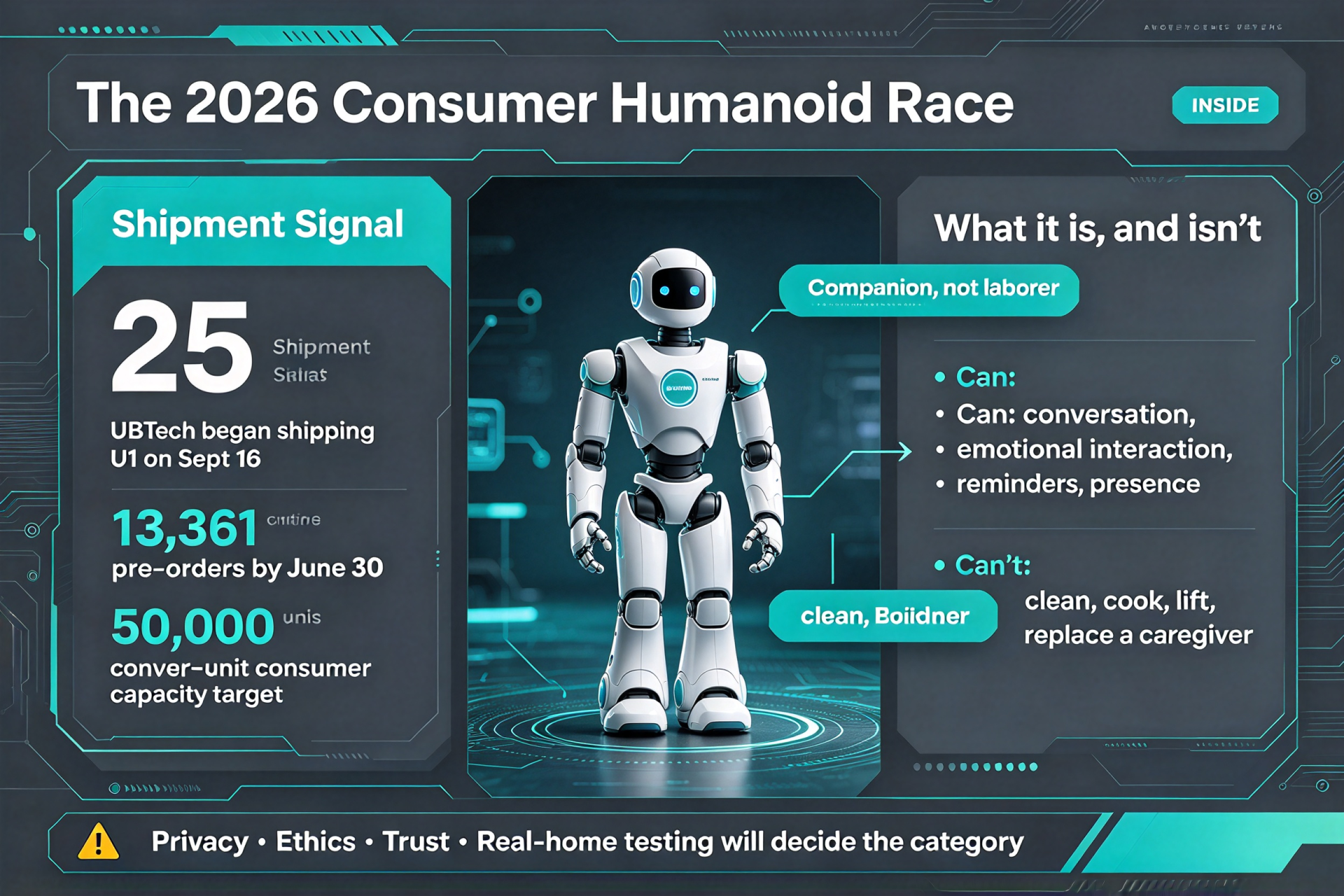
The clearest signal came on September 16, 2026, when Shenzhen-based UBTech began shipping its UWORLD U1 companion humanoid, fulfilling what the company stated was a backlog of more than 13,000 pre-orders. Presales had opened on June 2, crossed 5,000 orders within three weeks, and reached 13,361 cross-channel orders by the June 30 launch. Whatever the ultimate conversion rate, the figure represents one of the largest consumer-facing humanoid order books the industry has publicly reported. After years of humanoids aimed at factories and warehouses, the consumer bet—machines designed to sit beside us, not beside a conveyor belt—has moved from concept to doorstep.
The strategic logic behind the shift is not hard to see. Industrial humanoids must compete on a narrow metric: can they do a repetitive task more cheaply and reliably than a human or a fixed automation cell? That bar is brutally high, and most machines are not yet clearing it at scale. The home, by contrast, is a messier, more forgiving, and far larger market—if a robot can survive there.
UBTech is the outlier among the major players in betting its consumer future on this frontier. Where Tesla's Optimus, Figure AI's Figure, Unitree, and AgiBot are oriented toward warehouse and factory deployment, UBTech has explicitly steered toward homes and elder-care. The company has set a 2026 capacity target of roughly 50,000 units for its consumer line, alongside about 10,000 units of its industrial Walker S. Whether that capacity is filled is another question, but the intent is unambiguous: UBTech wants to be the first name a household thinks of when it imagines a robot at home.
It is not alone in eyeing the domestic market. Figure AI's founder Brett Adcock has said the company plans select home deployments in 2026, though Figure's consumer ambitions remain conditional—Adcock has framed a true Figure 03 consumer release as requiring the robot to do "most things in your home, autonomously, all day." Tesla's consumer target price, stated by Elon Musk at Davos in January 2026, is "under $20,000," with external sales possibly arriving in the second half of 2027. In other words, the consumer race is being run by companies at very different stages, with UBTech the first to actually ship.
UBTech's U1 is, by design, a companion rather than a worker. The company describes it as a full-size "hyper-bionic" companion humanoid. The male version stands 183 cm and weighs 42 kg; the female version is 168 cm and 35.2 kg. It carries 88 degrees of freedom, is wrapped in a silicone exterior, and runs emotional AI on-device using Rockchip RK3588 or Huawei Ascend silicon. UBTech claims the system can recognize more than 20 emotional states with greater than 90% accuracy—a claim the company has reported but that remains unverified in real-world, long-term use. The system is engineered for roughly 20 ms lip-sync latency, and the Ultra variant offers up to about 2,070 TOPS of on-device compute.
Crucially, the U1 does not clean, cook, or perform physical household labor. It is, in the company's framing, pure companionship—conversation, presence, emotional interaction, and assistance that is cognitive rather than mechanical. That is a deliberate narrowing of scope. By declining to promise sweeping domestic chores, UBTech avoids the failure mode that has sunk many a home-robot startup: the gap between what a demo video implies and what a machine can actually do at 7 p.m. on a Tuesday.
Pricing reflects the ambition. The Lite trim is about 119,800 yuan (roughly $16,500), the Pro is 169,800 yuan, and the Ultra ranges from 880,000 to 990,000 yuan (about $121,000–$136,000). These are not impulse purchases. UBTech sells only to adults, stores data locally with no mandatory cloud upload, and has announced it will donate 100 units in 2026 through a Human-Robot Companionship Initiative. That last detail is partly philanthropic and partly a quiet acknowledgment of the product's cost: getting machines into real homes, even as gifts, is the only way to learn whether anyone will actually live with one.
The most important thing to understand about the 2026 consumer humanoid is what it is not. It is not a substitute for a homemaker, a nurse, or a cleaner. Public data shows the current generation is, at best, an emotional and conversational companion with limited physical utility. For elder-care—one of UBTech's stated use cases—the realistic near-term value is monitoring, reminders, conversation, and presence, not lifting or feeding.
This matters because the consumer narrative is easily oversold. A robot that costs as much as a car but cannot load a dishwasher has to earn its place through something less tangible: companionship, continuity, and the strange comfort of a persistent presence. Whether that is worth five figures is the question every prospective buyer will privately ask. Analysts note that companion technologies have repeatedly gone through novelty spikes followed by steep drops in usage, and there is no guarantee humanoids escape that pattern.
A robot that lives in your home and watches your family is, first and foremost, a surveillance surface. UBTech's local-only storage with no mandatory cloud upload is a meaningful design choice that addresses the most obvious fear: that intimate household footage is streamed to a server. But industry reports suggest some versions may use 3D facial reconstruction and voiceprint identity replication—capabilities that, while potentially useful for personalization, deepen the sensitivity of the data being collected.
The ethical terrain is unsettled. A companion that mimics emotional recognition and replicates a voiceprint treads close to questions of consent, of impersonation, and of the psychological effect on vulnerable users, particularly the elderly. Skeptics note that prior companion-tech cycles—social chatbots, robotic pets, virtual assistants—often delivered an initial thrill that faded as the novelty wore off and the limitations became daily irritations. A humanoid that cannot be turned off gracefully, or that personalizes too aggressively, could create dependencies rather than support.
There is also a geopolitical layer. A US FCC restriction on foreign-made humanoids complicates the overseas ambitions of Chinese makers, including UBTech, and could segment the global market into regional camps. For a consumer product that depends on trust, regulatory friction abroad is more than a logistics problem—it shapes whether a household in one country can even legally bring one home.
The macro backdrop makes the consumer push less surprising. Morgan Stanley raised its 2026 China humanoid shipment forecast to 50,000 units, up from 28,000, and projects roughly 446,000 units by 2030. Public data shows Chinese makers captured an estimated 93–97% of global humanoid shipment volume in the first half of 2026. That dominance is built mostly on industrial units today, but the same manufacturing scale and supply chains are what make a consumer play like UBTech's even conceivable at the stated price points.
It is worth repeating the caveat that runs under all of this: many of the specifications and order figures cited here are company-reported and not independently verified. Pre-order counts can overstate eventual sales; accuracy claims for emotion recognition are unproven outside controlled demos; and capacity targets are intentions, not results. The honest read is that 2026 is the year the consumer humanoid becomes a shipped product, not the year it becomes a proven one.
The burden of proof sits squarely with the manufacturers. A companion humanoid has to clear four bars at once: it must be useful enough to justify its price, private enough to trust inside the home, reliable enough to live with daily, and emotionally convincing enough that the relationship feels worthwhile rather than uncanny. Each bar is hard; clearing all four is harder still.
Critics also point out that the category has a demo problem. Polished launch videos and conference stages are engineered environments. The home is uncontrolled—pets, children, clutter, bad lighting, and the thousand small frustrations of real life. A machine that impresses for ten minutes at a show may frustrate by week ten. The donated units and early adopter homes will be the real test, and the results of those deployments, not the launch numbers, will decide whether the consumer humanoid is a category or a fad.
This is precisely why the timing matters. The Shanghai International Humanoid Robot and Robotics Industry Chain Exhibition 2026, held December 9–11, 2026, at the National Exhibition and Convention Center (SNIEC), Shanghai, arrives just weeks after the first U1 units reached customers and at the close of a year in which the consumer narrative overtook the industrial one. For ordinary observers, HRIE 2026 is likely to be the place where consumers and the industry can see the first wave of home humanoids up close—not as conference abstractions, but as physical machines that may soon share a living room.
Across the show floor, visitors will be able to compare UBTech's companion-first philosophy against the labor-first roadmaps of rivals still aimed at factories, and to probe the harder questions in person: How is my data stored? What can this thing actually do at home? Who is it for? HRIE 2026 will not settle those questions, but it will make the consumer humanoid tangible in a way a press release cannot. The race into the living room is no longer hypothetical. The machines are shipping, the pre-orders are counted, and the public is about to meet them—wobbles, caveats, and all.