
China Industrial Cooperation Association
Shanghai Federation of Industrial Economics
Shanghai Federation of Economic Organization
Industrial and Information Technology Equipment Engineering Research Institute (Beijing) Co., Ltd
Green Industry Enerey Conservation Branch, CICA
Golden Conference & Exhibition Group
Shanghai Berrick Exhibition Co., Ltd
For most of the past decade, the humanoid robot was treated as a curiosity — a research lab demo, a conference stage gag, a moonshot from Tesla and a handful of well-funded startups. That framing ended on July 28, 2026, when the US Federal Communications Commission effectively declared the Chinese-made humanoid a national security problem. The decision pulled the world's most advanced robotics supply chain into the center of US-China technological rivalry, and it is now forcing a quiet but consequential realignment of who builds, who supplies, and who buys the machines.
The story is not simply "America versus China." It is a story about magnets, batteries, actuators, and the slow construction of two parallel supply chains — one centered on China, one being assembled everywhere else, with South Korea emerging as a pivotal new node. To understand what comes next, start with the ban itself.
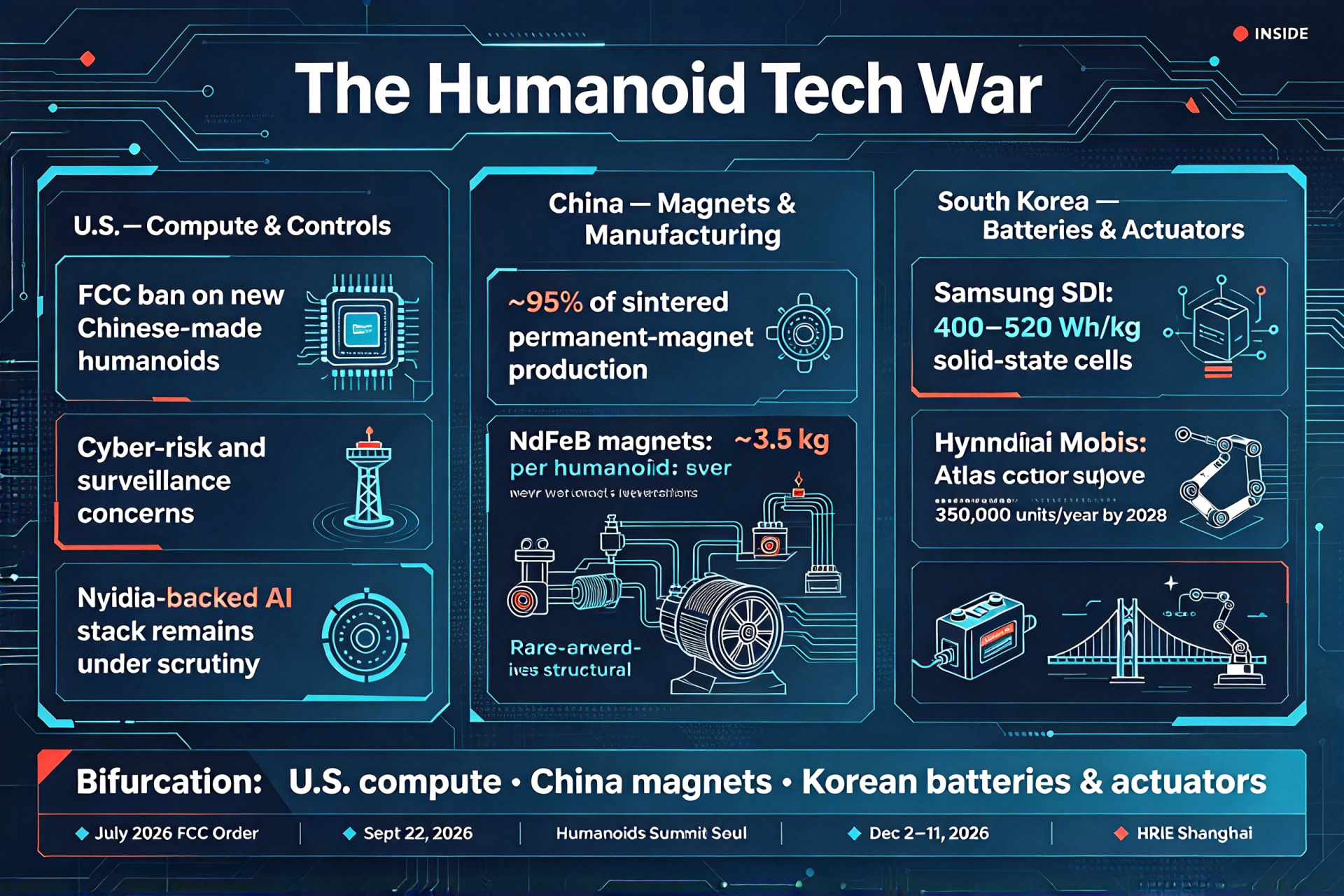
On July 28, 2026, the FCC announced that it would ban imports of new Chinese-made humanoid and quadruped robots, along with connected power inverters, adding them to its "Covered List." The order is effective on publication and applies specifically to not-yet-released models; the FCC retains the authority to revoke prior authorizations, and industry reports suggest the restrictions could expand over time. The rationale, the FCC stated, is to protect critical supply chains from "foreign threats" and to limit cyber risk to infrastructure. FCC Chair Brendan Carr argued that the robots "could be leveraged by malign actors to surveil Americans... or remotely commandeer the robots."
The language echoes earlier US actions against Chinese drones and routers: the goal is to keep networked hardware built by a strategic rival out of American homes, factories, and public spaces. Public data shows the ban applies only to new imports — existing authorized models already on the market remain unaffected — but the precedent is what matters. Once a product category is on the Covered List, the burden of proof shifts to suppliers, and non-Chinese vendors stand to benefit by default. Analysts note the FCC is expected to exempt many non-Chinese suppliers, much as it did with earlier drone and router bans.
The most exposed company is Unitree. According to Counterpoint, Unitree holds just under one-fifth of the global humanoid market, and Counterpoint's installation-share data ranks Unitree, Agibot, and UBTech as the top three humanoid makers, with Tesla's Optimus fifth. Unitree also sits on the Pentagon's list of alleged Chinese military-backed firms and has a high-profile Nvidia Blackwell partnership. Nvidia, for its part, says robot data stays in the US and that its biggest customers for this work are American academic and research institutions — a point that complicates any simple narrative of Chinese capture of the AI stack.
China's response was swift and predictable. Its embassy in Washington condemned what it called the "politicizing [of] trade" and pledged countermeasures. China's commerce ministry urged reversal of the decision or warned of "repercussions." The exchange is now a familiar choreography of the wider tech conflict. The US already restricts advanced semiconductor exports to China, and Treasury's Bessent has warned that Chinese AI firms could face intellectual-property-theft sanctions. The robot ban is the latest tile in a much larger mosaic.
If Washington holds the semiconductor nozzle, Beijing holds something equally structural: the magnet. Humanoid robots are actuator-dense machines. Public data shows each humanoid uses roughly 3.5 kilograms of neodymium-iron-boron (NdFeB) magnet material spread across more than 40 actuators, and the high-performance servo magnets in those actuators depend on heavy rare earths — terbium and dysprosium — to survive heat and retain strength. According to the International Energy Agency, China controls about 94% of global sintered permanent-magnet production. That dominance is not easily replicated; building alternative magnet supply outside China is a multi-year, capital-heavy undertaking.
This is the counter-leverage Marc Einstein of Counterpoint has pointed to: Beijing's most effective countermove, he argues, would be restricting rare-earth exports to US firms and limiting US market access — for Tesla and Nvidia — inside China. Such a move would not stop American robots, but it would raise their cost and slow their scaling precisely at the moment the industry is trying to move from demo to deployment. The dynamic is asymmetric and therefore unstable: each side can hurt the other, but the pain lands on different parts of the value chain.
Here is where the map gets redrawn rather than simply split in two. As the US and China dig in, a third ecosystem is accelerating — and South Korea is its anchor. The Humanoids Summit Seoul opens September 22, 2026, and the country arrives with two concrete advantages that matter for exactly the parts of a humanoid that are hardest to source.
The first is batteries. Samsung SDI targets solid-state battery mass production in late 2027, with energy densities of 400–520 Wh/kg compared with 250–300 Wh/kg for today's NMC cells. For a humanoid, where every gram of payload is precious and runtime is a design constraint, that step-change is significant. TrendForce projects that solid-state battery demand for humanoids alone could exceed 74 GWh by 2035 — a market large enough to anchor an entire domestic supply chain.
The second is actuators, the mechanical heart of any humanoid. Hyundai Mobis now supplies actuators for Boston Dynamics' Atlas, becoming the first official Korean robotics supplier for the platform, and it plans US actuator capacity exceeding 350,000 units per year by 2028 — enough, analysts note, to support roughly 30,000 Atlas-class robots annually. Goldman Sachs' June 2026 Korea report argues that Korean firms will "eventually see a greater role" as a key supplier for non-China humanoids. In a world where Chinese actuators may face the same scrutiny Chinese robots now do, a friendly, high-quality alternative supplier is exactly what Western robot makers need.
The timing is not accidental. Korea's conglomerates spent years building battery and powertrain expertise for automobiles, and the humanoid is, in engineering terms, a small, untethered vehicle with legs. The same discipline that made Korean EVs competitive — cell chemistry, thermal management, precision mechatronics — transfers directly to robots. That inherited capability, combined with Seoul's position outside both the US Covered List and Beijing's retaliation perimeter, makes Korea the natural neutral ground on which a non-China humanoid supply chain can be assembled. The Humanoids Summit Seoul, opening September 22, 2026, is less a coming-out party than a staging event for suppliers already moving into the gap.
What is emerging is not a single clean break but a layered restructuring. The US ban applies only to new imports today, and the impact is still unfolding; existing authorized Chinese models remain on the shelves, and American researchers can still work with Nvidia-backed systems under the data-handling arrangements Nvidia describes. But the direction is clear. Experts expect the restrictions could expand, and the mere presence of humanoids on the Covered List recalibrates procurement, investment, and partnership decisions across the industry.
Consider the incentives now in play. A US or European robot maker has a new reason to qualify Korean actuators and batteries, and to design around Chinese magnets where possible. A Chinese maker has a new reason to deepen domestic supply and to push into non-US markets — the Global South, the Middle East, and parts of Asia where the FCC's label carries less weight. South Korea, sitting between the two blocs, has a new reason to build capacity that serves neither side exclusively but is trusted by both the West and, commercially, by China's neighbors.
This is the real story of the humanoid tech war: not a single winner, but a bifurcation of the bill of materials. Compute and semiconductors tilt American. Magnets and volume manufacturing tilt Chinese. Batteries and a credible actuator alternative tilt Korean. The robot that walks out of a factory in 2030 will carry a different passport depending on which supply chain assembled it.
The commercial logic reinforces the political one. Companies hate single-source dependency, and the threat of a rare-earth squeeze or an expanded import ban makes dual-sourcing a board-level priority rather than a procurement footnote. Public data shows the US ban's impact is still unfolding, and that existing authorized Chinese models remain unaffected for now — but the planning horizon in this industry runs to 2028 and beyond, exactly the window in which Samsung SDI's solid-state line and Hyundai Mobis' US actuator plant come online. The supply chains being designed today will be the ones shipping when the restrictions, experts expect, likely broaden.
That is precisely why the coming year's exhibition calendar matters. The Shanghai International Humanoid Robot and Robotics Industry Chain Exhibition 2026 — held December 9–11, 2026, at the National Exhibition and Convention Center (SNIEC), Shanghai — arrives at the exact moment this realignment is taking shape. As a global showcase, HRIE 2026 will put the competing US, Chinese, and Korean supply-chain ecosystems on display side by side: the Chinese champions racing to prove scale and self-reliance, the American compute-and-Al platforms navigating a restricted import regime, and the Korean battery and actuator suppliers positioning themselves as the indispensable bridge for everyone building outside China.
For buyers, the geopolitical layer is no longer background noise. A procurement decision in 2027 will implicitly choose a supply chain as much as a product, with consequences for data residency, upgrade paths, and regulatory exposure. For policymakers, HRIE 2026 will be a live read on how deeply the decoupling has bitten. And for the industry itself, the exhibition is a reminder that humanoids were supposed to be a shared technological frontier — and that, at least for now, the frontier has borders.
The robot has walked into the trade war. Whether it walks out on one supply chain or many will be decided in places like Shanghai, Seoul, and Washington over the next eighteen months.