

China Industrial Cooperation Association
Shanghai Federation of Industrial Economics
Shanghai Federation of Economic Organization
Industrial and Information Technology Equipment Engineering Research Institute (Beijing) Co., Ltd
Green Industry Enerey Conservation Branch, CICA
Golden Conference & Exhibition Group
Shanghai Berrick Exhibition Co., Ltd
The first wave of humanoid robots is not arriving with pink slips. It is arriving with timesheets that nobody can fill.
Across factories, warehouses, hospital wards and freight yards, employers in 2026 are deploying two-legged, two-armed machines less because they want to shed workers and more because a shrinking pool of workers is forcing their hand. The framing that dominates the public debate — robots versus jobs, a zero-sum war for human livelihoods — is real enough in the anxiety it produces, but it obscures the more complicated reality on the floor: for the foreseeable future, the dominant pattern is augmentation under duress, not replacement at scale. The displacement risk is genuine and will intensify through the decade, yet the immediate story is one of emergency reinforcements against labor shortages so severe they are throttling output.
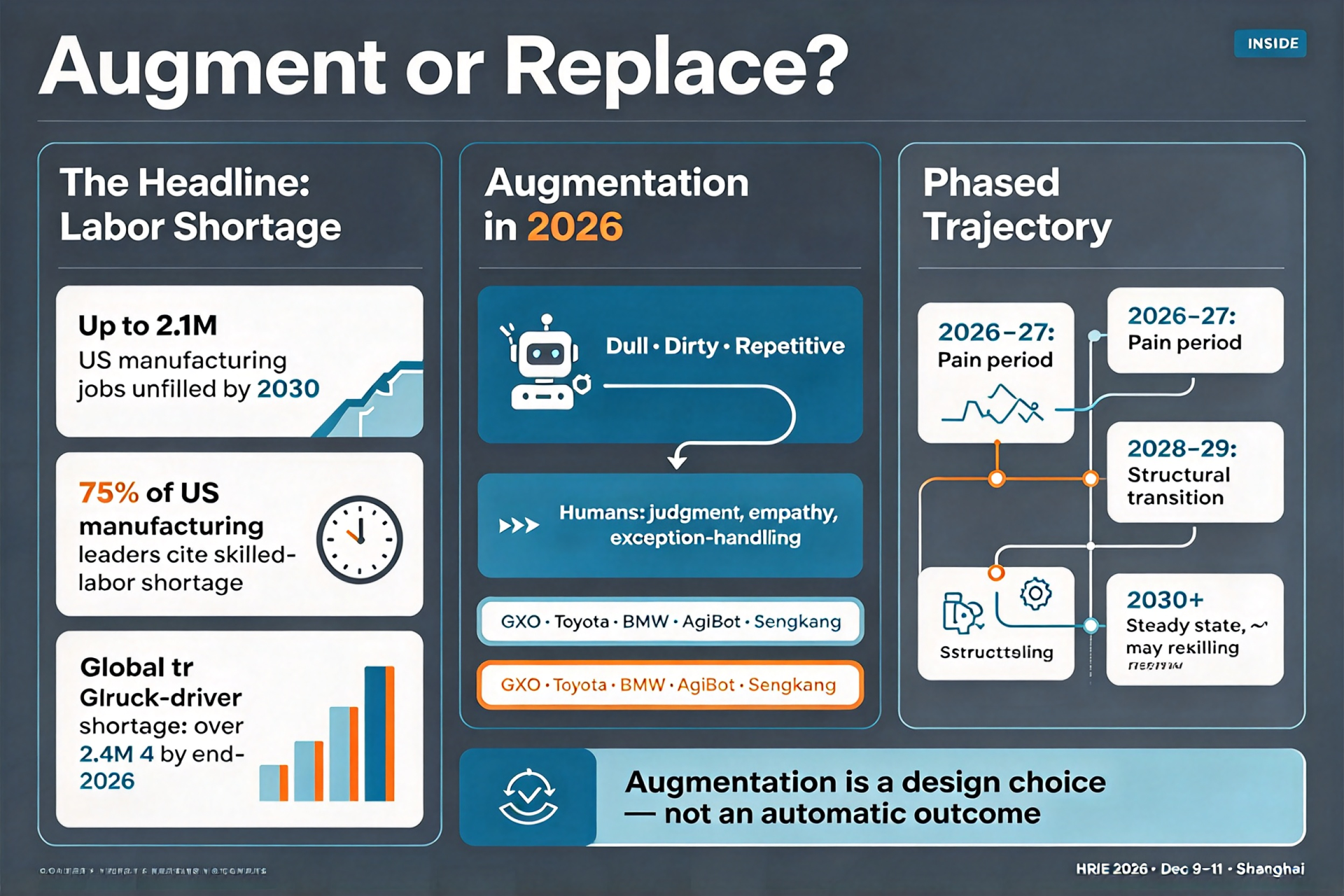
The pressure pushing humanoids into workplaces is, above all, demographic and structural. According to a Deloitte and The Manufacturing Institute projection, up to 2.1 million US manufacturing jobs could go unfilled by 2030, translating into roughly $1 trillion in lost annual output. A January 2026 CADDi survey found that 79% of US manufacturing leaders cite the skilled-labor shortage as their single biggest barrier to growth. The squeeze is not uniquely American: public data shows about 74% of global employers struggle to find skilled workers. And the gap extends well beyond the factory gate — the International Road Transport Union projects a global truck-driver shortage exceeding 2.4 million by the end of 2026.
This is the context in which humanoids stop being a science project and start becoming a procurement line item. When a logistics operation cannot staff its shifts, the question is not "will a robot take someone's job?" but "who, or what, will run the line tonight?" Forrester's "The State of Humanoid Robots, 2026" captures the mood: the firm reports that roughly 69% of automation decision-makers are adopting or planning to adopt humanoids. That is an adoption intent driven less by a lust for headcount reduction than by the simple arithmetic of empty seats.
The early deployments tell a consistent story: robots are being slotted into the dull, dirty and dangerous work that humans are either scarce for or reluctant to do, freeing people for tasks that need judgment, empathy or flexibility. Forrester's early adopters report roughly 40% fewer processing errors and about 20% lower labor costs where humanoids standardize repetitive, high-friction work — gains that come precisely from taking variability off human hands.
The field evidence is accumulating fast. GXO, working with Agility Robotics' Digit, moved more than 100,000 totes in live operations by November 2025. Toyota's manufacturing plant in Cambridge, Ontario (TMMC) signed a robotics-as-a-service (RaaS) deal with Digit in February 2026. At BMW's Spartanburg plant, Figure 02 loaded more than 90,000 sheet-metal parts and contributed to over 30,000 BMW vehicles across roughly 11 months on 10-hour shifts. In China, AgiBot's A2-W handles about 30% of material transport with zero errors. And in a telling care-setting example, Singapore's Sengkang hospital uses a robot named Dexie for multilingual dementia care, allowing staff to focus on the higher-empathy parts of the job.
None of these is a human being shown the door. Each is a machine absorbing a task that was previously a bottleneck — a tote that needed moving, a part that needed loading, a transport run that needed a body. Forrester VP Charlie Dai sums up the posture his firm recommends: view humanoids as "workforce multipliers that augment human capabilities rather than wholesale replacements."
It would be glib to tell a warehouse picker or a logistics clerk that the robot is "just helping." The replacement risk is real, and industry reports suggest the first impact will land precisely on the repetitive, rules-based roles that humanoids are best at today. Analysts note a phased trajectory:
2026–27, the "pain period" (projection): repetitive logistics and factory roles are hit first, while embodied-AI roles — the people who build, deploy and supervise the machines — grow by an estimated 70–80%.
2028–29, the "structural transition" (projection): human-robot collaboration becomes the norm and pure-execution roles shrink.
2030 and beyond, the "steady state" (projection): industrial penetration reaches 30–40%, logistics exceeds 50%, and — per McKinsey — roughly 14% of the global workforce, about 375 million people, may need to reskill.
These are projections, not settled facts, and the ranges will shift with cost curves, regulation and the pace of AI. But the direction is widely agreed: the roles most exposed are the ones defined by repetition, predictability and physical load, while the roles hardest to replace are those saturated with empathy, creativity and judgment — teachers, clinicians, repair technicians, caregivers. The realistic trend is not man-versus-machine but human-robot teaming: machines absorb repetitive physical work, and humans migrate toward robot debugging, maintenance, exception-handling and quality control.
The labor shortage is not confined to factories and freight. Healthcare and elder care face some of the most acute gaps, and this is exactly where the augmentation logic is easiest to defend. The Sengkang hospital example — a robot handling multilingual dementia-care routines so nurses can focus on higher-empathy contact — points to a pattern that scales. In aging societies across East Asia, Europe and North America, the demand for care labor is rising while the working-age population shrinks. Humanoids here are less a threat to caregivers than a relief valve for tasks that are essential but draining: monitoring, transport, routine interaction, overnight checks.
This matters for the augmentation-versus-replacement debate because care exposes the limits of the machine. The roles hardest to automate are saturated with empathy, trust and judgment — a clinician reading a hesitant patient, a teacher adapting to a distracted child, a repair technician diagnosing a fault no manual describes. Industry reports suggest the realistic boundary runs along that line: robots take the load-bearing repetition, humans retain the meaning-bearing contact. That is also why the "emergency reinforcement" framing fits care better than almost anywhere else — the alternative to a robot doing the routine is often no one doing it at all.
For all the anxiety, the wholesale-replacement scenario runs into hard walls that keep pushing the timeline out. Forrester expects most humanoid projects to remain at pilot scale for about two years, held back by cost, safety, cybersecurity and liability rules. A robot that can load sheet metal in a controlled plant is a long way from one that can be trusted unsupervised in a crowded public space or a hospital corridor. Safety certification, cyber hardening and clear lines of liability are not details — they are the gates that determine whether a machine ships or sits in a lab.
There is also the economics. RaaS models — where a customer pays for capability rather than buying a depreciating asset — lower the entry barrier and explain deals like Toyota's Digit agreement. But the unit economics still have to beat a human wage plus training plus turnover in a given task, and in many settings they do not yet. The 20% labor-cost reduction Forrester's adopters report is real, but it sits inside a narrow band of standardized work. Stretch that band and the safety and liability costs rise with it.
If the steady-state projection holds, the central workforce question of the late 2020s is not "will I be replaced?" but "what do I become?" With roughly 375 million people potentially needing to reskill by 2030 under McKinsey's estimate, the bottleneck shifts from the robot to the retraining pipeline. The emerging high-value roles are adjacent to the machine rather than competing with it: robot operators who monitor fleets, technicians who maintain and repair, engineers who tune perception and grasping, and supervisors who handle the exceptions a robot cannot.
This is where policy and enterprise decisions made in 2026 matter most. Public data shows the skilled-labor gap is already global and structural, so the reskilling response cannot be a footnote. The firms getting early value from humanoids — GXO, Toyota, BMW, AgiBot, the Sengkang care team — are not just automating; they are reorganizing work so that people move up the stack of complexity while machines take the floor-level repetition. The lesson for workforce planners is that augmentation is a design choice, not an automatic outcome. Left to chance, the same technology that multiplies output can also quietly erode the entry-level rungs where workers have historically climbed in.
The deployment-versus-displacement question is too consequential to be left to vendor brochures and earnings calls. It needs a place where the industry, labor representatives and workforce policymakers sit in the same room and confront the trade-offs head-on — what to automate first, how to protect the displaced, and how to fund the reskilling that the projections say is coming. That conversation has a natural home at the Shanghai International Humanoid Robot and Robotics Industry Chain Exhibition 2026, held December 9–11, 2026, at the National Exhibition and Convention Center (SNIEC), Shanghai. As the showcase where the first wave of deployments meets the people who will staff, regulate and be affected by them, HRIE 2026 is positioned to be the forum where the industry and workforce policymakers confront the deployment-versus-displacement question — not with slogans about augmentation or doom about replacement, but with the deployment data, safety standards and reskilling frameworks that will decide which future actually arrives.
The honest answer to "augment or replace?" in 2026 is: both, on different timelines, and the balance is still ours to shape.