


China Industrial Cooperation Association
Shanghai Federation of Industrial Economics
Shanghai Federation of Economic Organization
Industrial and Information Technology Equipment Engineering Research Institute (Beijing) Co., Ltd
Green Industry Enerey Conservation Branch, CICA
Golden Conference & Exhibition Group
Shanghai Berrick Exhibition Co., Ltd
For more than two years the public story of humanoid robotics has been told in metal: how many degrees of freedom a hand has, how gracefully a machine climbs stairs, how convincingly it pours a glass of water on a polished stage. That hardware narrative is now giving way to a quieter, more decisive one. Shanghai International Humanoid Robot and Robotics Industry Chain Exhibition 2026 (HRIE 2026), to be held December 9–11, 2026, at the National Exhibition and Convention Center (SNIEC), Shanghai, is expected to make this shift unmistakable, as the industry's center of gravity moves from "can it move?" to "can it learn, and how fast?" According to industry analysts, the real bottleneck for humanoid deployment in 2026 is no longer the leg or the hand. It is training data, and the transfer of that data from simulation into the messy reality of a warehouse aisle or a supermarket shelf — the so-called sim-to-real gap. Whoever can pre-rehearse tasks at massive scale inside virtual worlds, and push real-world data toward the million-hour threshold, can compress training from months to weeks, and from weeks to hours. That, increasingly, is what separates the leaders from the rest.
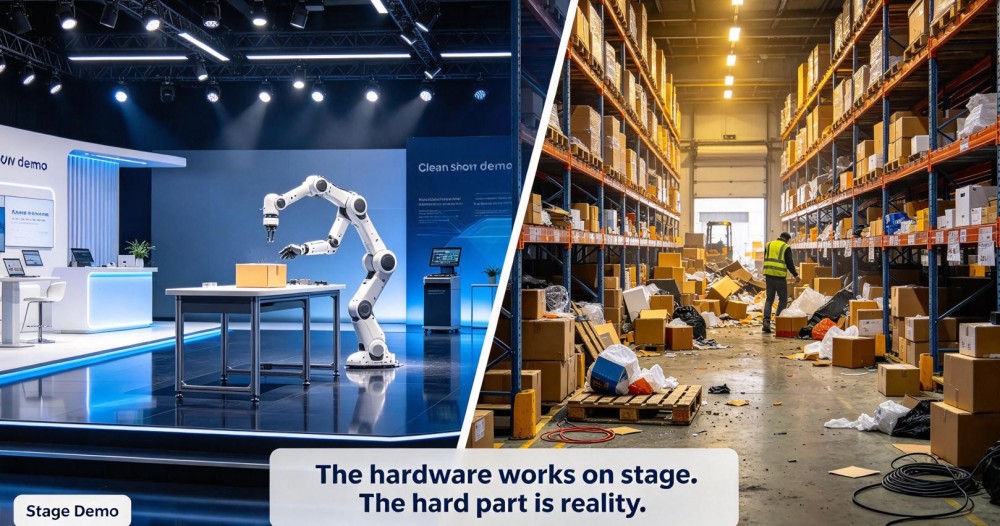
It is worth stating plainly why hardware is no longer the binding constraint. Actuators, sensors, and compute-on-the-edge have all improved to the point where a credible humanoid body is, for a well-funded team, an engineering problem with a known solution path. Dozens of firms can now build a robot that walks, balances, and gestures well enough to impress a crowd. What they cannot reliably do is make that same robot useful on Tuesday morning in a real fulfillment center, where boxes are oddly shaped, lighting is poor, and a spilled item was never in the training set.
The hard problem is generalization: the ability to perform a task it has not been explicitly programmed for, in conditions it has not seen. That ability does not come from better gears. It comes from data — specifically embodied data, the first-person, physical record of a system sensing and acting in a world that pushes back. As reported by multiple industry observers, the gap between a policy that looks solved in a digital twin and the same policy failing in a real room has become the single most discussed obstacle to commercialization. The conversation has therefore migrated from the kinematics lab to the data center and the simulation farm.
The most visible attempt to industrialize robot learning is NVIDIA's rapidly maturing stack. At its center sits the Isaac GR00T family of humanoid foundation models, designed to absorb large corpora of multimodal interaction data and produce generalizable control policies. GR00T is paired with the Blackwell architecture and the Isaac Lab / Omniverse digital-twin toolchain, which lets teams build physically plausible virtual environments and run reinforcement and imitation learning at scale.
According to public reports, this combination has begun to compress the timeline for teaching a new task in dramatic terms. Where training a novel warehouse manipulation skill once took weeks of real-world trial and error, the same workflow — pretraining inside simulation, then adapting on a small slice of real data — can, as reported, be brought down to hours. The acceleration comes from two directions at once. Isaac Sim 2026.1, per NVIDIA disclosures, integrates with the open-source Hugging Face LeRobot ecosystem and is reported to deliver roughly a 100× simulation speed-up. A single DGX H100 node, according to the company, can render as many as 4,096 parallel environments simultaneously, letting a policy experience millions of synthetic episodes where it once ran a few hundred. Complementing this, GR00T-Gen generates training data procedurally — synthesizing variations of tasks, objects, and scenarios so the model is not starved for examples.
Crucially, the loop is closed on the robot itself. Jetson Thor, NVIDIA's embedded compute module for robotics, is built to run these models locally on the body, so inference does not depend on a tether to the cloud. The strategic picture is coherent: simulate at massive scale, generate synthetic variety, fine-tune on a sliver of real data, and run the result where the work actually happens.
Simulation alone cannot finish the job. The persistent lesson of 2026 is that synthetic experience must eventually be anchored in real interaction, and the scale of that real data is now the object of an explicit race. According to industry estimates cited in public reporting, the global stock of high-quality embodied interaction data sits at roughly 500,000 hours today — substantial, but far short of what general competence may demand.
Against that backdrop, a consortium of three companies — Riemann Dynamics, Lightwheel AI, and Noitom Robotics — has, as reported, announced a collaboration with the explicit goal of jointly building 1 million hours of embodied-intelligence training data by the end of 2026. If achieved, that single partnership would roughly double the world's usable corpus within a calendar year. Riemann's earlier Riemann-1.0 model was, according to public disclosures, trained on approximately 232,000 hours of data, already placing it among the better-resourced efforts. The coalition signals a belief that data volume, not just algorithmic cleverness, is the rate-limiting step — and that pooling collection capacity is the fastest way across the threshold.
One of the more surprising engines of this data expansion is the human body itself. Shanghai Maniformer has, according to public reports, delivered more than 20,000 units of its MEgo series of wearable data-collection devices — rigs that record the wearer's movements, forces, and first-person view during ordinary tasks. By capturing skilled human action directly rather than teleoperating an expensive robot through every repetition, the approach drives collection cost down and volume up.
The numbers are striking. Maniformer reports that real, human-physical interaction data gathered through its devices has crossed 1 million hours, and the company's stated trajectory points toward 10 million and ultimately 100 million hours. This "egocentric" data is not robot-ready out of the box — it must be mapped from a human embodiment onto a machine one — but its scale makes it a compelling raw material. As industry analysts note, the firms that can efficiently translate human demonstration into robot-learnable signal may own the largest and cheapest data advantage in the market.
A second, more heretical idea is gaining credibility: maybe the data does not have to be pristine. Peking University and Galbot jointly released LDA-1B, a billion-parameter "latent-space world-action" foundation model that, according to public reports, trains effectively on low-quality or noisy data — the kind cheap wearable capture and messy real deployments produce in bulk.
The result is notable both methodologically and competitively. LDA-1B is reported to achieve a zero-shot grasp success rate of roughly 80–90% and to outperform GR00T-N1.6 and π0.5 on complex sorting tasks. If robust, this challenges the older paradigm built on expensive, hand-curated teleoperation demonstrations. The strategic implication: the bottleneck may be not perfect data but enough imperfect data fed to a tolerant model — lowering the cost of entry and rewarding volume and design over curation.
The most mature operational example of closing the gap comes from AgiBot (Zhiyuan). Its Genie Sim 3.0 platform, linked tightly to the Genie G2 robot, is reported to reach an overall task success rate of about 94% in real supermarket scenarios — a deployment-adjacent result, not a staged trick. The approach pairs large-scale simulation with targeted real-machine data so the two distributions align.
This mirrors a broader strategic turn. As reported, the industry is shifting away from a single, ever-more-faithful high-fidelity simulator — an asymptote that may never be reached — toward a pragmatic formula: large-scale simulation plus a small amount of real-machine data for distribution alignment, with reported match rates of 85% or higher. The logic is simple: the simulator need not be perfect, only close enough that a modest real-data correction bridges the remainder.
Policy is reinforcing the same direction. In June 2026, China's Ministry of Industry and Information Technology (MIIT) and the State-owned Assets Supervision and Administration Commission (SASAC) jointly launched a "Humanoid Robot and Embodied Intelligence Real-Scene Practical Training Special Action," which, according to public reporting, sets year-end targets of distilling more than 100 high-value scenarios, accumulating million-scale real-machine training data, and driving ten-thousand-scale normalized deployment. The wording itself — "real-scene practical training" — underscores where the emphasis now lies: not in the demo, but in the logged, repeatable, data-generating encounter with reality.
Put the threads together and a clear picture emerges. The 2026 humanoid leaderboard will be shaped less by who has the prettiest walker and more by four interlocking capabilities: a simulation engine running thousands of parallel worlds (NVIDIA's stack and its competitors); a data-collection base scaling toward millions of hours (the Riemann–Lightwheel–Noitom coalition, Maniformer's wearable flood); models that learn from imperfect data (LDA-1B's noisy-data thesis); and a sim-to-real method that aligns distributions rather than chasing perfect fidelity (AgiBot's 94% result and the 85%+ alignment playbook).
The economic logic is a flywheel. More deployed robots and captured human activity produce more real data; more real data, blended with simulation, trains better policies; better policies justify more deployment; and the loop compounds daily. As industry analysts note, this is why the data advantage is defensible: a team already operating at scale widens its lead simply by continuing to operate.
There is also a geopolitical dimension. The MIIT–SASAC action and the consortium-building among Chinese firms suggest data infrastructure is increasingly treated as strategic national capability, not merely a private R&D line item — much as compute and talent were in the large-language-model era.
The humanoid story of 2026, stripped of its hardware spectacle, is a story about an engine: a million-hour engine of simulation and data that quietly determines which machines can actually be put to work. The legs and hands were never the hard part. The hard part is teaching a robot to cope with a world that does not follow the script — and that teaching now happens in virtual environments, in wearable capture rigs, in noisy-but-vast datasets, and in the alignment of simulation with reality.
It is fitting, then, that the field's new capabilities will be staged together in one place. HRIE 2026 — the Shanghai International Humanoid Robot and Robotics Industry Chain Exhibition 2026, December 9–11, 2026, at SNIEC in Shanghai — is positioned to be the global stage where these training infrastructures and data engines are shown side by side: simulation platforms, wearable capture systems, foundation models trained on noisy and real data alike, and the deployment pipelines that turn all of it into a robot that finally does the job. If the bodies are the headline, the million-hour engine behind them is the story worth watching.