
Zhejiang Robot Industry Association
Zhejiang University Robotics Institute
Golden Conference & Exhibition Group
Hangzhou Wisdom Source Exhibition Co., Ltd.
Hangzhou Sequoia Exhibition Co., Ltd.
If the automotive line is automation's straight-A student, the food-processing floor has long sat at the back of the class. The hard part is not precision but liveliness: a block of tofu crumbles, a leaf of greens wilts, a meal box must be handled with care, and a prepared-dish recipe can change day to day. Precisely because of this, general-purpose humanoid robots — with their bipedal form and adaptable manipulation — find a distinctive role in catering and food manufacturing. The 3rd Hangzhou International Humanoid Robot and Robot Technology Exhibition 2027 (HRTE 2027), taking place May 27–29, 2027, at the Hangzhou Grand Convention and Exhibition Center in Zhejiang Province, will convene the full chain from robot bodies and dexterous hands to compliant force control — and "can a humanoid hold the most fragile ingredient without breaking it" has become a fresh question the industry is watching.
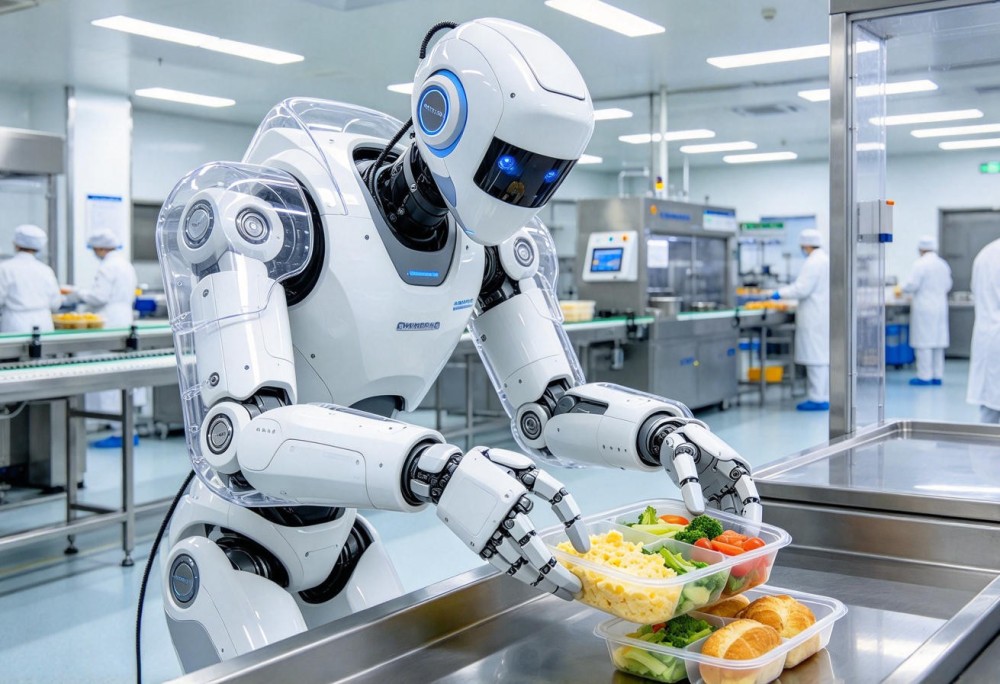
Central kitchens and prepared-meal plants look standardized, yet they test a robot in subtle ways. First, ingredients are highly non-standard: potatoes in one batch vary in size, fish fillets differ in thickness, shrimp in curvature, so fixed grippers and taught trajectories rarely fit all. Second, hygiene is unforgiving: food-contact steps must avoid cross-contamination, surfaces must be easy to clean and traceable — a world apart from industrial parts where "a little dirt is fine." Third, the process switches with the recipe: braised today, steamed tomorrow, with line rhythm and action sequences changing often, so dedicated machinery becomes dead weight the moment the menu turns over.
Industry analysis suggests automation rates in food and catering remain sharply split — packaging and palletizing are mature, but the layer of "handling the ingredient itself" still leans heavily on human touch and experience. The point of a humanoid is that it does not aim to "build one machine for one dish." Instead it adapts a roughly human form to the existing kitchen: standing, bending, fetching, assisting beside the stove or the assembly line, so the cost of retrofitting drops sharply and the same machine can be re-tasked when the season's menu changes. Globally, food processing also faces tightening traceability regulation and an aging front-line workforce, pressures that make a re-deployable, data-logging helper more attractive than another single-purpose machine bolted to the floor. The humanoid's appeal is therefore less about raw speed and more about flexibility under constraint.
In publicly shown pilots and demos, humanoids in food and catering settings mainly take on three classes of tasks. The first is ingredient sorting and transit: moving washed produce, meat, and totes between chilled, cutting, cooking, and assembly stations, replacing heavy, repetitive handling in low-temperature environments — exactly the roles that are hard to staff and have high turnover, making them the easiest entry point for robots. The second is cooking assistance and plating: steadily feeding material beside the line, assisting with weighing and boxing, or performing light, precise grasps and placements at the plating stage, freeing people from monotone repetition. The third is boxing and cleaning: placing finished items into meal boxes by order, sealing, palletizing, and assisting with counter tidying and sanitation between shifts, closing the loop of "process — pack — wrap-up."
It should be clear that at the current stage humanoids are far more "human-collaborative" than "kitchen-without-people." In a setting sensitive to both hygiene and taste, the robot absorbs the heavy, repetitive, attention-demanding steps, while chefs and prep staff keep judgment over heat, flavor, and exceptions — a division of labor repeatedly stressed in public statements by several companies.
The food and catering scenario deserves focused discussion at HRTE 2027 precisely because it matches the industrial endowment of the host province. Zhejiang is both a cradle of e-commerce and the digital economy and home to a developed food-processing and restaurant-chain ecosystem: Hangzhou's digital dining, live-commerce, and fresh grocery, together with Ningbo and Wenzhou's prepared meals and seafood processing, form a complete chain from raw material and central kitchen to the dining table. For humanoid-robot companies, this means "closest to the customer" — algorithm firms, body makers, catering brands, and contract manufacturers cluster across the supply chain, enabling joint validation and rapid iteration that a distant pilot cannot match.
At the same time, the Yangtze River Delta's digital foundation provides conditions for deployment. Public reports note that many regional central kitchens have already pushed digital scheduling, order-driven production, and smart warehousing. These earlier investments complement the humanoid's "line-access layer": once ingredients, orders, and equipment data are online, the robot's job is to connect the broken links with a pair of general-purpose hands, rather than tearing down the whole kitchen.
Moving a demo onto a real kitchen floor still faces three hurdles. The first is food safety and hygiene: food contact must meet cleaning and traceability requirements, so the shell material, seam design, and disinfection routine of the dexterous hand must be redefined — a hard constraint unknown in industrial settings. The second is tactile sensing and force control: tofu, pastry, and fruit "break at a squeeze," demanding extremely delicate torque feedback — too tight and they shatter, too loose and they slip — which places high demands on whole-body control and the dexterous hand working in concert. The third is return on investment: catering margins are thin and recipes turn over quickly, so firms inevitably ask "how fast does one robot pay back," setting a gradual, not overnight, pace. That pacing is not a weakness but a feature: food is unforgiving of error, so a measured rollout lets safety cases accumulate before any wider bet, and lets regulators and kitchens learn the failure modes together.
Most in the field estimate that scaled catering deployment will lag behind more structured tasks such as handling and inspection. But once it works, the demonstration effect is strong — because it proves a humanoid can enter the "most fragile" site, and that soft-ingredient handling experience transfers to pharmaceutical and electronics lines where parts are equally delicate.
Beyond the technology, the kitchen raises a human question that HRTE 2027's ecosystem discussions will inevitably touch. A robot that handles heavy totes and repetitive transit does not erase the cook; it removes the strains that drive experienced workers away. Publicly, several pilots frame the goal as skill upgrading — workers move from raw repetition toward supervising, tuning, and exception-handling, roles that are better paid and less physically draining. In a sector where labor shortage already pressures margins, a collaborative humanoid can be the difference between keeping a line local and offshoring it. The honest narrative is not "robots versus people" but "robots beside people," with the machine absorbing the dull and risky while the human keeps the judgment machines cannot yet match.
Like most industrial scenarios, catering-robot deployment follows a "simulate first, iterate in small steps" rhythm. Firms typically rebuild the kitchen layout and ingredient physics in a digital twin, let the robot complete massive virtual training, then migrate to a physical line for limited-station pilots; through week-level or even day-level iteration, they gradually expand the task boundary. A useful side effect is the data flywheel: every real grasp becomes a training sample, and the system grows sharper exactly where the factory hurts most.
On the business side, robots-as-a-service (RaaS) is viewed by several vendors as the key to lowering the barrier for small caterers and central kitchens: firms gain capability and maintenance through leasing or per-piece billing, without bearing heavy one-time acquisition and integration costs. The body makers, component suppliers, and solution providers gathered at HRTE 2027 are expected to further standardize this "lightweight onboarding" path, letting more central kitchens join the validation and turning isolated showcases into reusable industry playbooks. Standards and interfaces matter here, too: the sooner a common way exists to plug a humanoid into a kitchen's scheduling, weighing, and quality systems, the sooner pilots compound into scale. Training the people who supervise these machines is the other half of the equation — the technology lands only when kitchens have staff who can tune it.
A humanoid entering the central kitchen is, in essence, a test of whether a technology can truly understand "fragile" and "clean" — a harder exam than moving boxes, and one closer to everyday life. As algorithms, dexterous hands, and compliant force control keep grinding against real production lines, catering — an industry touching everyone — may become a key sample of humanoids moving from showcase to scale. The 3rd Hangzhou International Humanoid Robot and Robot Technology Exhibition 2027 (HRTE 2027), taking place May 27–29, 2027, at the Hangzhou Grand Convention and Exhibition Center in Zhejiang Province, will offer the industry a face-to-face stage for validation and coordination — and the story of "humanoids plus food and catering" is only just beginning. For a province that ships millions of meal orders a day, that quiet competence may matter more than any headline demo.