
Zhejiang Robot Industry Association
Zhejiang University Robotics Institute
Golden Conference & Exhibition Group
Hangzhou Wisdom Source Exhibition Co., Ltd.
Hangzhou Sequoia Exhibition Co., Ltd.
As The 3rd Hangzhou International Humanoid Robot and Robot Technology Exhibition 2027 (HRTE 2027), taking place May 27–29, 2027, at the Hangzhou Grand Convention and Exhibition Center in Zhejiang Province, approaches in Hangzhou, one link that quietly powers the "next-day delivery" experience—yet fights labor shortages year-round—is being reexamined: the e-commerce fulfillment center. As general-purpose robot bodies acquire stable walking, dual-arm coordination, and autonomous carrying, this torrent of conveyors, AGVs, and cartons is becoming another decisive proving ground for the humanoid's core promise: a general body built for variety.
Why E-commerce Fulfillment Is the Eye of the Automation Storm
An e-commerce warehouse is not an ordinary warehouse. According to publicly available information, order volume during major shopping festivals can reach several times the daily level, SKUs often run into the tens or even hundreds of thousands, and product forms defy standardization: soft pouches, odd-shaped boxes, glass bottles, snack bags, crush-prone apparel. Traditional automation excels at "high-speed flow of standard items"—conveyors, sorters, and palletizing arms are stunningly efficient on uniform cartons; yet the moment non-standard goods, sudden demand spikes, or new categories appear, a rigid line must be retooled at high cost and long lead time. And the mix keeps shifting: a livestream flash sale can push one obscure SKU to the top of the queue within minutes, while subscription boxes and cross-border parcels keep adding new shapes, weights, and labeling styles to the same pick face.
The staffing problem is just as real. Picking, carrying, loading, and returns processing are physically demanding and repetitive; peak seasons rely on temporary labor surges while off-seasons leave hands idle, and turnover stays persistently high. Industry observers widely report that pre-festival recruiting difficulties have become a recurring ritual. The pattern repeats across mature markets: warehouse labor sits among the most churn-prone job categories, and every hiring cycle burns training time, quality consistency, and institutional memory. The industry has long been asking: is there a machine that adapts to varied goods and stations the way a person does, yet steps in quickly when the tide of orders surges?
That is precisely where humanoid robots carry high expectations—not to beat specialized equipment in any single task, but to hedge "variability" with "generality." Returns add a tide of their own: industry estimates suggest return rates in some categories reach double digits, meaning a fulfillment center must process nearly as many inbound surprises as outbound promises during busy seasons.
Three Roles on the Fulfillment Floor: From Transport to Processing to QC
Placed inside a fulfillment center, a humanoid robot's work roughly falls into three categories.
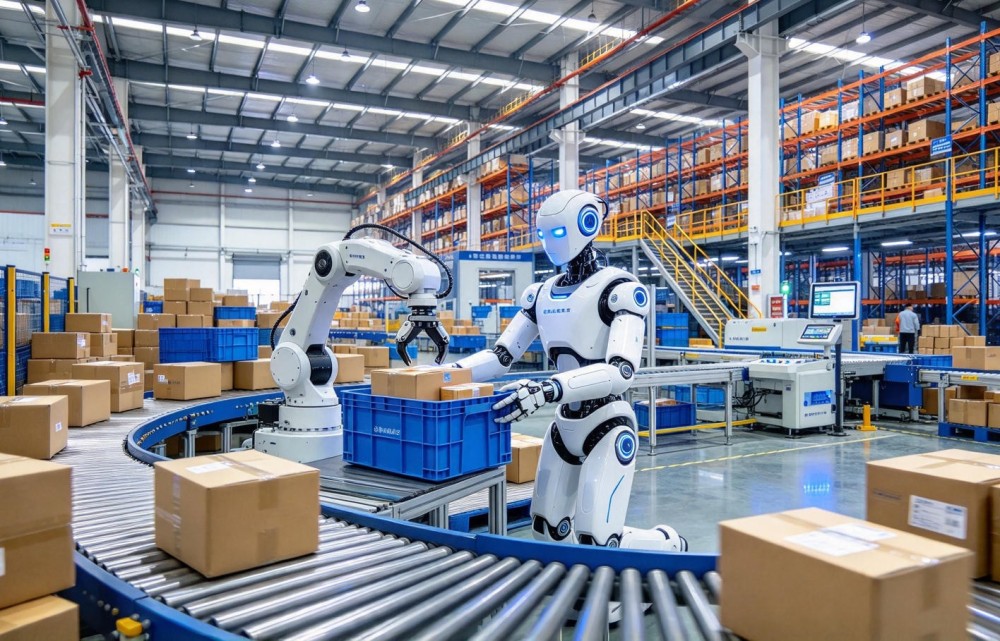
The first is "transporting"—tote handling and rack interfacing. Moving order-filled totes from picking zones to packing stations, returning empty ones, and continuously feeding picking workstations. With relatively fixed routes and moderate payloads, this is the easiest foothold for humanoids—and the natural complement to AGVs: AGVs run the point-to-point trunk lines, while humanoids cover the capillaries AGVs handle poorly—loading and unloading at stations, riding freight elevators across floors, and squeezing through narrow aisles. Because the robot talks directly to the warehouse execution layer, a tote it carries is never "blind freight": every handoff is logged, checked against the order plan, and rerouted the moment a priority changes.
The second is "processing"—depalletizing, palletizing, and replenishment. Carton depalletizing at inbound docks, case palletizing at outbound docks, and shelf replenishment have mostly required robot arms plus custom grippers, with tooling changes whenever odd shapes appear. With dual arms and multi-degree-of-freedom dexterous hands, a humanoid can in principle face many product types with one body, cutting changeover downtime. The prize is biggest at mixed-case palletizing and irregular inbound unload, where custom end-effectors multiply quickly and a retooling pause can idle an entire dock door.
The third is "quality control"—returns processing and re-shelving. Returns are e-commerce's nagging headache: unboxing and inspection, counting, photo grading, repackaging, and re-shelving—fiddly actions with shifting rules, long dominated by manual labor. Paired with vision-language models, humanoids could progressively take over part of this flow once processes standardize, turning returns from a "pure labor pool" into a human-robot collaborative one. The economics are attractive precisely because returns work is batchy and unpredictable—exactly the profile where a flexible body beats both a fixed machine and idle headcount.
Zhejiang and Hangzhou: A Natural Testbed of the E-commerce Capital
Why does this topic deserve focused discussion in Hangzhou? Because Zhejiang offers nearly every ingredient for fulfillment upgrading. Hangzhou hosts the headquarters ecosystem of leading e-commerce and livestream-commerce platforms, with nationwide-leading order density and SKU diversity; Yiwu's small-commodity trade supplies a flood of non-standard goods—the severest and most valuable exam for "general-purpose" machines; and the Ningbo-Zhushan port complex plus a dense express network welds warehousing to trunk and last-mile logistics. According to publicly available information, Zhejiang has already formed a sizable industrial cluster in intelligent logistics equipment and warehouse robotics, spanning mobile-robot navigation, sorting machinery, and warehouse software—giving humanoid newcomers a dense neighborhood of potential partners rather than a blank map.
Add Hangzhou's mature AI, machine vision, and cloud ecosystem, and humanoid robots can plug quickly into warehouse management systems (WMS) and order-dispatch platforms—"online as soon as the order arrives." This combination of "real order flow plus digital foundation plus local supply chain" is exactly why HRTE 2027 places its stage in Hangzhou and focuses on the full humanoid robot industry chain—so that validation runs not in a sandbox but in the fiercest real business torrent.
Three Hurdles: Grasping, Dispatching, and the Ledger
The outlook is promising, but the fulfillment floor sets three hard hurdles.
The first is grasp diversity. Soft snack pouches deform; glass bottles demand a gentle touch; apparel bags resist localization; frozen goods can be frosted and slippery. To grasp such a zoo of products at high tempo, humanoids need dexterous hands, tactile sensing, and visual recognition far beyond what standard cartons require. Grasp libraries trained in simulation help, but the warehouse is an adversarial test: packaging changes with seasons, suppliers, and marketing campaigns, without waiting for anyone's model update.
The second is dynamic dispatching. During festivals, orders surge like tides, waves shift quickly, and priorities keep changing. Robots must integrate with order systems in real time, reroute with each new wave, and stay safe in aisles shared with people, where forklifts cross paths, seasonal staff pull carts, and floor markings fade under months of scuffing. What is tested is not only the body but deep integration with WMS and warehouse control systems.
The third is the ROI ledger. How many stations can one robot cover, how is utilization balanced between slack and peak seasons, and who absorbs downtime losses—these questions decide whether it moves from "showpiece" to "standard." Fulfillment margins are thin, and every investment must be justified to the decimal. That is why pilots increasingly measure not unit price but cost per wave served, uptime during festival peaks, and overtime hours avoided—metrics that speak the operator's language.
From Pilot to Scale: Peak-Season Leasing and Human-Robot Coexistence
The pragmatic path begins with "peak-season gap-filling," not wholesale replacement. The first deployments are the clearly bounded tasks—tote transport and palletizing—while everyday flows stay on resident equipment; during festivals, robots arrive as rented reinforcements. Robotics-as-a-Service (RaaS) matches this tidal staffing pattern: billed by day or by wave, expanding elastically at peaks and returning units in valleys, so the warehouse pays for extra capacity only when the order flood truly demands it.
More crucial is coexistence rather than substitution. Conveyors, AGVs, and sorters remain the aorta of the warehouse; humanoids fill the non-standard, flexible, cross-zone gaps, while workers shift from repetitive carrying to equipment supervision, exception handling, and quality control. Combined with simulation training and digital-twin rehearsal, robots can first run layouts and contingency plans in a virtual warehouse, then enter the real one—compressing trial-and-error costs. Every shift on the floor then feeds telemetry back into the model, so the fleet that handles next year's festival should be measurably faster and steadier than the one that survived this year's. And this kind of hard exam set in real order flow is precisely the topic HRTE 2027's body makers and e-commerce logistics operators are most willing to debate face to face.
Conclusion
E-commerce fulfillment is the heartbeat of the consumer economy—and one of automation's toughest non-standard battlefields. Humanoid robots entering fulfillment centers does not mean empty warehouses overnight; it means a general body flexibly filling the gaps between order tides, freeing people from the heaviest and dullest links. As grasp reliability, dispatch integration, and the business ledger are proven out, this track is expected to become another main battlefield for scaled humanoid deployment—less glamorous than a launch event, yet far more telling about whether these machines can truly earn their keep at festival scale.
HRTE 2027 will be an important window for observing this progress—by then, from body manufacturers to warehouse integrators and e-commerce platforms, more answers grounded in real order flow may well emerge.